
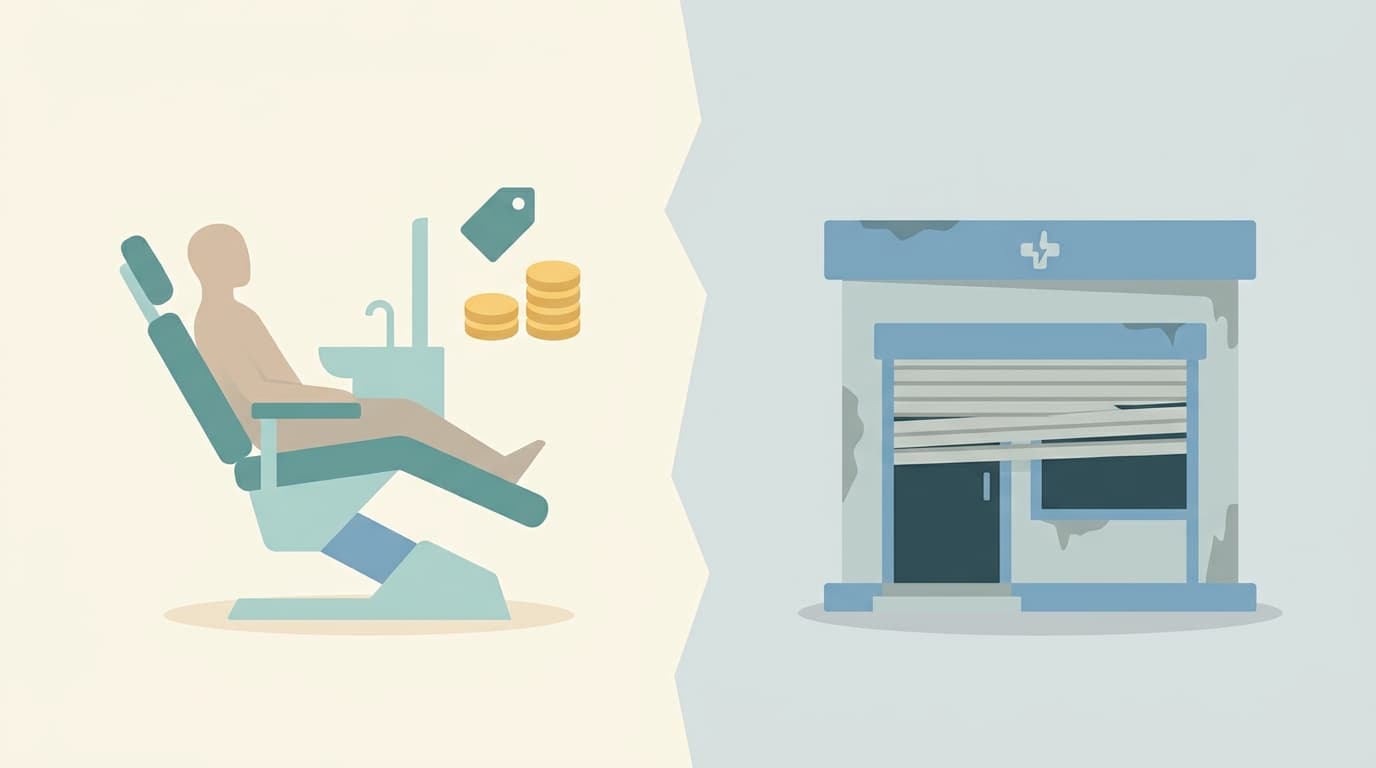
The UK government launched a market investigation in March into sharply rising private dental fees. But critics say the real root of the crisis lies elsewhere: the state-run National Health Service (NHS) dental system, which is increasingly collapsing.
Private Fees Jumped More Than 20% in Two Years
According to Bloomberg, the UK's Competition and Markets Authority (CMA, the government body that monitors competition in markets) began investigating the private dental market in March at the request of Chancellor of the Exchequer Rachel Reeves. Between 2022 and 2024, the fee for a first private consultation rose more than 23% to £80 (about 150,000 won), while routine check-ups for existing patients rose 14% to £55 (about 100,000 won). The same check-up costs just £27.90 (about 50,000 won) on the NHS. Fitting two crowns costs £332.10 (about 610,000 won) on the NHS, but at least £1,000 (about 1.83 million won) privately, and more than £2,000 (about 3.66 million won) for porcelain crowns.
The UK's private dental market is worth about £8.4 billion (roughly 15.4 trillion won), but large corporate dental chains account for only 2,000 of the 12,000 practices nationwide, while independent practices running one or two locations make up two-thirds of the total. Because the market is not concentrated in a few hands, some argue that a lack of competition alone cannot explain the rising prices.
The Real Crisis Lies in the National Health Service
The British Dental Association (BDA) called the request for this investigation a "fig leaf" for the government's failure to properly increase NHS dental funding. The share of adults who visited an NHS dentist within the past two years has stayed in the 40s since 2023, below the pre-pandemic figure of 49%. NHS dental spending also fell, from £3.66 billion (about 6.7 trillion won) in 2019-2020 to £3.11 billion (about 5.69 trillion won) in 2023-2024.
Behind this lies the Units of Dental Activity (UDA) system, which assigns a fixed point value to each type of treatment. Dentists must complete work equivalent to 96-102% of their annual allotted points, and doing more brings no extra pay. Doing less means the NHS claws back money already paid. Because a simple filling and a lengthy root canal are scored the same, dentists have been discouraged from taking on NHS patients whose treatment requires more time. Over the past two years, dental practices have turned back £900 million (about 1.65 trillion won) worth of NHS work for this reason. Parliament's Public Accounts Committee called the system "unfit for purpose," and while the Labour government changed the compensation method in April to reflect treatment time and difficulty, the BDA criticized the move for not increasing the budget itself.
Bloomberg columnist Matthew Brooker wrote that, at this rate, it would not be surprising to see more people pulling their own teeth out or turning up at the emergency department with dental sepsis, a body-wide infection, because they cannot get dental care. He noted that reports of such cases have already appeared.
In South Korea, the National Health Insurance Service covers one scaling session per year, up to two implants over a lifetime for people aged 65 and older, and one set of dentures every seven years, with a 30% out-of-pocket rate. There are limits on age and quantity, but it is a different situation from being unable to get dental care at all and ending up in the emergency room.