
Question
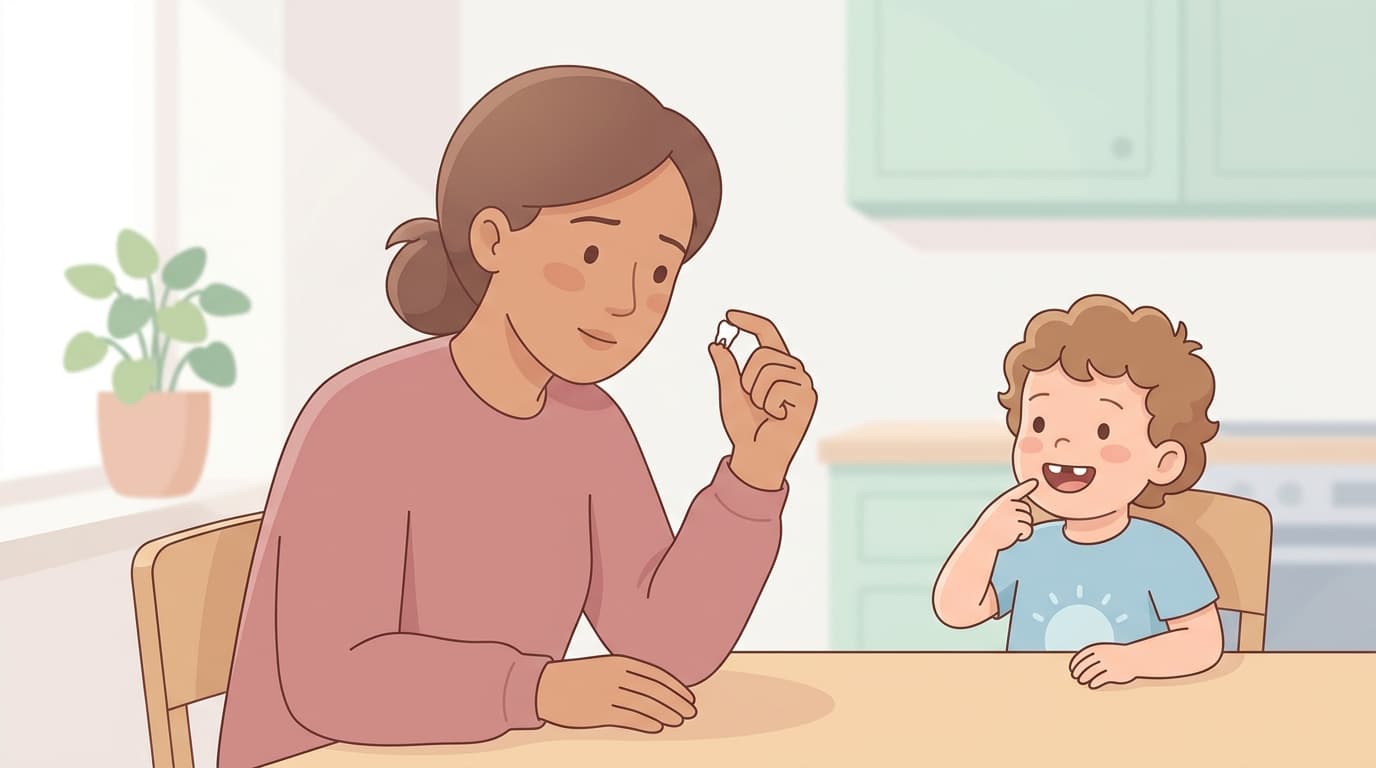
My child's loose baby tooth fell out, and looking at it, the root looks short or is barely visible. I'm worried that part of the root might have broken off and is still left inside the gum.
Short Answer
A short or barely visible root on a lost baby tooth is, in most cases, the result of a normal process. Baby teeth are designed so that pressure from the permanent tooth erupting behind them causes the root to dissolve on its own, so it's common for the tooth to fall out with only the crown (the part of the tooth that shows above the gum) remaining after the root has fully resorbed. That said, simply looking at the fallen-out tooth or a photo of it can't reliably tell you whether a root fragment is left in the gum or whether the root actually broke. If the site keeps swelling, hurting, or fails to heal, it's best to have it checked directly at the dentist.
Why Does This Happen?
Baby Tooth Roots Are Designed to Resorb on Their Own
Unlike permanent teeth, baby teeth were never meant to keep a permanent root. Root resorption begins around age 4 and continues until about age 10-11, driven by the pressure of the permanent successor tooth pushing up from below. That pressure activates odontoclasts (cells that dissolve bone and tooth tissue), which gradually eliminate the root. Resorption first eats inward from the outer surface of the root to about half its length, and then continues from the wall of the pulp canal on the inside of the tooth. As a result, by the time a baby tooth loosens and falls out naturally, most of the root has usually already dissolved away, so falling out with a short or barely visible root is actually closer to the normal outcome.
Sometimes the Speed or Shape of Root Resorption Differs
Not every baby tooth resorbs its root at the same steady pace, though. If the tooth previously had pulp inflammation or inflammation in the tissue around the root tip, if it had trauma or root canal treatment that led to ankylosis (fusion between the tooth and bone), if the permanent tooth bud behind it sits in an unusual position, if a granuloma or cyst is present at the site, or if a tooth supporting a space maintainer has been under excessive force, the root can resorb abnormally, causing the tooth to fall out earlier than expected or, conversely, to remain in place longer than usual. A tooth affected by any of these circumstances may show a root that looks especially short or uneven, but this is still a different phenomenon from a broken root.
Root Fractures Do Sometimes Really Happen
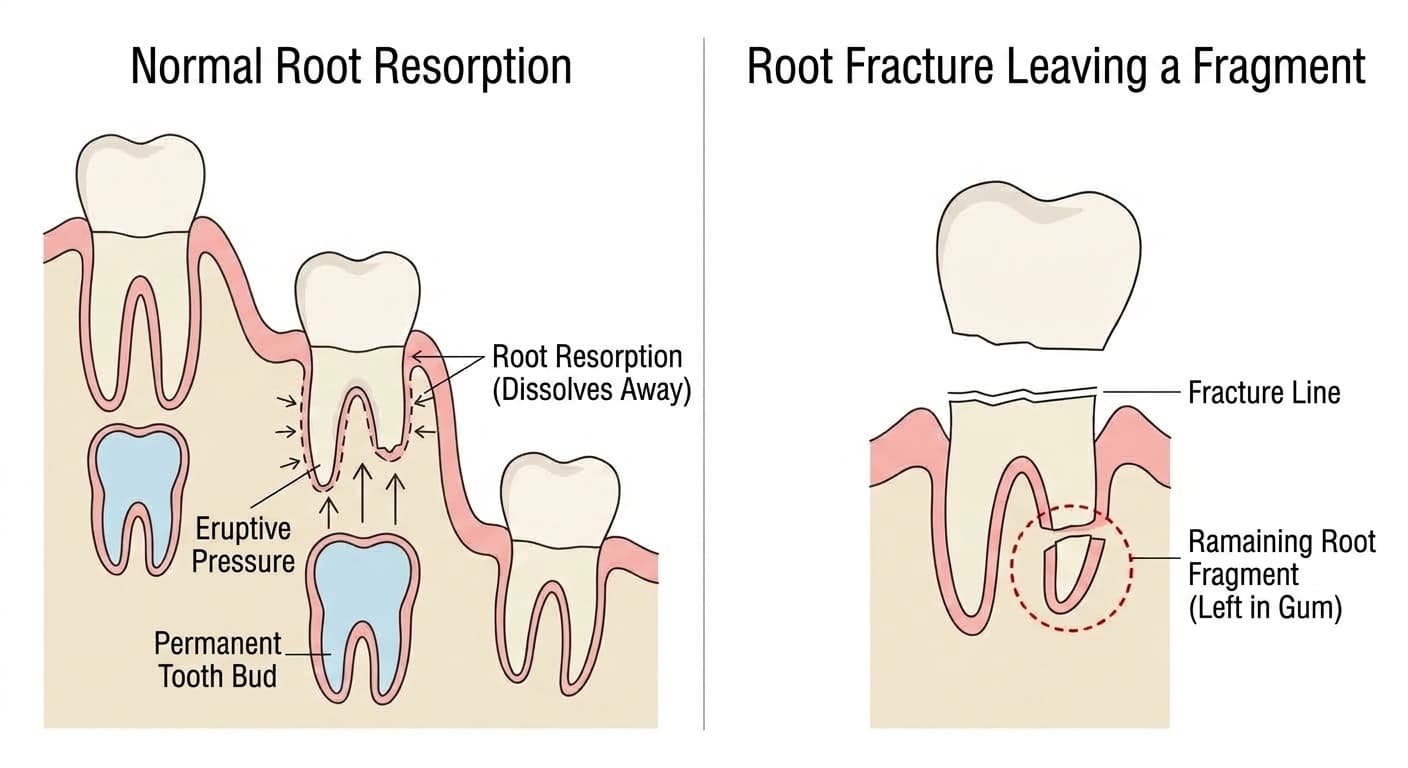
Actual root fractures aren't nonexistent. A blow to a tooth from trauma can break the root, and because ages 3-4 happen to overlap with the period of physiological root resorption, trauma around that age fairly often results in a root fracture. In such cases, if the tooth isn't mobile, the dentist will typically just monitor it, and the broken root-tip fragment will resorb and disappear on its own over time without needing to be removed. Roots can also break during extraction of another baby tooth at the dentist. The roots of primary molars (the baby teeth that function as molars) are thin and splay outward, which makes them prone to breaking during extraction; here too, if the fragment is small, sits deep in the bone, and shows no sign of infection, the dentist will usually leave it in place rather than forcing a surgical removal. That's because trying to dig it out carries a greater risk of injuring the permanent tooth bud just beneath it. Small fragments left this way are often pushed out or dissolve on their own as the permanent tooth erupts behind them.
A Photo Alone Can't Tell You
Normal root resorption and an actual root fracture are hard to tell apart just by looking at the outcome, and appearance alone can't confirm whether a fragment remains in the gum. If the tooth loosened and fell out on its own, and there's no swelling, pain, or pus at the site to suggest infection, it can generally be treated as a normal part of the tooth-exchange process. On the other hand, if the tooth suffered trauma such as an impact before it fell out, or if the site keeps hurting or swelling, a dental X-ray is needed to determine whether a fragment is actually present and, if so, whether it's safe to simply monitor it. Even when a fragment is confirmed, if there's no sign of infection, it's usually not removed right away, instead it's followed with periodic X-rays, while also checking that the permanent tooth is erupting into its proper position.