

Question
My 5-year-old's gums are swollen where a molar is about to come in, and she's in pain. Looking closely, there's something that looks like pus sitting on top of the gum. I'm wondering whether we can leave it as it is or whether we should take her to the dentist right away.
Short Answer
Swollen, sore gums are common when a molar is erupting. As the tooth pushes through the gum, the surrounding tissue gets irritated and develops temporary inflammation. However, it's hard to tell from appearance alone whether what you're seeing is part of this normal eruption process or an actual infection with pus. If the swelling and pain aren't severe, you can keep the area clean and watch it for now, but if fever or an inability to open the mouth as wide as usual appears alongside it, you should see a dentist quickly.
Why Is That?
Why gums swell and hurt when a molar is coming in
When a tooth pushes through the gum, damage or pressure from chewing can combine to cause temporary inflammation in the gum tissue around it (the marginal gingiva) and the gum between the teeth (the interdental papilla). This is called eruption gingivitis (localized gum inflammation caused by the irritation of a tooth erupting). In children and adolescents, it mainly appears when the permanent first molar erupts, and comes with localized pain in that area. During this period, food debris and plaque (the bacterial film that builds up on the tooth surface) collect more easily in the newly exposed gum crevice, so oral hygiene is especially important.
The first molar usually starts to erupt around age 6. Between the time the primary dentition is complete and this point, there is a quiet period with little visible change, and age 5 falls near the end of that quiet period. Because the timing of eruption varies from child to child, an exam is needed to confirm exactly what stage the change at the molar site actually represents.
What could the "pus-like" area actually be?
Around the time a tooth pushes through the gum, something can look concerning but actually be a normal change.
- Pre-eruptive bulge: Before the crown (the part of the tooth that shows above the gum) has broken through, the gum can swell firmly and appear slightly pale, taking the shape of the tooth underneath. This is a normal, physiological change.
- Eruption cyst and eruption hematoma: When tissue fluid collects around an erupting crown and makes the gum swell, this is called an eruption cyst. When blood collects inside that cyst, it's called an eruption hematoma, and the gum looks bluish-purple. This commonly appears at the second primary molar or the first permanent molar, and in most cases it resolves on its own once the tooth finishes erupting. Only when the swelling is large enough to block the tooth from coming through does it need to be treated by cutting away the soft tissue covering it.
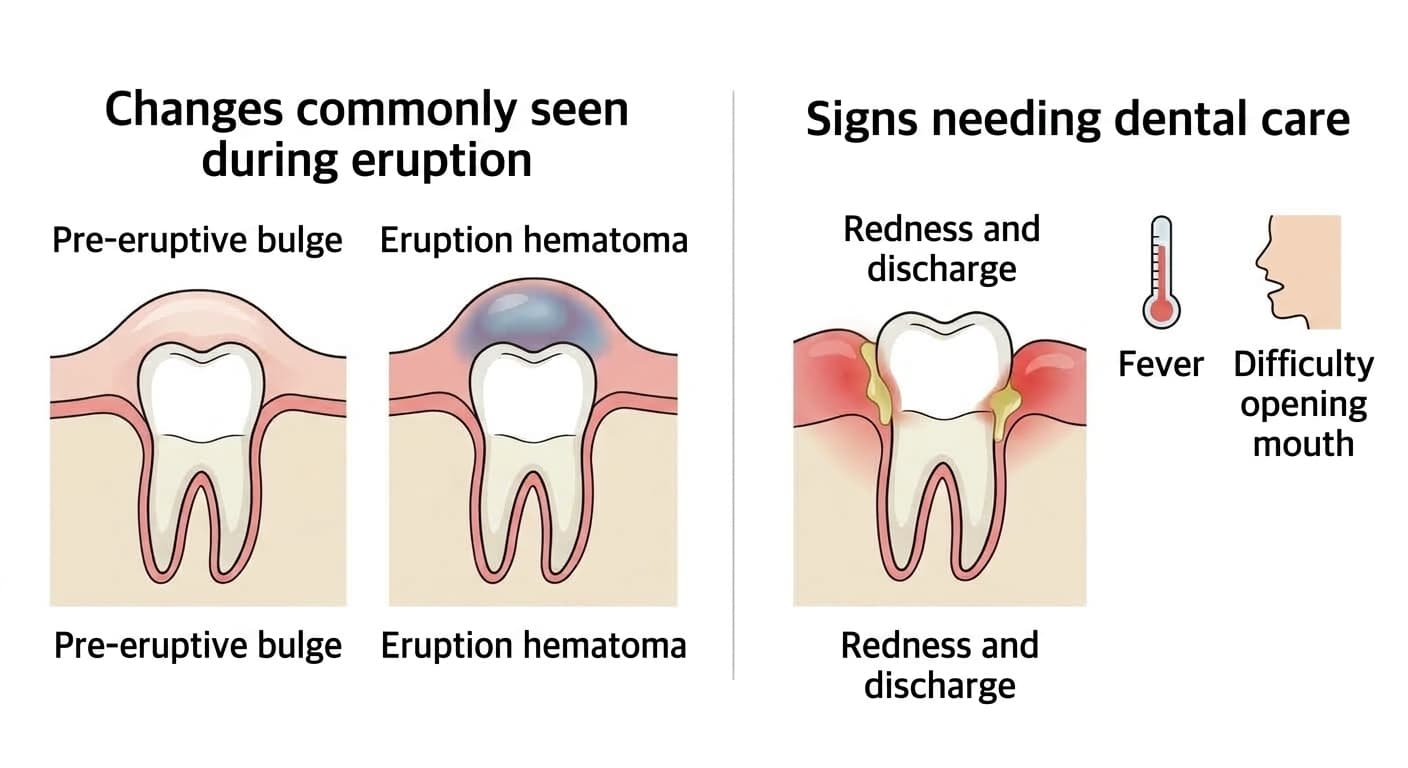
These changes often resolve without treatment, but if pus is actually oozing out or the pain keeps getting worse, that's a different situation involving infection. In both cases the gum can look similarly swollen, so you need to look at the color, firmness, and how the pain changes over time together to judge which one it's closer to. It's difficult to definitively distinguish a normal eruption change from an infection based only on a photo or a verbal description.
What the dentist checks, and when active treatment is needed
Whether what you're seeing now is a normal eruption change or an infection depends on color, firmness, and whether pain or discharge is present, so it needs to be checked directly at a dental office. Most cases of eruption gingivitis resolve just by keeping the area clean. In particular, when the lower (mandibular) first molar is erupting, infection can rarely cause fever or trismus (difficulty opening the mouth), and in that case antibiotics or surgical removal of the gum tissue covering the tooth may be needed. If your child currently has a fever or is having more trouble opening her mouth than usual, it's best to seek care sooner than if those accompanying symptoms weren't present.