

Question
I'm having root canal treatment on a front tooth. My dentist says I don't need a crown, but I'm worried the tooth could break while biting or chewing food. Shouldn't every tooth that's had root canal treatment be crowned?
Quick Answer
A front tooth is finished with either a resin filling or a crown, depending on how much tooth structure remains after treatment. If there's little damage beyond the access opening made for root canal treatment, a resin filling can finish the tooth; if a lot of the outer tooth structure is gone, a crown and the structure that supports it are considered together. The deciding factor is whether the remaining tooth can hold the restoration in place and withstand biting force.
Why?
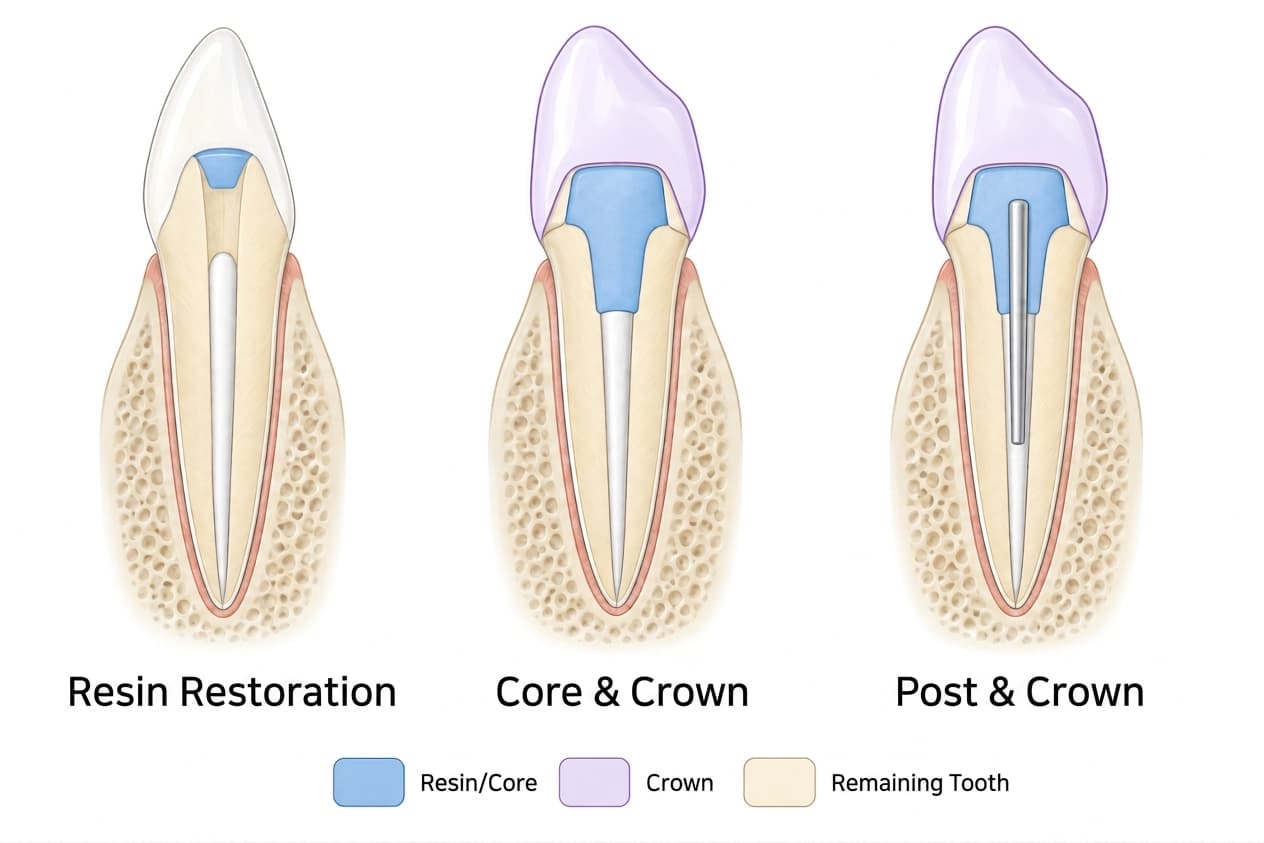
The restoration method is chosen to match the remaining tooth structure, and a post is considered when the core is difficult to retain.
After root canal treatment is finished, the access opening must be sealed tightly to keep saliva and bacteria from getting back in, and the tooth's lost shape and function need to be restored. This final restorative step is called "restoration."
If There's Little Damage Beyond the Access Opening
For a front tooth where the outer structure is well preserved and only the access opening made for root canal treatment needs to be restored, filling that area with resin can be an option. Resin is a material that bonds to the tooth and fills the empty space. Even when a crown isn't placed, this is how the access opening is sealed and the tooth's shape is finished.
When worrying about fracture, it helps to look not just at the fact that root canal treatment was done, but also at which surfaces remain, and how much of them. A front tooth with enough of its outer wall remaining and one where trauma has broken away much of that wall as well are in different conditions for supporting a restoration.
If the Tooth Is Extensively Damaged
When a lot of tooth structure is gone, including the front wall, rebuilding the missing part and covering it with a crown is considered. The foundation that supports the crown in this case is called a "core." It means rebuilding the tooth's central shape with a material such as resin and then placing a crown over it.
Even when making a crown, healthy tooth structure that wraps around and supports it at the margin matters. That's because the remaining tooth walls share in absorbing the force of biting. So when a treatment plan is explained, the position and amount of remaining wall are considered along with the crown material itself.
When Is a Post Needed?
When the tooth is damaged enough that there isn't enough structure left to hold a core in place, a post (a small rod placed inside the root canal) is used to help retain the core. The post's main role is to help the core stay firmly fixed in place. The post itself doesn't increase the tooth's strength, and if too much tooth structure is removed to make room for it, the root can end up weakened.
So the choice among filling just the access opening with resin, building a core and placing a crown, or also using a post is made based on how much tooth structure remains. The shared goal is to restore only as much as is needed while preserving healthy tooth structure.