
Question
I'm a teenager. A permanent tooth never came in where it should have, and the baby tooth that stayed in its place is now loose. My dentist says I shouldn't get an implant right away and need to wait until my jaw finishes growing. I'm curious what growth has to do with implants that I'd have to wait years.
Short Answer
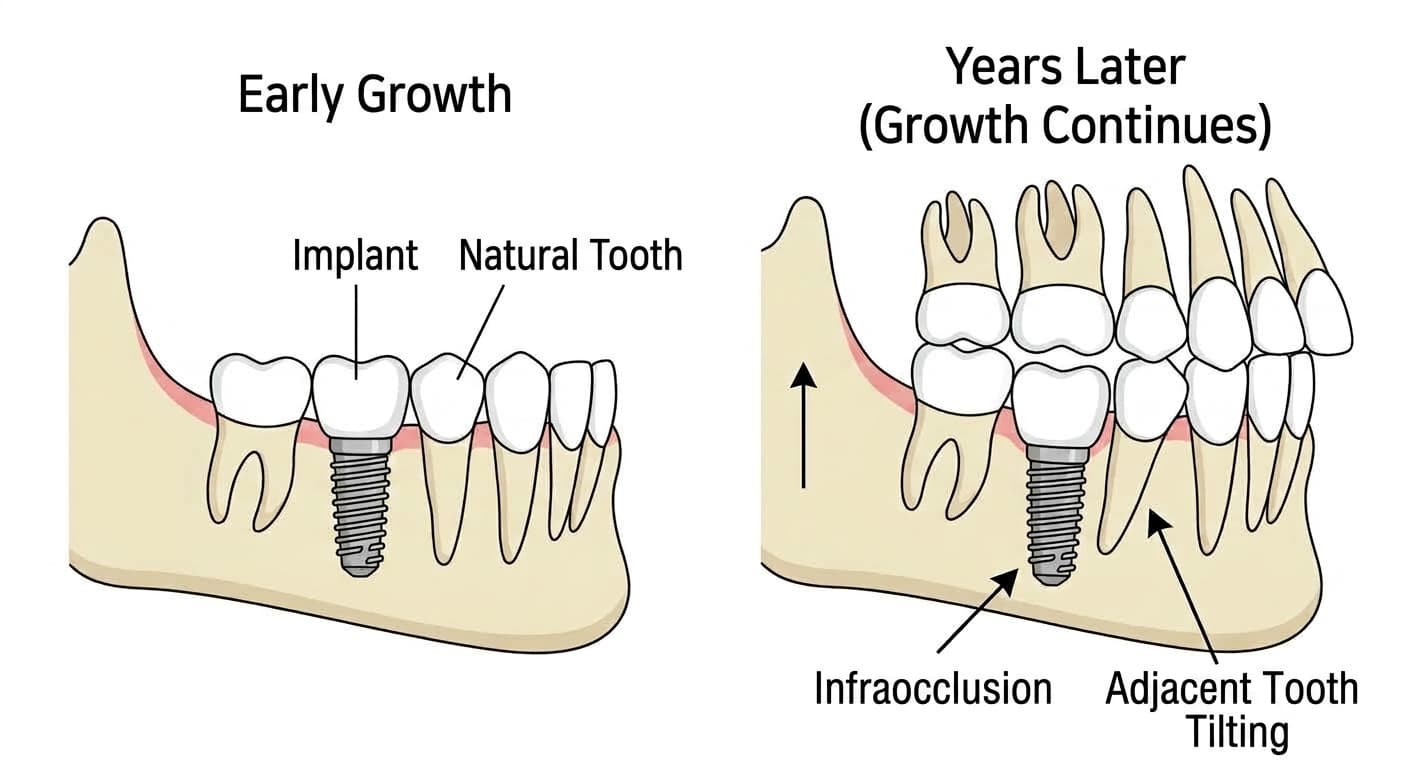
An implant is a treatment that places an artificial tooth root in the jawbone and lets it fuse tightly with the bone (osseointegration). Once it has fused, that spot no longer moves the way a natural tooth does. During adolescence, however, the jawbone keeps growing, and the natural teeth above it move along with the bone. If an implant is placed during this period, the bone keeps growing while the implant stays fixed in place, which can leave its chewing surface lower than the neighboring teeth or cause the adjacent tooth to tilt toward it. For this reason, dentists don't decide the timing by age alone. They confirm that jaw growth has actually finished before deciding when to place the implant, and in the meantime they discuss how to manage the space left by the loose baby tooth.
Why Is That?
A Growing Jawbone and a Non-Growing Implant
A natural tooth continues to erupt, moving along with the alveolar bone (the jawbone that surrounds a tooth's root) as that bone grows vertically. An implant, by contrast, is an osseointegration treatment that places an artificial root in the alveolar bone and fuses it with the bone, so once it is in place it does not move on its own the way bone does.
Because of this difference, an implant placed in a still-growing jaw behaves like an ankylosed tooth, one whose root has fused directly to the bone. The surrounding bone and teeth keep growing upward while the implant stays where it is, which can produce infraocclusion (a chewing surface lower than the neighboring teeth) or cause an adjacent tooth to tilt toward the gap. Once this has set in, it is difficult to reverse, so placement is avoided until growth has finished.
The Upper and Lower Jaw Wait for Different Lengths of Time
The point at which growth finishes differs by region of the jaw. In the upper jaw, placement is considered only from around age 10 at the earliest, and once a person passes age 15 the risk associated with the gumline settling into place around the teeth (passive eruption) becomes lower. The lower front teeth, by contrast, are considered relatively safer than the upper jaw because that area of the jaw grows mainly in the front-to-back (sagittal) direction. This, however, is only a general tendency by region, and the actual timing of placement is decided through the individual growth assessment described below.
How Is It Confirmed That Growth Has Finished?
Age alone cannot tell you exactly whether a person's jaw growth has finished. So dentists take lateral skull radiographs (cephalometric analysis) six months apart and superimpose them. If the position of the jawbone no longer shifts when the two images are overlaid, growth is judged to have stopped, and implant placement is considered at that point. If the bone's position still keeps changing between the two images, that means growth is still underway, so placement is postponed further.
How to Manage the Space While Waiting
Once the loose baby tooth falls out, that space cannot simply be left empty. The opposing tooth loses something to bite against and can keep extruding down into the gap, and the teeth on either side can tilt into the empty space. So until growth has finished, dentists discuss a temporary prosthesis that holds the space and makes up for chewing function and appearance in place of an implant.
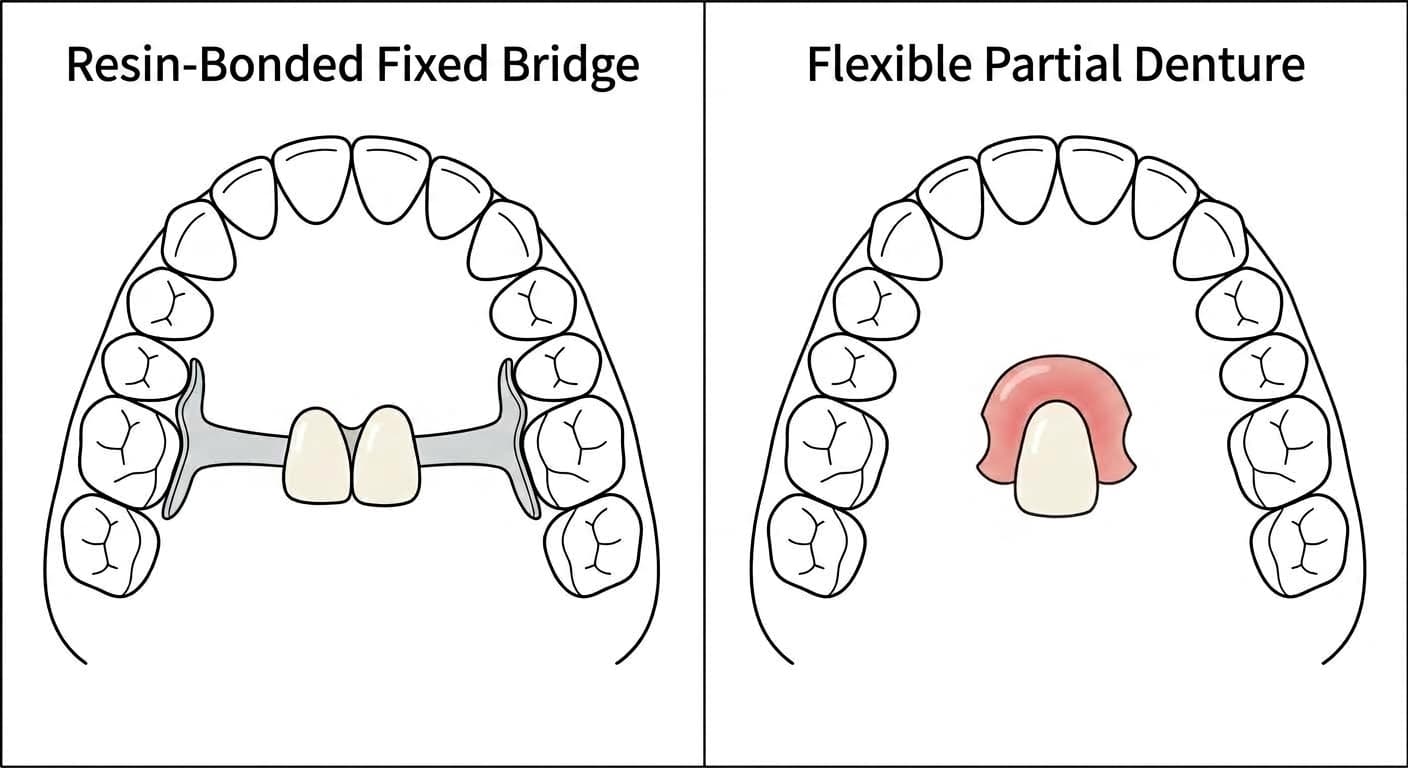
One option is a resin-bonded fixed bridge, which is cemented to the backs of the neighboring teeth without cutting them down significantly. Only a very thin layer of the enamel surface is prepared, and an artificial tooth is bonded on top of it, so tooth damage is minimal and the cost tends to be lower.
The other option is a flexible partial denture made of a nylon-based flexible resin with no metal clasps. It is removable, can be made with almost no cutting of the teeth, and is commonly considered for space management in adolescent patients missing a single tooth or teeth on only one side.
Both options are temporary measures, not the final treatment, meant to hold the space and support function and appearance until growth has finished. Which one is more appropriate is decided in consultation with your dentist based on the location and number of missing teeth and the condition of the remaining teeth.