
Question
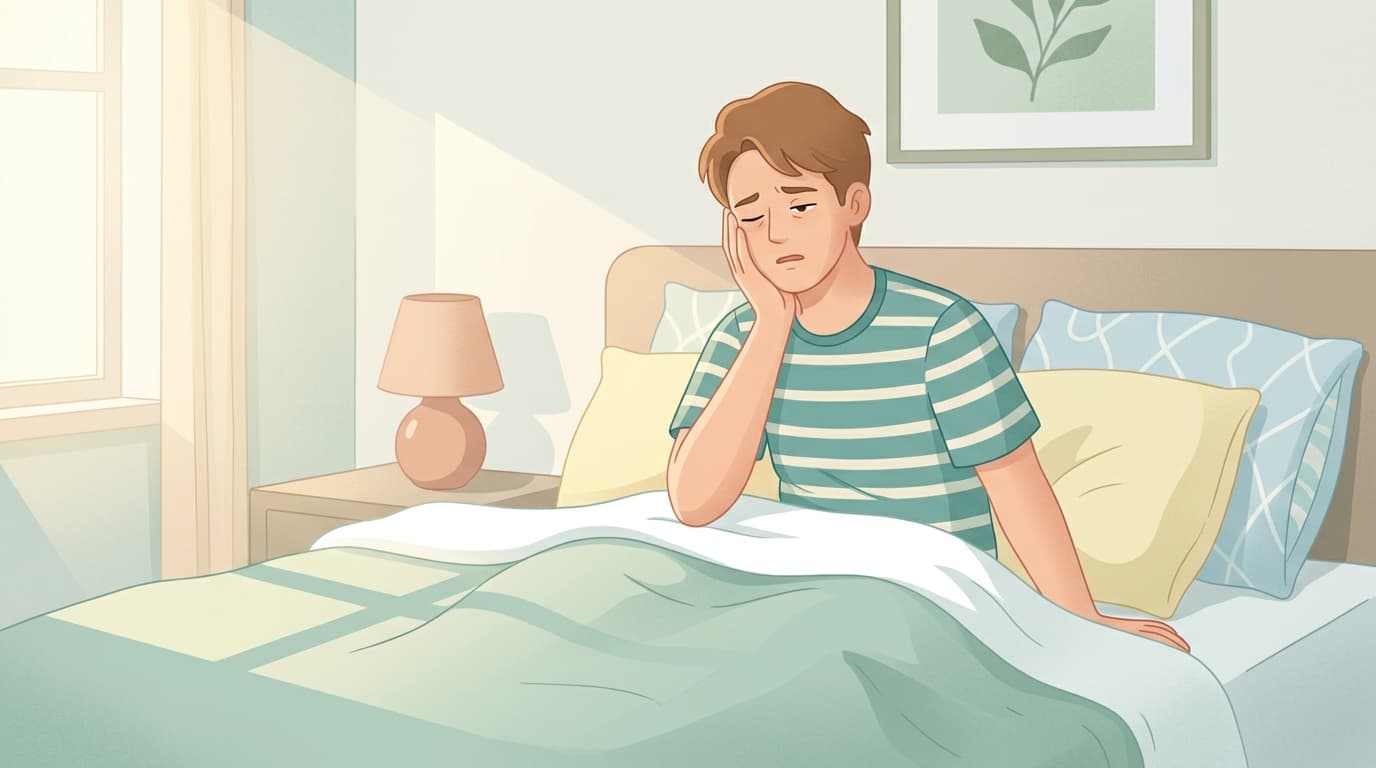
When I wake up in the morning, my jaw and the area around my temples feel stiff, and I've had a tight feeling when opening my mouth for several days now. I don't remember grinding or clenching my teeth while sleeping, but I'm wondering whether these symptoms could be caused by bruxism (teeth grinding) or clenching.
Short Answer
Morning stiffness in the jaw or masticatory muscles (the muscles used for chewing) is a common sign that may point to bruxism or clenching during sleep. However, since these are habits that occur while asleep, they are difficult to notice on your own, and stiffness can also arise from other problems within the jaw joint itself, so this symptom alone cannot confirm the cause. Dentists narrow down the cause by asking about sleep and daytime habits and examining the condition of the jaw joint and masticatory muscles together.
Why Is This the Case?
The Relationship Between Morning Stiffness and the Masticatory Muscles
Bruxism is a non-functional habit of continuously grinding the teeth during sleep or in an unconscious state, while clenching is a habit of unconsciously biting down hard on the teeth during sleep or throughout the day. Bruxism involves repeated forces reaching 2 to 3 times the maximum bite force, which can lead to tooth wear, tenderness in the masticatory muscles, and microtrauma to the jaw joint. Clenching also increases the load placed on the masticatory system and can cause or worsen tenderness and muscle tension in the masseter (the cheek-side chewing muscle) as well as damage to the jaw joint. Because of this, both habits tend to first produce a dull, stiff ache in the molar area or around the temples right after waking, and if left unaddressed, the pain can become more pronounced.
When the load on the masticatory system increases in this way, tenderness develops in the masticatory muscles, and microtrauma accumulates in the jaw joint. This can gradually displace the articular disc (the tissue that cushions between the bones inside the jaw joint) from its normal position, potentially leading to temporomandibular disorder (a general term for functional abnormalities and pain in the jaw joint and masticatory muscles).
Why We Ask About Sleep and Daytime Habits Together
Bruxism and clenching mostly occur while asleep, making them difficult to notice on your own. That's why dentists first ask when the morning stiffness began and where it occurs, and also check whether you tend to clench your teeth when concentrating or feeling tense during the day, and whether you have recently been going through a period of high stress. Emotional stress is a common factor in bruxism, and it can also appear alongside malocclusion (where the upper and lower teeth do not align properly) or conditions that narrow the airway, such as allergies. This questioning is not meant to definitively confirm the habit itself, but rather to gauge whether the stiffness is more likely related to bruxism or clenching, or to some other cause.
Why We Evaluate the Jaw Joint and Masticatory Muscles Together
Whether morning stiffness comes from bruxism or clenching, or from another problem within the jaw joint itself, is difficult to determine from symptoms alone. That's why the jaw joint and masticatory muscles are evaluated together. Dentists check whether pressing on the masticatory muscles causes tenderness, whether the joint makes a clicking or grating sound when opening the mouth, and whether mouth opening has decreased to 40mm or less, the threshold for restricted opening.
The pattern that appears varies depending on the situation. When the articular disc is displaced but returns to its normal position upon opening the mouth (disc displacement with reduction), a reciprocal clicking sound is characteristic, occurring both when opening and closing. When the disc does not return to place (disc displacement without reduction), the sound instead disappears, and mouth opening is restricted to only about 25 to 30mm or less. If the jaw joint has been overloaded for a long time and progresses to degenerative changes (osteoarthritis), a grating sound tends to appear along with pain on one side of the jaw that worsens in the afternoon or evening. Because these findings differ from one another, the approach for the same morning stiffness can vary depending on the evaluation results: some cases may simply be monitored, while others may call for considering a device that reduces the load on the jaw joint (such as a stabilization splint, a device placed between the upper and lower teeth to reduce muscle tension and joint strain).