

Question
My child is in the mixed dentition stage, and a permanent tooth has not come in for several months in the spot where a baby tooth fell out. The same tooth on the opposite side has already erupted, so I'm wondering whether we should keep waiting or get this checked.
Short Answer
The pace of permanent tooth eruption varies from child to child, so being a little late is common on its own. However, if the same tooth has already erupted on the opposite side while this one is noticeably late, or if the spot is still empty well past the expected timing, it's worth checking what's happening underneath with an X-ray. What gets checked falls into three main areas: whether there is enough space for the permanent tooth to come in, whether some other tissue is blocking that spot, and whether the tooth itself is buried deep (impacted). Which of these three applies determines whether watchful waiting is enough or treatment is needed, so it's hard to judge this from guesswork alone without an X-ray.
Why Does This Happen?
Losing a Baby Tooth and a Permanent Tooth Erupting Are Naturally Connected Processes
A baby tooth's root is gradually resorbed and shortened under the pushing force of the permanent tooth erupting beneath it, until it falls out. This resorption typically begins around age 4 and continues until age 10 to 11. In other words, a baby tooth falling out normally means the permanent tooth was already exerting an upward pushing force at that point. So if a permanent tooth still hasn't appeared long after the baby tooth is gone, the more likely explanation to check first is that something is blocking its path, rather than the permanent tooth simply being absent.
Eruption Timing Varies From Child to Child
Front teeth typically switch from baby to permanent teeth in the early elementary school years, while canines and premolars switch in the later elementary years. Between these two periods there is a resting phase with little visible change, during which few new teeth normally come in anyway. The pace of eruption itself can also vary with a child's growth rate and whether puberty has started, so being a few months behind peers often falls within a range that can simply be watched. However, if there is a clear difference compared to the same tooth on the opposite side, or no change at all well past the expected timing, this can't be explained by individual variation alone.
Check 1: Is There Enough Space to Erupt Into?
If a baby tooth falls out earlier than expected, the neighboring teeth can gradually tilt or drift into the empty space, narrowing the spot for the permanent tooth that will come in later. This space loss is known to mostly occur within 6 months of losing the baby tooth, so a common preventive measure is fitting a space maintainer before the space narrows. In fact, one reported case had a space maintainer placed immediately after a baby molar was extracted, and the premolar beneath it erupted into normal position a year later.
Conversely, there are also cases where there is enough space, but the permanent tooth strays from its normal path and grows in an angled direction, failing to find its correct position. In such cases, some reports describe the tooth finding its way into place after simply extracting the remaining baby tooth above it, fitting a space maintainer, and observing for a few months.
Check 2: Is Something Blocking the Path?
A supernumerary tooth is an extra tooth that grows beyond the normal set, and it most commonly appears between the upper front teeth. Supernumerary teeth are a leading cause of delayed eruption, tooth displacement, and root resorption in permanent teeth, so the standard approach is to remove them once found. Other physical obstacles that can block the eruption path include an odontoma (a benign tumor arising from tooth-forming tissue) and a dentigerous cyst, a cyst that grows around the root of a tooth that has not yet erupted.
What happens after removing such an obstacle depends on how deeply the tooth is impacted and how much its root has developed. If the impaction is shallow and the root is not yet fully formed, removing the obstacle alone is often enough for the tooth to erupt on its own. In fact, one child's front tooth, which had been pushed sideways by a supernumerary tooth, erupted on its own 1 year and 8 months after the supernumerary tooth was removed. On the other hand, if the impaction is deep or the root has already fully formed, the tooth may not move on its own even after the obstacle is removed, and additional treatment such as surgical exposure and orthodontic traction may be needed.
Check 3: Is the Tooth Itself Deeply Buried (Impacted)?
A tooth that remains buried in the gum or bone past its normal eruption time is called an impacted tooth. Impaction is most common in the lower wisdom teeth, and can also occur, in order of frequency, in the upper canines, upper and lower premolars, and upper front teeth. Causes include the tooth bud being out of its normal position, physical obstacles such as the supernumerary teeth, odontomas, or cysts mentioned earlier, or problems with the ligament tissue surrounding the tooth. Its position is checked with a panoramic X-ray or a CT scan, and treatment is carried out with a combination of obstacle removal, space creation, surgical exposure, and orthodontic traction, depending on the cause.
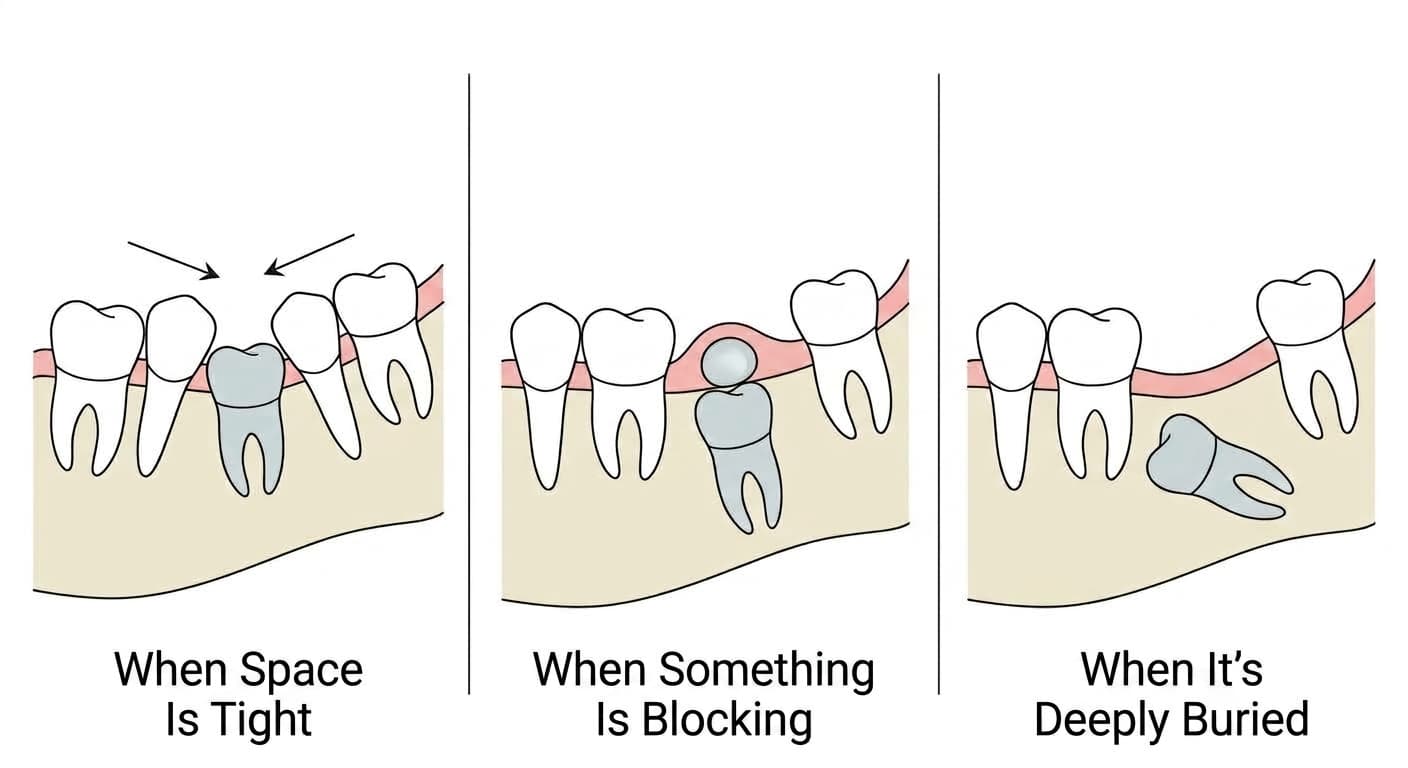
So if a permanent tooth is noticeably late to erupt in the spot where a baby tooth fell out, the next step is checking the space, any obstacles, and whether the tooth is impacted with an X-ray. When an X-ray alone isn't enough to judge, more detailed imaging such as a CT scan may be taken to pinpoint the tooth's position. Depending on what's found, the case may only need watching, or it may require removing an obstacle or orthodontically pulling the tooth into place.