
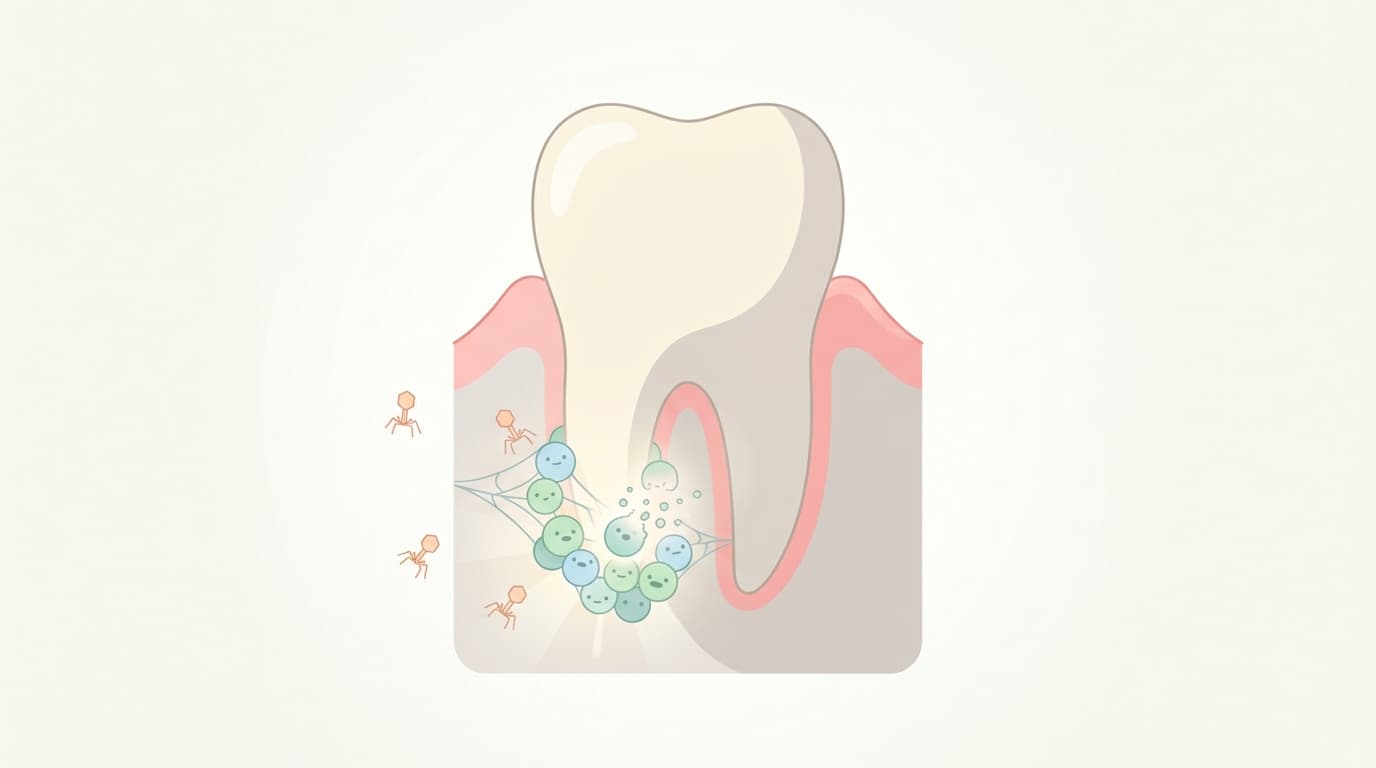
The bacteria that cause periodontitis and reinfection after root canal treatment often resist antibiotics. A series of recent studies have sought to target these bacteria using bacteriophages (hereafter phages), viruses that infect only bacteria. A research team at La Trobe University in Australia confirmed in the lab that eliminating just one species from a periodontitis bacterial community with a phage caused the entire biofilm to collapse, while a team at Wuhan University in China extracted only the enzyme phages use to burst bacteria, packaged it in a nanomaterial, and used it to treat root-tip infections in mice. Both studies remain at a stage prior to clinical trials in humans.
A Virus That Selectively Kills Bacteria
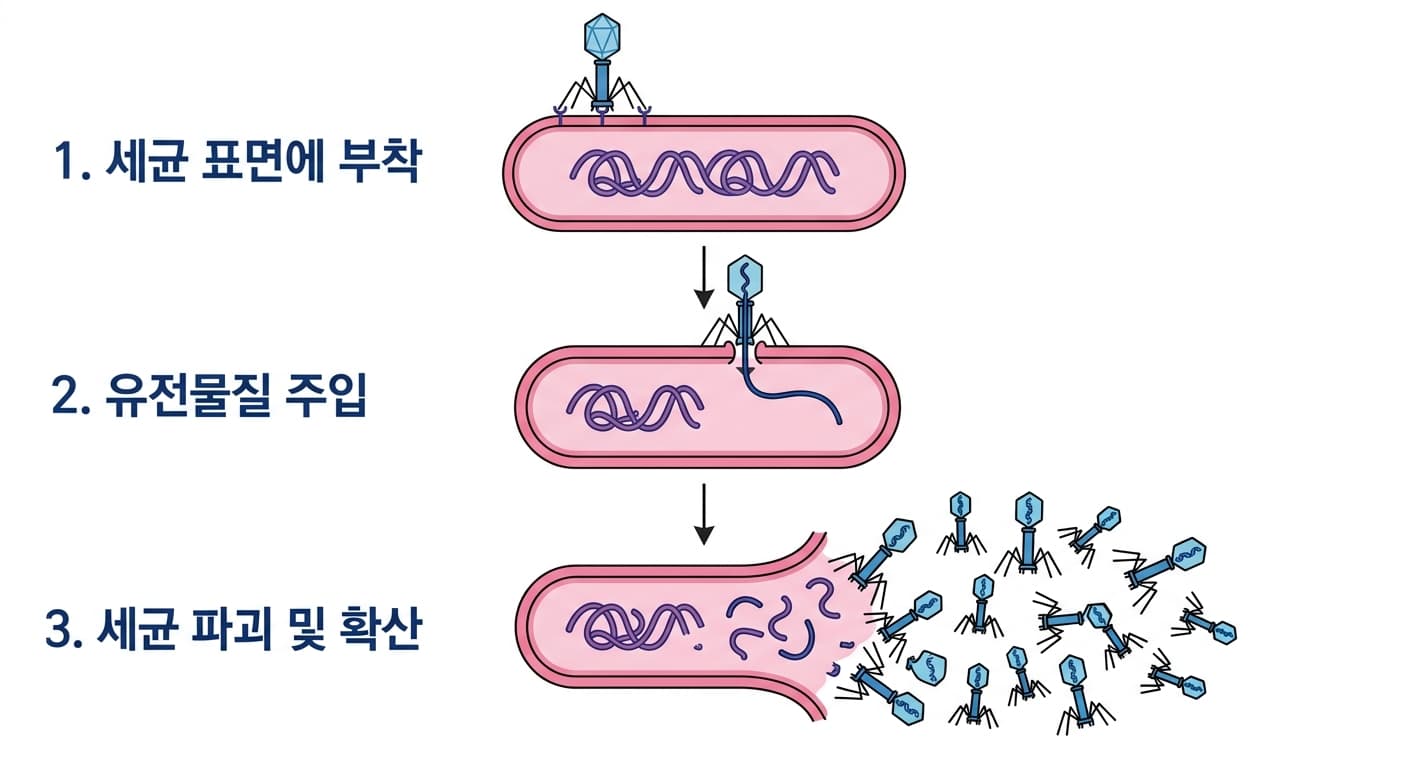
Phages are viruses that infect only bacteria. They recognize and attach to a specific structure on the surface of their target bacterium, inject their genetic material into it, multiply inside the cell, and then burst it open to spread outward. Because human cells lack this structure, phages cannot infect them, and they mostly have no effect on bacterial species other than the one they target.
This specificity is where phages diverge from antibiotics. Antibiotics kill a broad range of bacteria at once, which also reduces beneficial bacteria in the mouth, and the bacteria that survive the process can easily develop resistance. As antibiotic-resistant bacteria increase, phage therapy is drawing renewed attention in dentistry as a way to supplement or replace antibiotics. Scaling, which scrapes tartar out from beneath the gumline, is the standard treatment for periodontitis, but as periodontal pockets deepen, this method alone struggles to remove all the bacteria, which is part of why phages are being studied as an adjunct treatment. The strengths cited for phage therapy include its ability to penetrate deep into biofilms, its low toxicity, and its ability to multiply on its own within the target bacteria to increase in number.
Removing Just One Species Collapsed the Entire Biofilm
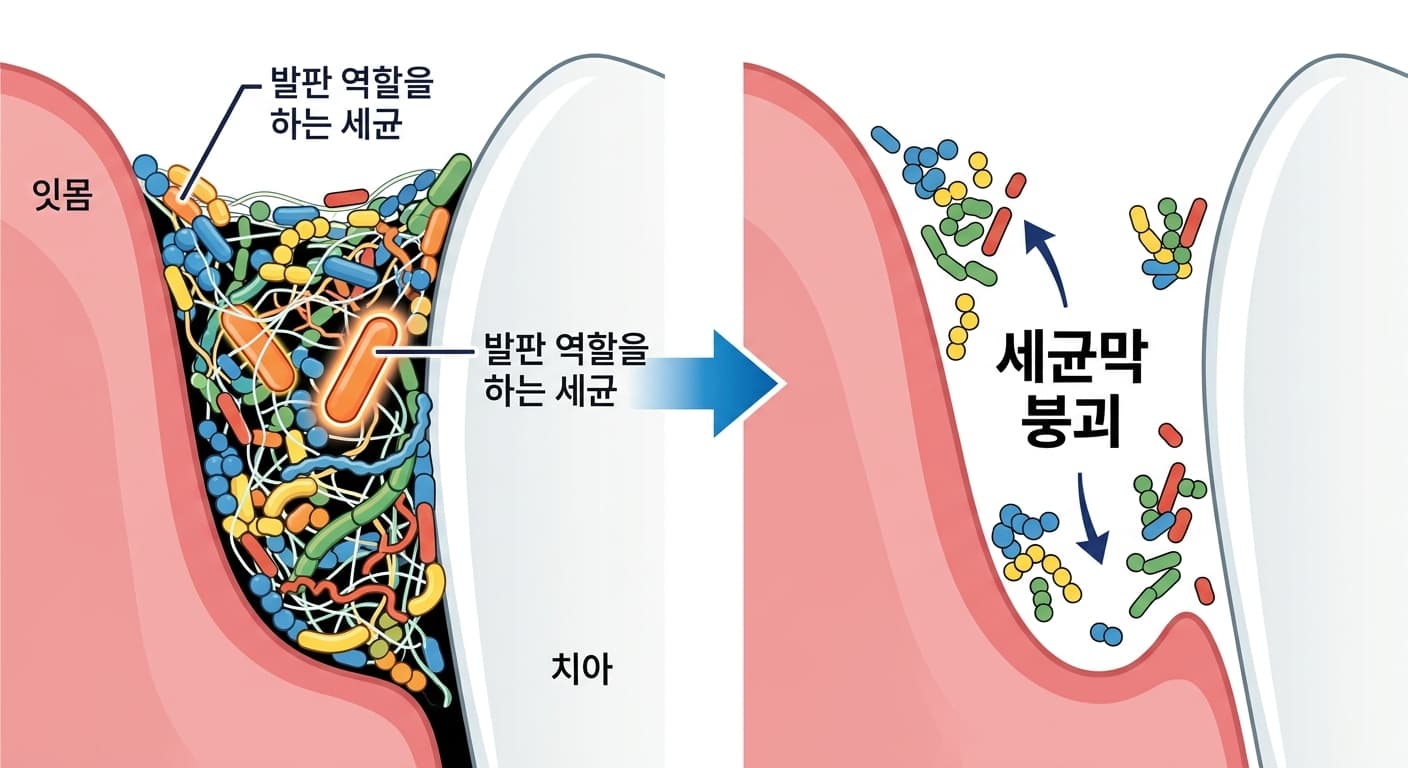
The La Trobe University team tested FNU1, a phage that selectively kills Fusobacterium polymorphum, a keystone species that bridges other bacteria within a periodontitis bacterial community. This species connects early-colonizing bacteria with pathogenic bacteria that join later.
The team created three types of biofilm in petri dishes: one with only this species, one with two additional bacterial species added, and a four-species mixed biofilm that also included Porphyromonas gingivalis, a leading cause of periodontitis. Even though FNU1 eliminated only the Fusobacterium, both the total amount of biofilm and bacterial density dropped markedly, even in the complex four-species biofilm. This means that removing just one keystone species, without killing every species in the biofilm, can destabilize the entire disease-causing bacterial community.
The same team had previously isolated three phages targeting the related species Fusobacterium nucleatum and confirmed that they collapsed a biofilm formed jointly by this species and P. gingivalis. However, the genomes of these bacteria also contain defense systems that resist phages, so more verification is needed before phages can be applied as they are. Both experiments were conducted in petri dishes, and no results have yet been confirmed within an actual gum crevice.
For Root-Tip Infections, Only the Enzyme Was Extracted and Packaged in a Nanomaterial
Apical periodontitis, in which bacteria remain around the root tip and cause inflammation even after root canal treatment, is commonly caused by Enterococcus faecalis. This species is known to hide deep within narrow, winding root canals, where it is difficult to remove even with disinfectant solutions.
Instead of using live phages, a research team at Wuhan University in China extracted only lysin, the enzyme phages use to burst bacterial cell walls, and targeted it at E. faecalis. They created a material (LysPd138@ZIF-8) that encapsulates this enzyme in ZIF-8, a nanoscale metal-organic framework, allowing it to release gradually, and tested it in mice with apical periodontitis. As a result, E. faecalis disappeared from the pulp tissue, and CT imaging showed a reduction in areas of bone resorption. Activity of bone-forming genes also increased, confirming new bone growth. In effect, a single material combined bacteria-killing and bone-regenerating effects. However, this result is also still at the mouse-experiment stage, and it remains unconfirmed whether the same effect would be reproduced in human root canals, which are far narrower and branch in more complex ways.
As antibiotic-resistant bacteria increase, phage-based therapies that selectively target specific bacteria are being developed along two tracks in dentistry: using live phages to collapse the keystone species of a biofilm, and extracting only a phage's enzyme to deliver via nanomaterials. Both approaches remain at the laboratory and animal stage, and future clinical trials will need to answer whether they produce the same effect in human gums or root canals.