
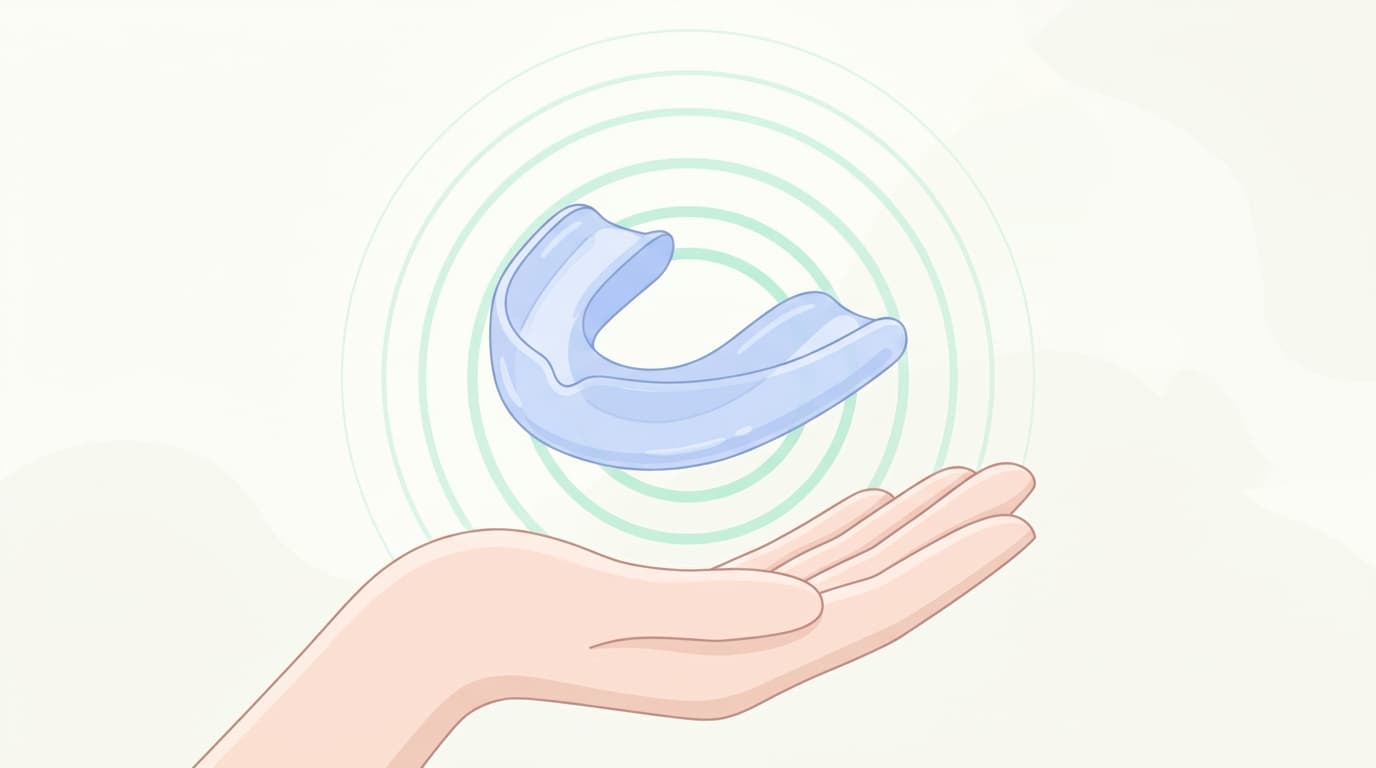
A team at Ludwig Maximilian University of Munich (LMU) in Germany reported in a 2020 study that both the frequency and duration of bruxism episodes decreased while using a vibrating splint, compared with before use. The product tested was a splint made by the German company bruXane, a device that detects pressure on the teeth and vibrates inside the mouth. The researchers tested it alongside a conventional splint.
Sensors Built Into a Tooth-Protecting Appliance
A splint is an oral appliance worn over the teeth that prevents the upper and lower teeth from touching directly. The bruXane device used in this study embeds pressure sensors along the biting surface and houses a battery, vibration motor, and control circuit on the palatal side.
Biting down hard lowers the sensor's electrical resistance. When it drops below a preset threshold, the circuit interprets this as a grinding motion and starts vibrating; when the bite force is released, it stops. Feeding a signal about the body's own activity back to the person like this is called biofeedback. It differs, in both sensing location and method, from devices that measure muscle electrical signals through electrodes attached to the skin.
Duration Fell During Use, and What Changed After Stopping
In the study, people who used the vibrating splint showed reduced frequency and duration of grinding episodes compared with before use. However, the same measures were not continuously recorded in a control group during treatment, so this reduction should not be read as direct superiority over a conventional splint.
After use was discontinued, measurements taken again with a splint whose vibration had been switched off still showed shorter average and maximum durations than before use. The reduction in frequency, however, was not statistically clear. This does not mean the grinding habit was permanently corrected even without the device; the change measured in a short-term study needs to be distinguished from a lasting change in habit.
Another Approach: Recording Jaw Movement
Beyond devices that provide feedback, bruxism technology also includes sensors that simply record movement. A team at the University of Zurich published a proof-of-concept study in 2026 that recorded jaw movement using an accelerometer, gyroscope, and magnetometer together. Feeding the movement data from each sensor into machine learning, they distinguished grinding motions from simply opening and closing the mouth.
A model trained on recordings from a small number of participants correctly classified up to 96% of a held-out test dataset. This does not represent the accuracy of diagnosing actual bruxism during sleep, nor the effectiveness of a treatment that reduces bruxism; it is a result confirming only that movement classification is possible.
The two studies do different things. The LMU Munich study tested a device that detects biting pressure and responds with vibration, while the Zurich study examined a method for distinguishing jaw motions using small sensors. Separating detection performance from the effect of actually reducing bruxism makes clearer what each technology has actually achieved.