
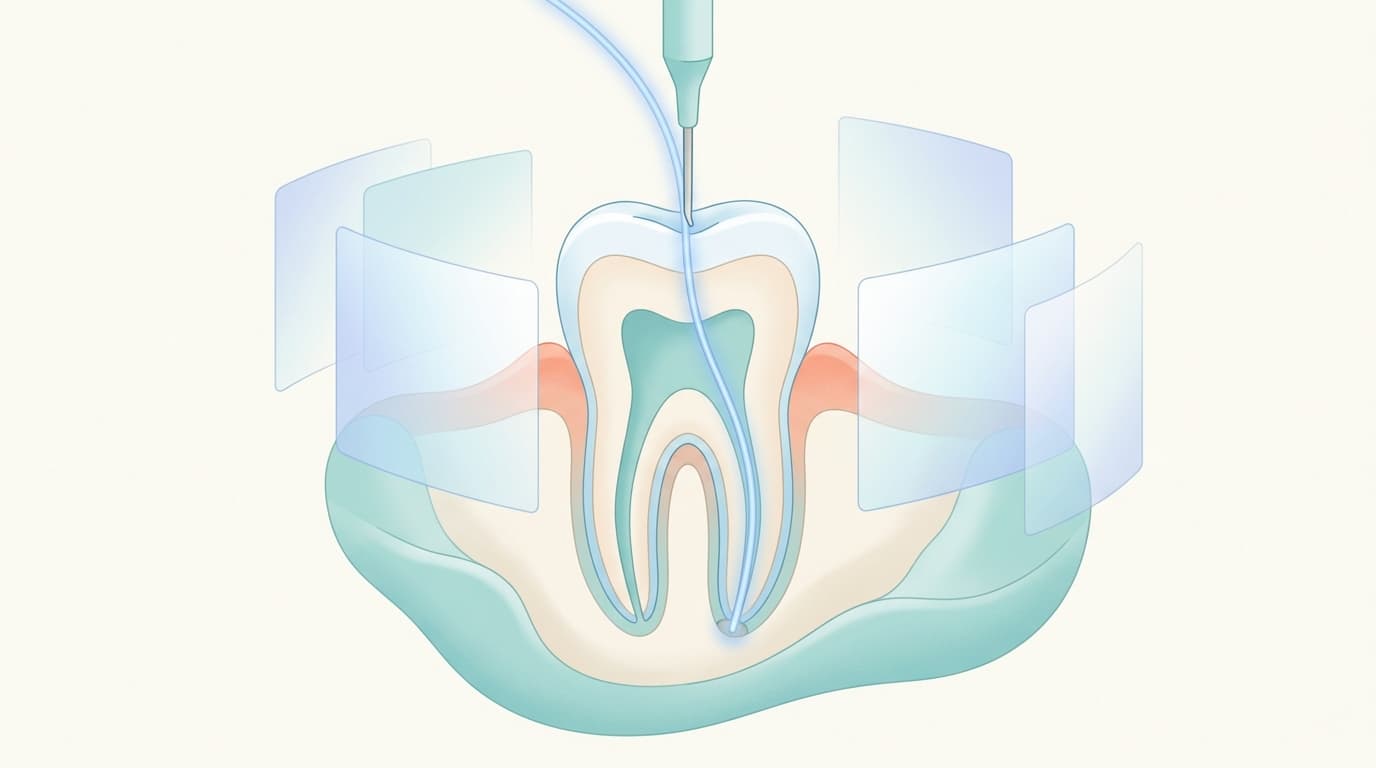
Apical surgery is a surgical endodontic procedure chosen when inflammation that began inside the root canal has spread to the root tip and cannot be resolved by nonsurgical retreatment. Because it addresses a small lesion at the tip of the tooth root, a deviation of just a few millimeters can determine success or failure. Recently, technologies that let a computer plan this narrow path in advance or guide it in real time, in place of the surgeon's hand feel, have come into use. These are static guides, dynamic navigation systems, and robot-assisted surgery.
Where Hand Feel Alone Fell Short
Surgical endodontics is a field that includes incision and drainage, apicoectomy, periapical curettage, retrograde filling, root resection, and intentional replantation, and it is chosen when nonsurgical retreatment is not possible or has already failed. The traditional approach used before the 1990s had a success rate of only 30-50%.
The subsequent introduction of the surgical microscope, ultrasonic tips, and biocompatible retrograde filling materials such as MTA raised the success rate to 74-92%, and to 80-90% in more recent studies. Microscope-assisted microsurgical endodontic treatment magnifies the field of view 8-10 times and examines the resected root surface at 15-25 times magnification, while narrowing the extent of bone removal to within 4-5mm and the root-end resection angle to 0-10 degrees, reporting a success rate of about 94% by meta-analysis. This is a large difference compared with the traditional approach (about 59%).
Even so, the microscope and ultrasonic tips alone still require the surgeon to judge, from experience and feel, from which direction and to what depth to approach a root tip hidden inside the bone. Static guides, dynamic navigation systems, and robot-assisted surgery are attempts to replace this judgment with three-dimensional CBCT imaging data.
Static Guides: Following a Predetermined Path
Static guides work by overlaying the three-dimensional CBCT image with digital impression data obtained from an intraoral scanner to calculate the approach path before surgery, then transferring that path onto a guide (stent) produced with a 3D printer. Inserting the instrument through a metal sleeve fitted into the guide allows it to reach the planned point without unnecessary damage to tooth structure or risk of perforation.
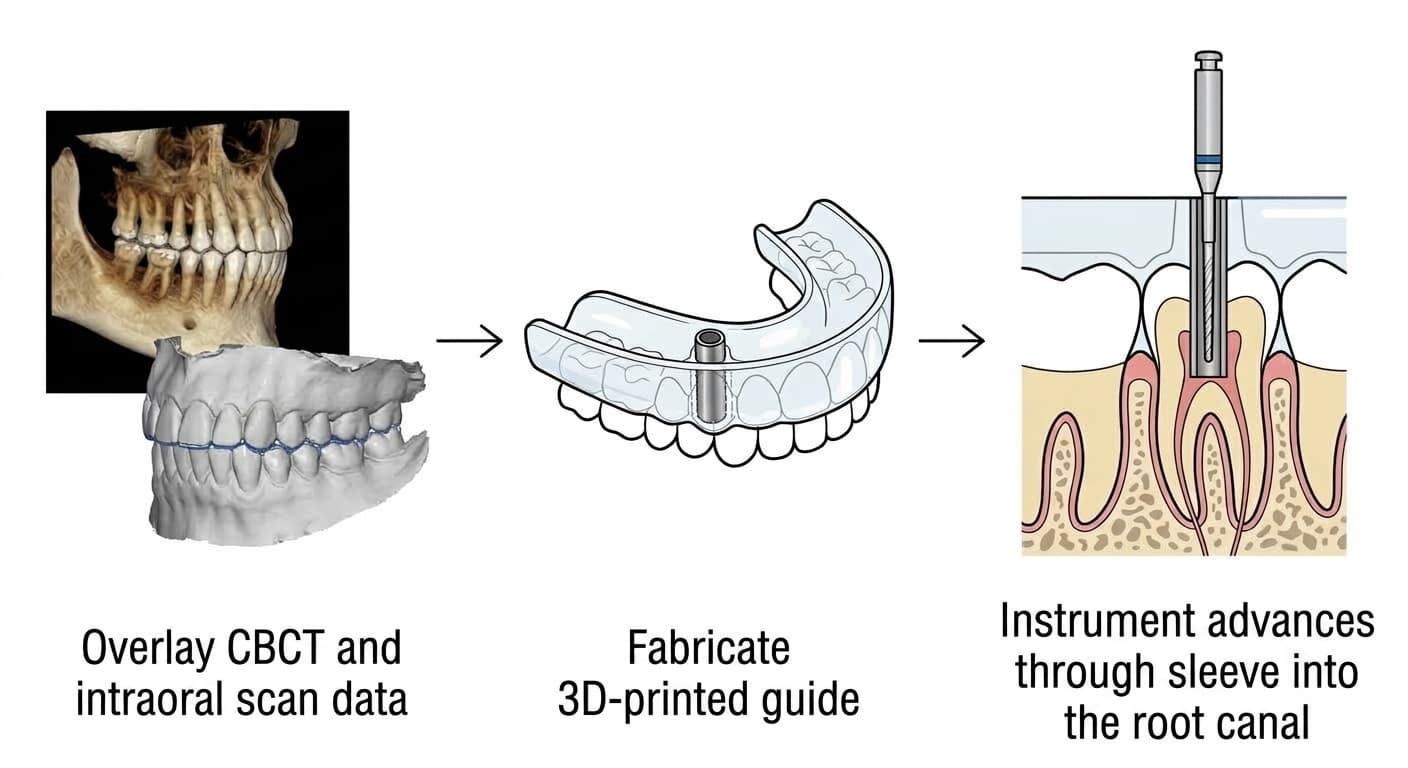
The effect of shortening surgical time and increasing accuracy is most pronounced in hard-to-reach sites such as difficult molars, the maxillary palatal root, and the mandibular distal root. A study by Buniag et al. reported a one-year success rate of 91.7%.
However, because the guide is made in advance before surgery, the path cannot be changed midway through the procedure. Errors arising during fabrication and limited mouth-opening space (interocclusal space) also remain limitations.
Dynamic Navigation Systems: Adjusting in Real Time on Screen
A dynamic navigation system (DNS) attaches infrared optical tracking markers to the patient and the handpiece, overlaying the instrument's position, direction, and depth onto the CBCT image in real time. Instead of fixing the path in advance like a static guide, the surgeon can change direction and angle at any point during the procedure while watching the screen, and no guide device blocks the field of view.
Compared with free-hand surgery relying on hand feel alone, linear and angular deviation is reduced and working time is shortened, a difference seen in both novices and experienced surgeons. A study by Chen et al. reported a one-year success rate of 94.3% based on CBCT assessment. The system is especially suited to situations requiring flexible responses, such as locating a canal blocked by calcification, removing a broken instrument, or retreating a tooth with complex anatomy. More recently, it is also being combined with ultrasonic retrograde filling and augmented-reality displays to further improve precision and reduce time.
Robot-Assisted Surgery: Machines Reduce the Hand's Deviation
Robot-assisted surgery applies a robotic system with haptic feedback to microsurgical endodontic treatment, aiming to reduce deviation caused by the surgeon's skill level or hand tremor. Smaller angular and linear deviation and improved precision have been reported compared with static guides or dynamic navigation systems, and guided surgical systems as a whole have shown one-year success rates confirmed at above 90%.
It has the advantage of narrowing skill differences among surgeons and shortening surgical time, but equipment cost is high, and its practicality in real clinical settings still needs further verification.
How the Three Technologies Differ
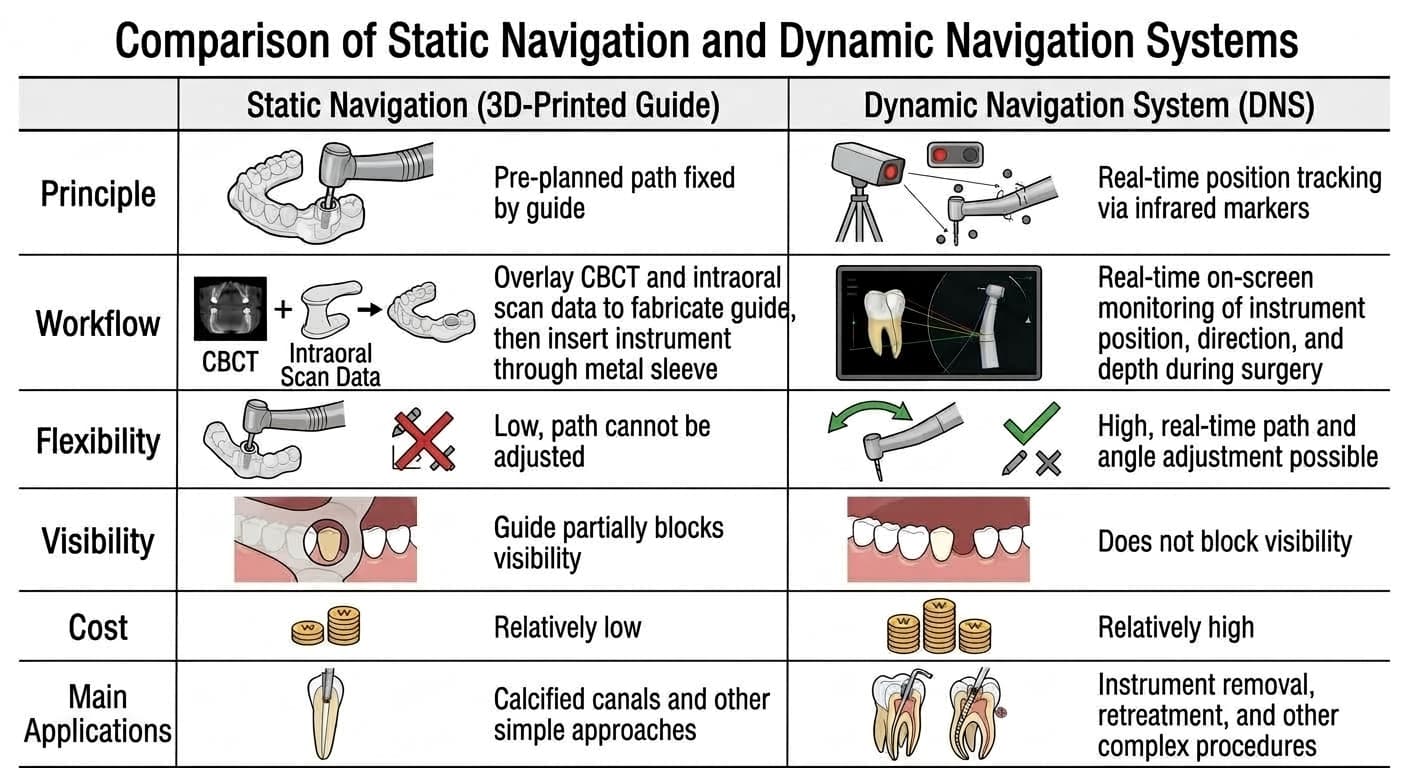
All three approaches start from three-dimensional CBCT data, but they use that data differently. Static guides fix the path in advance, making them relatively low in cost and strong for simple approaches, but the path cannot be changed midway. Dynamic navigation systems can change direction in real time, which is advantageous for unpredictable situations such as complex retreatment or instrument removal, but the equipment costs more. Robot-assisted surgery is reported to be the most precise, but verification of its cost and practicality is still ongoing.
What Changes for the Patient
These guidance technologies are considered when apical surgery, which treats only the lesion at the root tip without extracting the tooth, is needed, particularly when the canal is calcified and the entrance is hard to find, or when the anatomy is complex enough that hand feel alone makes access difficult. CBCT imaging is performed alongside this process; its effective radiation dose is 36.9-50.3 μSv, higher than a routine dental radiograph but lower than a hospital CT scan.
The success-rate figures are results reported in individual studies, and not every dental practice has the same equipment. If you are about to undergo surgery, you can ask your treating clinician which method will be used and why it is recommended.
Limitations That Remain
Static guides, dynamic navigation systems, and robot-assisted surgery are all technologies that rely on the accuracy of three-dimensional data obtained by CBCT. If there is error in the process of overlaying the data or in the imaging itself, the guidance becomes correspondingly inaccurate. Robot-assisted surgery still needs further verification of its cost and practicality, and all three technologies remain an aid to, rather than a full replacement for, the surgeon's judgment.