

Digital Navigation Enters the Dental Operating Room
Canals narrowed by calcification or roots with complex curvatures are among the classic challenges that determine whether endodontic treatment succeeds. Until now, clinicians have relied on experience and tactile sense to locate such canals, but digital navigation technology is now entering clinical practice: it combines three-dimensional CBCT (cone-beam computed tomography) imaging with intraoral scan data to calculate the access path in advance and then guide the clinician to follow that exact path. The first to take hold was static navigation using 3D-printed guides, followed by dynamic navigation systems that track position in real time, and now robot-assisted surgery in which a robot directly manipulates the instrument, each being adopted in stages. Dynamic navigation systems are sometimes nicknamed a 'dental GPS.'
Finding Calcified Canals With a 3D-Printed Guide
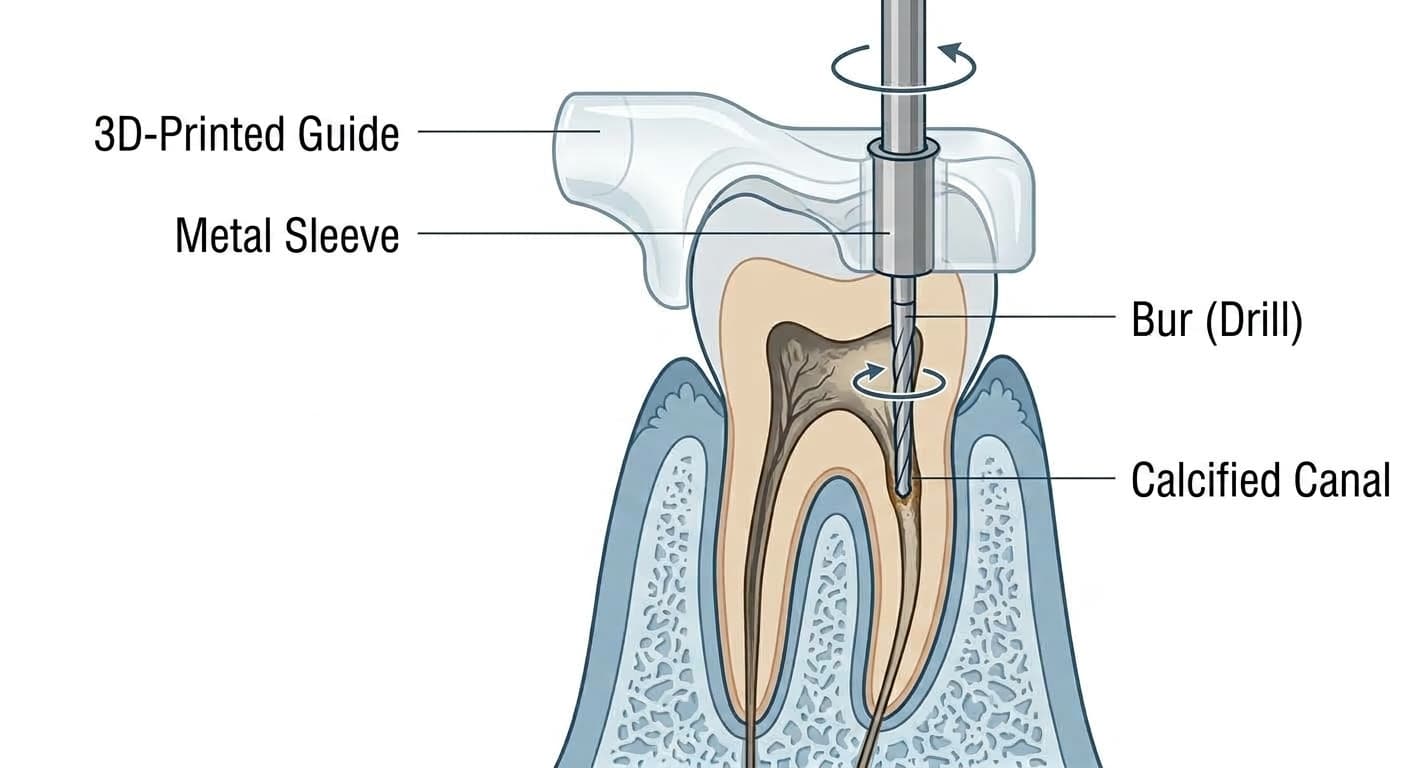
Guided endodontic treatment overlays three-dimensional CBCT data with the digital impression obtained from an intraoral scanner to plan, in advance, the access path to the entrance of a calcified canal. Based on that plan, a 3D-printed guide is fitted in the mouth and used to remove tooth structure. Because the bur (the rotary instrument that cuts tooth structure) is guided through a metal sleeve fitted into the guide, it can reach the canal entrance accurately and with minimal invasiveness, without unnecessary damage to tooth structure or perforation (an accident in which a hole is created where none should exist). The drawback is that once a guide is made, its path cannot be changed during the procedure.
Dynamic Navigation Systems That Map the Path in Real Time
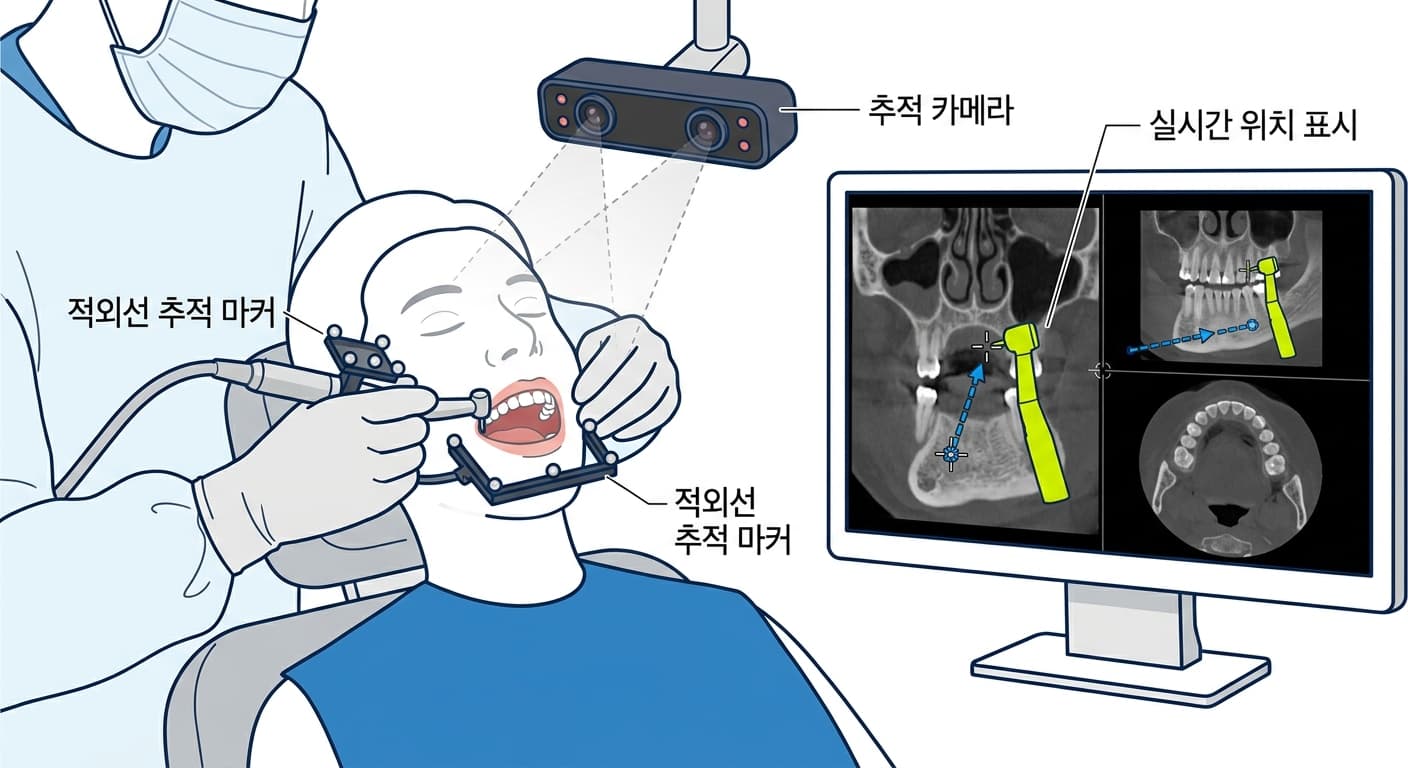
The Dynamic Navigation System (DNS) emerged to overcome this limitation on path correction. Infrared optical tracking markers are attached to the patient and the handpiece, and a camera recognizes these markers to overlay the bur's position, orientation, and depth onto the CBCT image in real time. Unlike a static guide, no physical stent blocks the field of view, and the path and angle can be corrected instantly during the procedure. Beyond access to calcified canals, it is also applied to demanding procedures that require flexible responses, such as removing fractured instruments, apical surgery, and anatomically complex retreatment. Recently it has been combined with ultrasonic retrograde filling and augmented reality (AR) displays, advancing toward greater precision and time efficiency together.
Static Guides vs. Dynamic Navigation: What's the Difference
Both approaches start from the same CBCT data, but they diverge sharply in how they work and in their respective strengths and weaknesses.
| Category | Static Guide | Dynamic Navigation System |
|---|---|---|
| Method | Follows a path planned in advance via a 3D-printed guide | Tracks the bur's position in real time using infrared markers |
| Mid-procedure path correction | Not possible | Possible |
| Field of view | The physically attached guide can obstruct the view | Does not obstruct the view |
| Main applications | Difficult roots such as molars, maxillary palatal roots, and mandibular distal roots | Calcified canal access, fractured instrument removal, apical surgery, complex retreatment |
| 1-year success rate | 91.7% (Buniag et al.) | 94.3% (Chen et al.) |
Static guides show excellent outcomes even in difficult cases such as molars, maxillary palatal roots, and mandibular distal roots, and they shorten surgical time. Dynamic navigation systems are reported to reduce linear and angular deviation compared with free-hand surgery performed by hand alone, shorten working time, and improve outcomes for both novice and experienced operators.
Robots Are Now Holding the Instruments
Robot-assisted surgery goes a step further than these two approaches. It applies a robotic system equipped with haptic feedback to microsurgical apicoectomy, aiming to reduce the limitations that come from relying on an individual operator's skill and variability. Some studies have found smaller angular and linear deviation and improved precision compared with static guides or dynamic navigation systems. Guided surgical systems overall have reported favorable outcomes, with 1-year success rates above 90%, but high cost and practicality still require further validation.
The Foundation Navigation Builds On: Microscopes and Ultrasonic Instruments
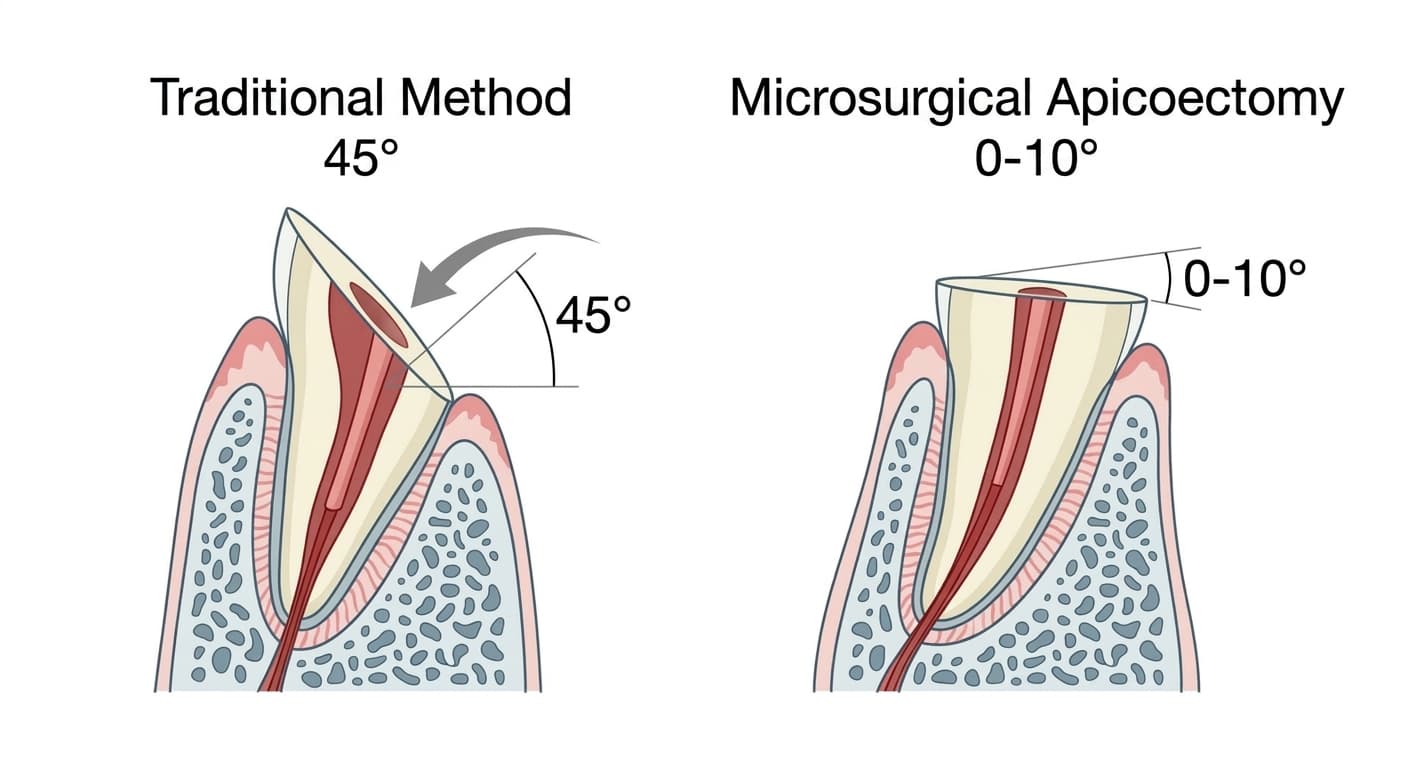
Behind the effectiveness of these navigation technologies lies the development of microsurgical apicoectomy, established since the 1990s. Before the introduction of the surgical microscope, ultrasonic tips, and biocompatible retrograde filling materials such as MTA, the success rate of traditional apical surgery stayed around 30-50%. Modern techniques that combine a microscope (8-25x magnification) with ultrasonic instruments have raised the success rate to 74-92% (80-90% in recent studies), and meta-analyses pooling multiple studies have reported figures reaching roughly 94%. The root-end resection angle (bevel) has also dropped from a traditional 45 degrees to 0-10 degrees, and the extent of bone removal has narrowed to within 4-5mm. Ultrasonic tips can create a retrograde filling cavity at least 3mm deep, parallel to the tooth's long axis, reducing the risk of perforation, though some note that improper power control can cause microcracks on the root surface. Static guides, dynamic navigation, and robot-assisted surgery are technologies that push precision one step further, building on this foundation laid by microsurgical apicoectomy.
Artificial Intelligence That Reads the Images
Artificial intelligence for reading CBCT and radiographic images is advancing in parallel. Using deep learning and convolutional neural network (CNN) algorithms to detect lesions on radiographic images and assist diagnosis, these systems are trained on tens of thousands of images to precisely detect anatomical variations that are difficult to discern with the naked eye, such as subtle periapical lesions, proximal caries, microscopic root fractures, and C-shaped canals. With this assistance, diagnostic accuracy is raised across the board, and the technology is expected to advance further into automated precision medicine, such as predicting treatment prognosis or quantitatively measuring working length. Because both guided endodontic treatment and navigation systems take CBCT imaging as their starting point, the accuracy of AI-assisted reading is also a factor that shapes the groundwork for all of these technologies.
Remaining Challenges
Static guides, dynamic navigation systems, and robot-assisted surgery all report 1-year success rates hovering around or above 90%, but each has clear limitations. Static guides cannot have their path corrected and are constrained by occlusal space, while dynamic navigation and robotic systems still require further validation of equipment cost and practicality. Because most of the success rates reported so far come from 1-year observation periods, longer-term follow-up data will need to accumulate before the place of these technologies becomes clear.