
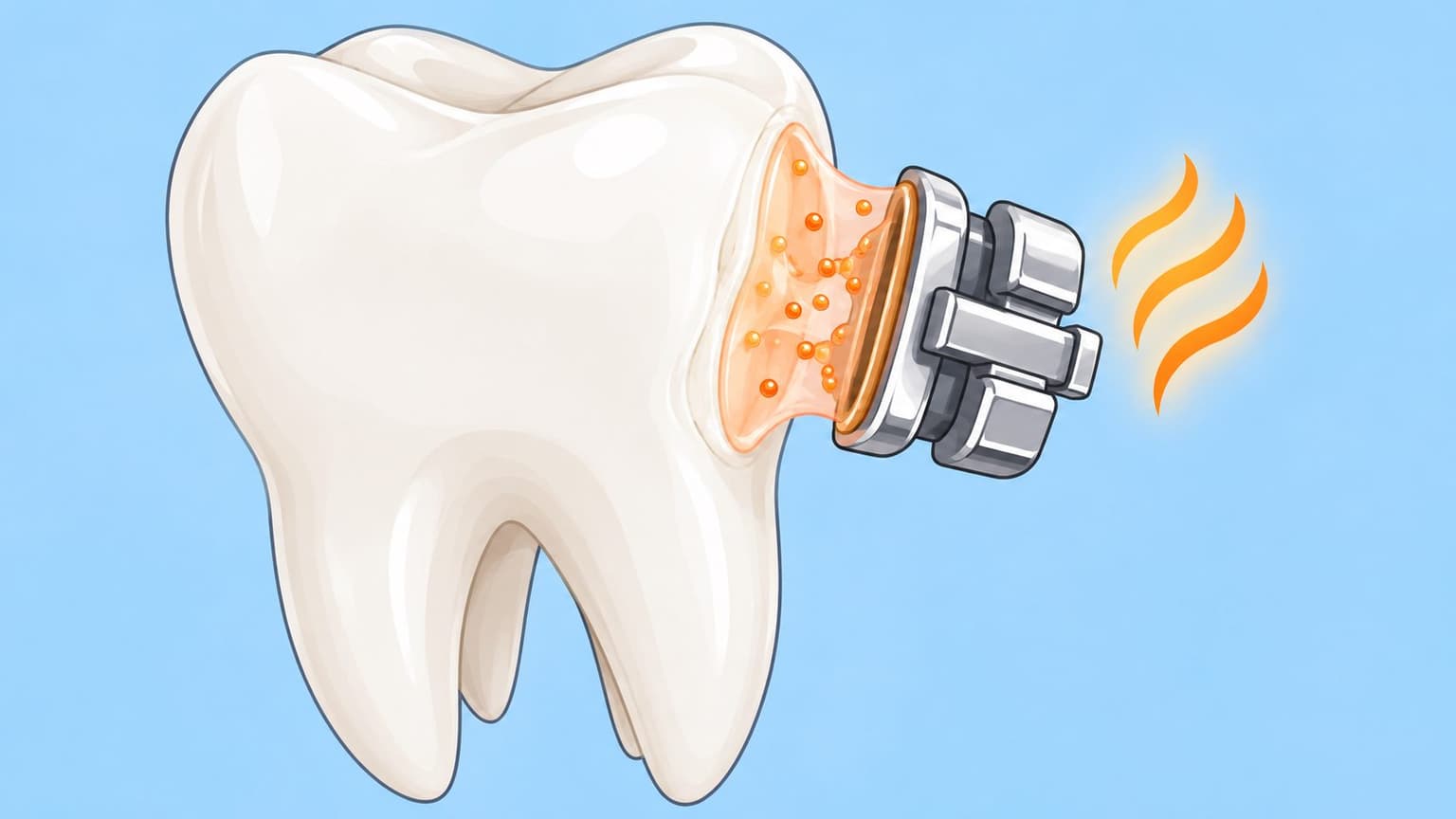
Researchers have developed an adhesive designed to hold orthodontic appliances firmly in place and weaken when they are removed. In a study published in February 2026 by researchers at Hokkaido University in Japan and other institutions, an adhesive containing a thermoresponsive gel maintained its strength at room temperature but weakened when heated in tests that pushed appliances off bovine teeth. At 50°C, one formulation's bond strength fell to less than half its room-temperature value. The study did not test whether removing appliances caused less pain in people.
Designing an adhesive for strong bonding and easy removal
Fixed orthodontic treatment involves bonding small appliances called brackets to the tooth surface. During treatment, these appliances must withstand chewing forces and orthodontic forces, but they all need to be removed when treatment ends. Conventional removal uses mechanical force to break the bond, raising concerns about pain during removal and damage to the tooth surface.
Making an adhesive weak from the outset also increases the risk that appliances will come off during treatment. The researchers chose a material whose adhesive strength decreases in response to a specific stimulus. The design combines the ability to hold firm during normal use with the ability to weaken at removal in a single adhesive.
The base material was Super-Bond, a dental adhesive resin made by Sun Medical. The researchers dried and ground a gel they had synthesized, then added it to the powder component at 30% by weight. This does not mean that existing Super-Bond is itself a product that readily releases with heat. It was an experimental formulation to which the researchers added gel.
The gel's crystalline structure loosens with heat
The added gel is made by linking stearyl acrylate and methyl acrylate. At low temperatures, long side chains attached to the molecules align into crystals that restrain the movement of the polymer chains. Above a certain temperature, these crystals break down, allowing the chains to move more easily and the gel to soften like rubber.
This change also affects the stiffness of the surrounding resin and its ability to withstand pulling forces. As the adhesive layer becomes less able to resist force, less force is needed to remove the appliance. This differs from burning away or melting away the entire adhesive with heat.
The ratio of the two starting materials controls the temperature at which softening begins. The gel synthesized with equal proportions of the two components had a transition temperature of 37.9°C, while a 3:1 formulation with a higher proportion of stearyl acrylate had a transition temperature of 41.6°C. The researchers judged the first formulation unsuitable for orthodontic use because its transition temperature was too close to the temperature inside the mouth.
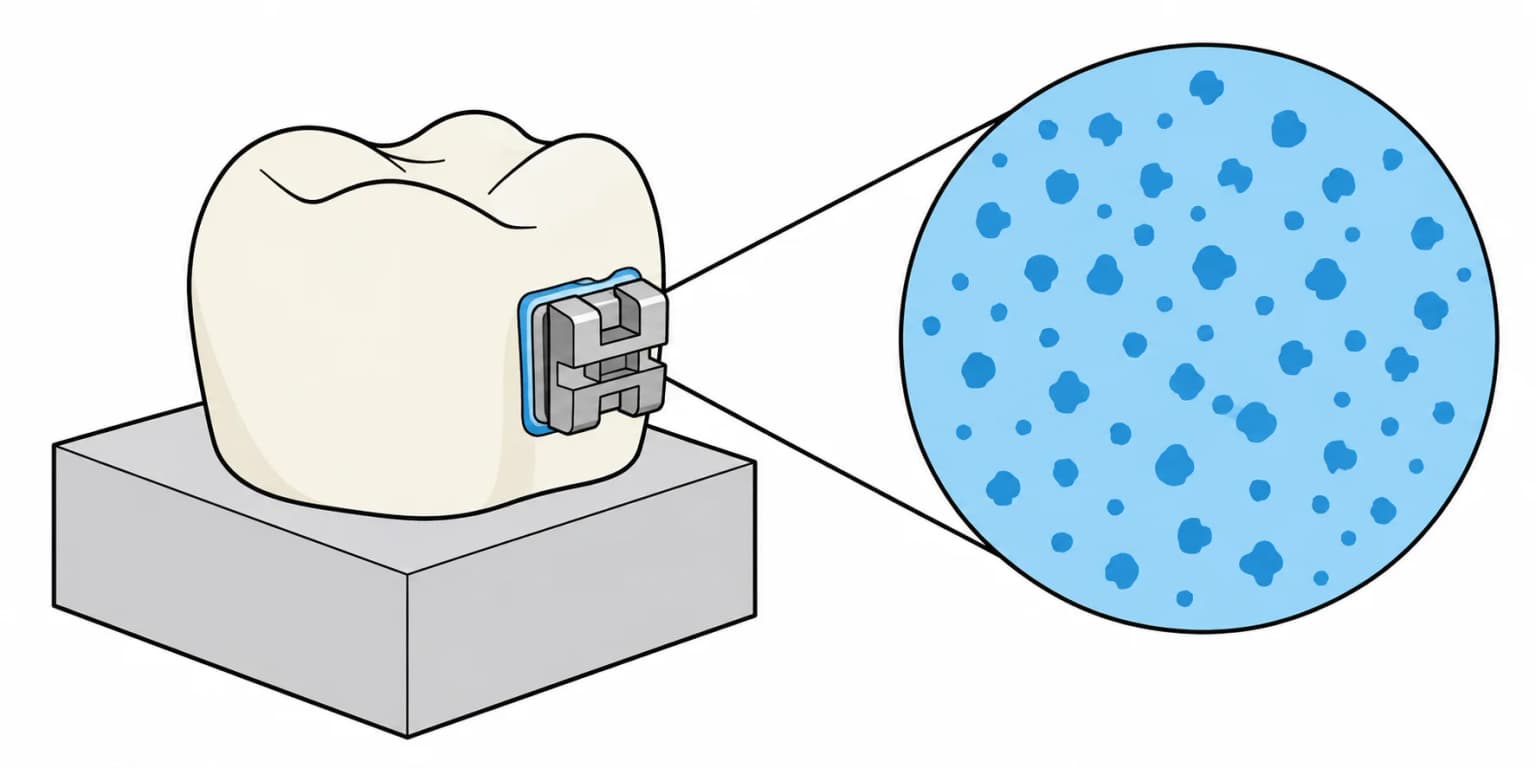
Bond strength before and after heating
The researchers bonded brackets to bovine teeth and compared the force needed to push them off sideways, divided by the bonded area. The adhesive containing the 3:1 gel formulation had a bond strength of 8.4 MPa at room temperature and 3.9 MPa at 50°C. For the same bonded area, this means that less than half as much force was needed to detach the bracket after heating.
The adhesive containing the gel synthesized with equal proportions also showed a decrease, from 7.1 MPa to 4.7 MPa. Super-Bond without added gel changed from 8.0 MPa to 6.0 MPa, but the difference was not statistically significant. There was also no significant difference in room-temperature bond strength between the two gel-containing formulations and the original resin.
In the tests, an industrial heat gun raised the area around the bond to 50°C and held it there for one minute. Both the effects of heat on tissues inside the tooth and the possibility that hot food could weaken the adhesive layer need to be considered. Because testing took place shortly after bonding, the study did not establish whether the same performance would be maintained after years of exposure to water and temperature changes.
The researchers also proposed a device such as heated tweezers that would deliver heat only to the bracket, but they did not proceed to an actual design or prototype. The development demonstrates a shift from simply adjusting the level of adhesive strength to creating a material whose bond strength changes with temperature. It adds responsiveness for the moment of removal to the ability to hold orthodontic appliances in place over time.