
More dental clinics are rapidly adopting intraoral scanners, which use a camera to scan the inside of the mouth instead of alginate impression material. Just a few years ago, this equipment was mostly found in large hospitals, but now it's common even in neighborhood dental clinics. Multiple studies have found that in mouths with most of their natural teeth intact, there is essentially no difference in accuracy compared to traditional impression methods. On the other hand, in mouths missing several teeth that require multiple implants placed at once, study results still diverge significantly. That's why the two cases need to be considered separately.
In Mouths with Natural Teeth, Scanners Have Already Caught Up
A meta-analysis pooling studies that directly compared scans of mouths with natural teeth against traditional alginate impressions found that the difference in error between the two methods was only about the width of a single human hair. Comparisons of measurements used in actual clinical practice, such as tooth width or the distance between molars, also showed no meaningful difference between the two methods. The variability seen when the same mouth was impressed repeatedly was similarly small for both methods. An error of this size is not large enough to translate into a prosthesis that feels loose or overly tight when actually fitted. For mouths with a full complement of natural teeth, there is already substantial evidence that a digital impression from an intraoral scanner can be trusted as much as a traditional impression. For impression-taking as simple as fitting a single crown or making an orthodontic appliance, there's little reason to be particular about which method is used.
In Mouths with Many Missing Teeth, It's Still a Different Story
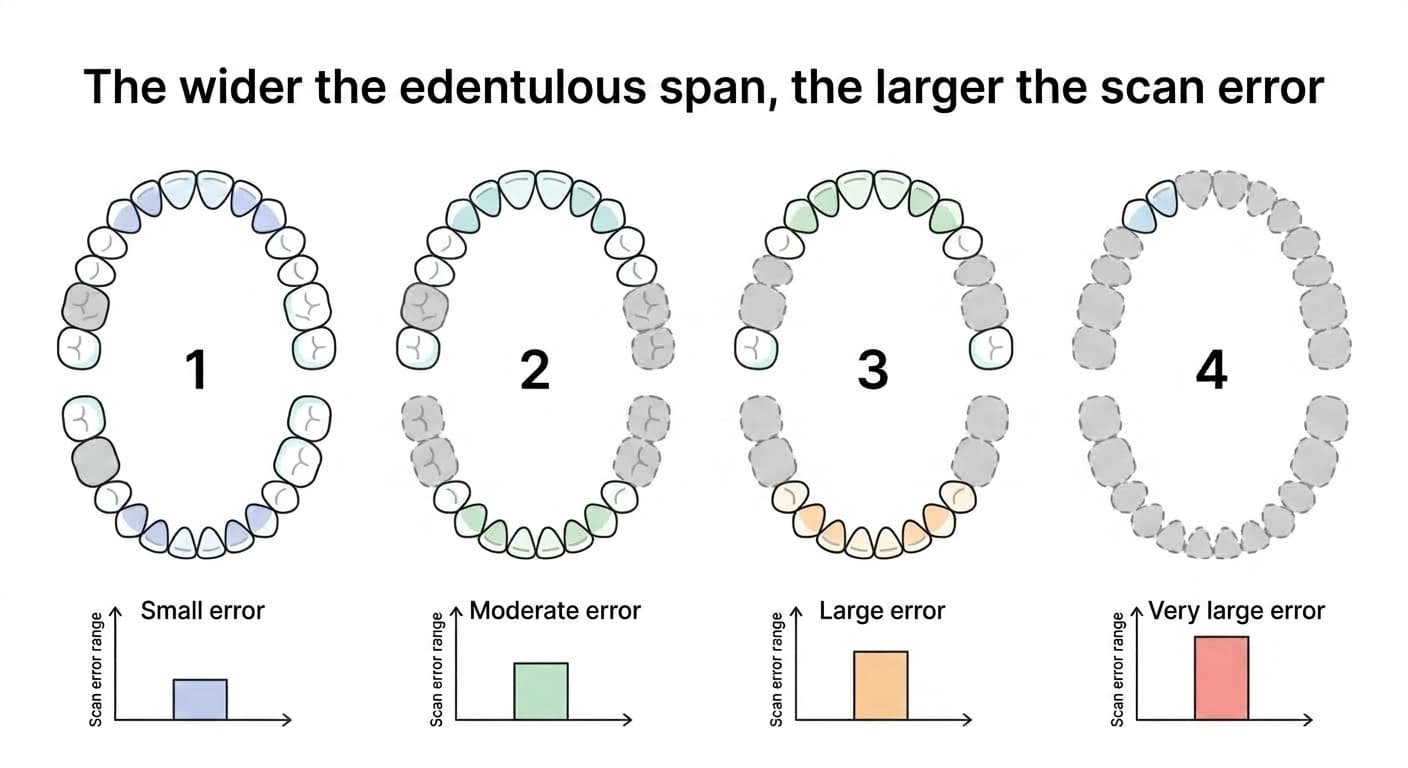
The problem lies in mouths missing several teeth that require multiple implants placed at once. A review pooling thirty studies that used scanning to capture the positions of multiple implants in completely edentulous jaws found that error varied by close to a hundredfold between studies. This review considered an error of around 0.1 millimeters to be clinically acceptable, yet more than half of the studies surveyed exceeded that threshold. Experiments that directly measured error while gradually widening the edentulous span also showed a clear trend: error increased as the span widened. The degree varied by scanner model, but the direction, getting worse as the span widened, was consistent. In other words, the error is not the same when scanning the site of one or two missing molars as when scanning an entire jaw.
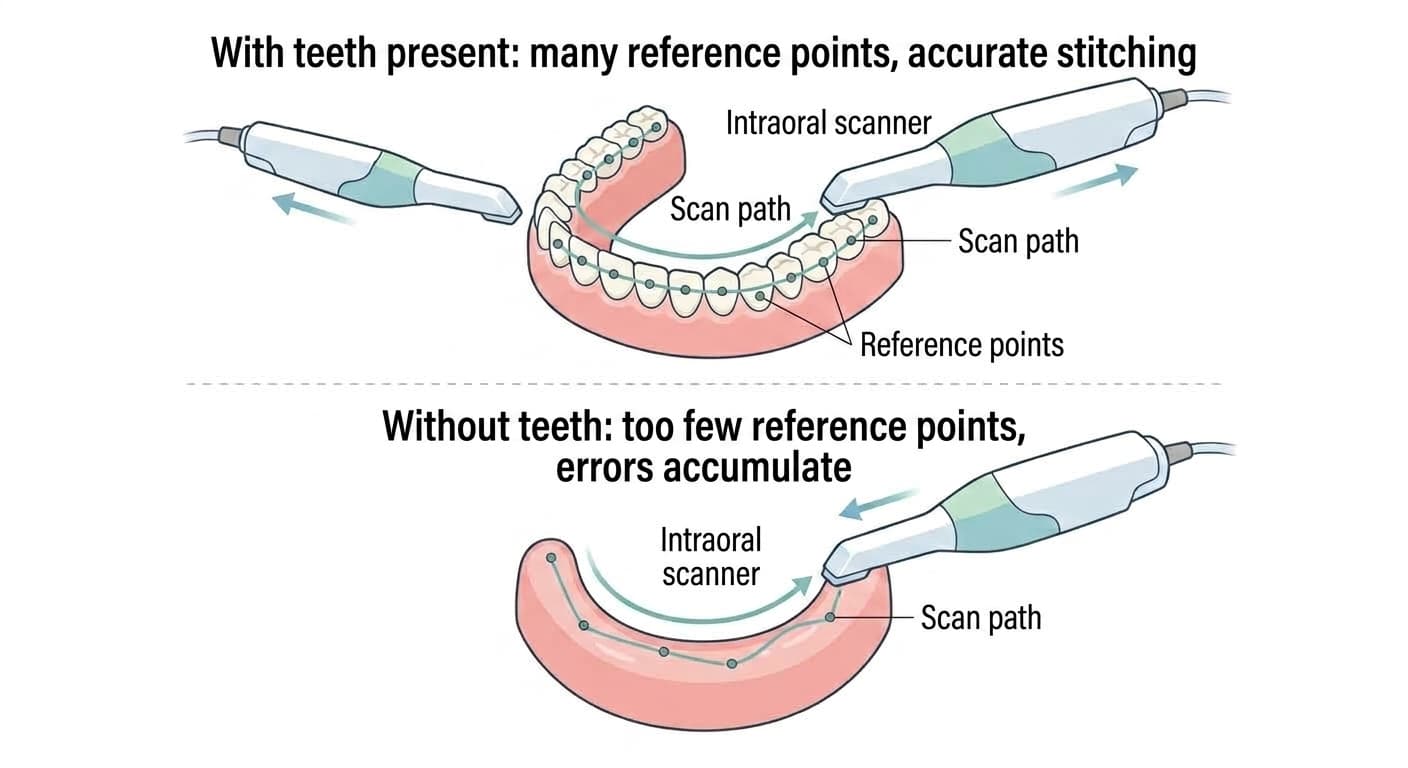
This is explained by how scanning works: it stitches together many individual images into a single shape, and doing so requires reference points where the images overlap. When teeth remain closely spaced, there are plenty of reference points, so the images align well. But in a jaw with no teeth at all, where only smooth, featureless gum tissue must be stitched together, there aren't enough reference points, and errors accumulate.
A review pooling twenty-three studies on whether traditional impressions or intraoral scanners are more accurate also found sharply divided results. About half found digital to be better, while the rest found traditional impressions better or the two comparable. The review also noted that because studies measure error using different methods, it's still difficult to draw a unified conclusion. Multiple studies have also repeatedly confirmed that the distance between implants and the skill of the person operating the scanner significantly affect error.
Why Scanners Are Preferred Anyway
Even though accuracy alone doesn't yet clearly favor one method, there are other reasons more clinics are adopting intraoral scanners. Studies gathering responses from patients who experienced both traditional impression material and intraoral scanners found that scanners caused much less of the odor and taste characteristic of impression material, as well as less foreign-body sensation at the back of the throat and gagging. The degree of tension or anxiety showed no clear difference between the two methods, and perceived time taken varied across studies. Most of these findings come from small-scale trials with limited numbers of participants, so the caveat is that they still need to be confirmed in larger studies. Even so, if accuracy is equal or similar, choosing the less unpleasant option is a perfectly reasonable choice.
So What Should You Ask?
For something as simple as fitting a few crowns on natural teeth or making an orthodontic appliance, there's ample evidence that a digital impression from an intraoral scanner can be trusted without reservation. But the story changes when several teeth are missing and multiple implants must be placed at once. It helps to ask the dental office how they divide up the scanning area, whether they use additional methods to improve accuracy when transferring implant positions, and whether there's a procedure to re-verify with a plaster model if needed. It's also worth remembering that results can vary with the skill of the person operating the same equipment. When the number of implants is small, or when natural teeth remain scattered throughout to serve as reference points, an intraoral scanner alone is often sufficient.