
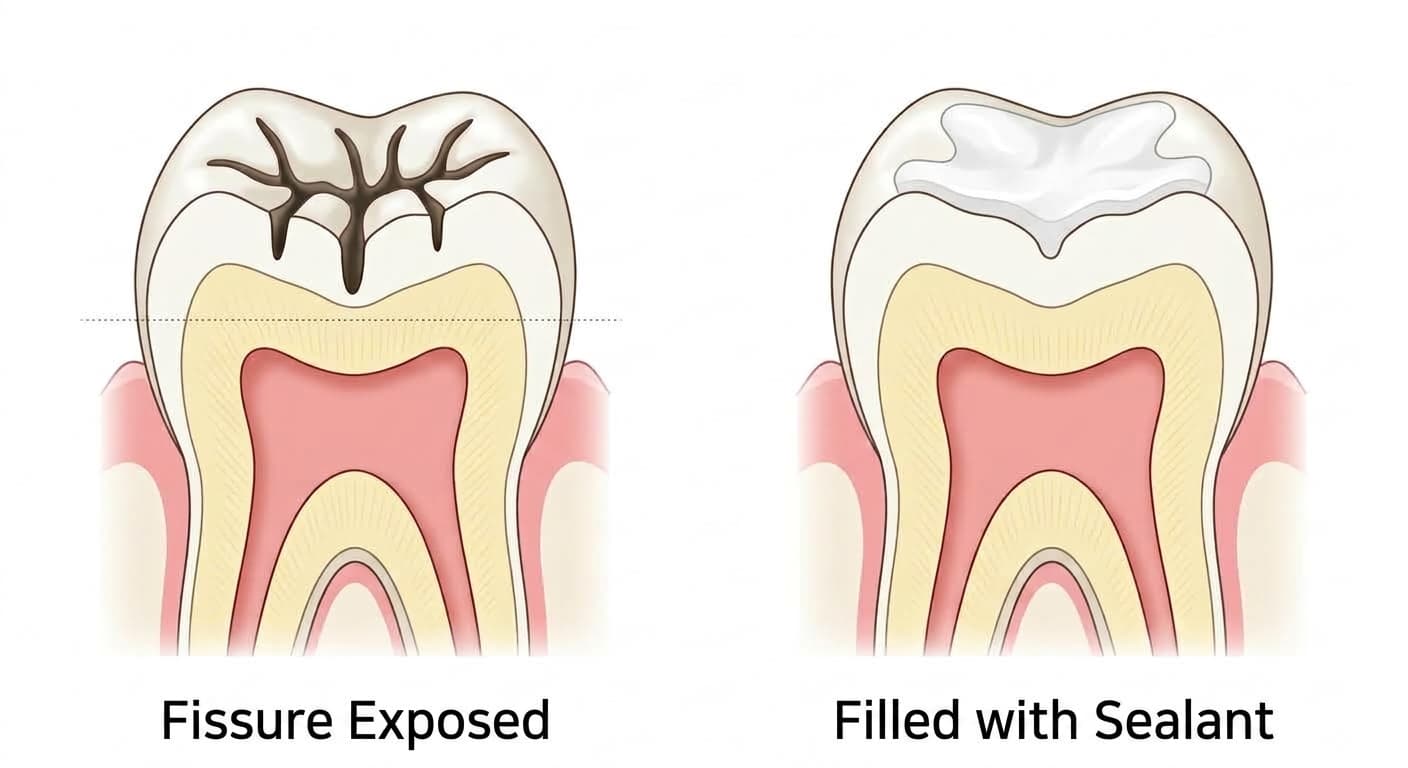
The chewing surfaces of children's molars have narrow, deep grooves. Toothbrush bristles struggle to reach into these grooves, so a procedure called pit-and-fissure sealing, commonly known as a sealant, fills them in to prevent cavities. The problem is that sealants gradually wear away over time. A research team at a university hospital in New Delhi, India, compared a silver nanoparticle sealant against a conventional resin sealant, applying both side by side and following them for one year. The results diverged: the silver nanoparticle sealant had a higher one-year retention rate, but the rate of new cavities was no different between the two groups.
What Sealants Do, and What Happens When They Fail
A sealant is applied by flowing liquid resin into the grooves and hardening it with light. The hardened resin covers the grooves like a lid, blocking the gaps where food and bacteria could otherwise work their way in. The problem is that this spot has to withstand chewing force and temperature changes every day, so it commonly lifts from the edges or comes off entirely. Where the sealant has come off, the groove is exposed again, leaving it defenseless against cavities.
A review pooling multiple studies found that resin sealants remained in place at rates of up to 80% even after two years, while glass ionomer-based sealants retained only 44%. In other words, how long a sealant stays in place varies substantially by material. That's why retention rate is the first thing researchers look at when developing a new material.
What Changes When Silver Is Added
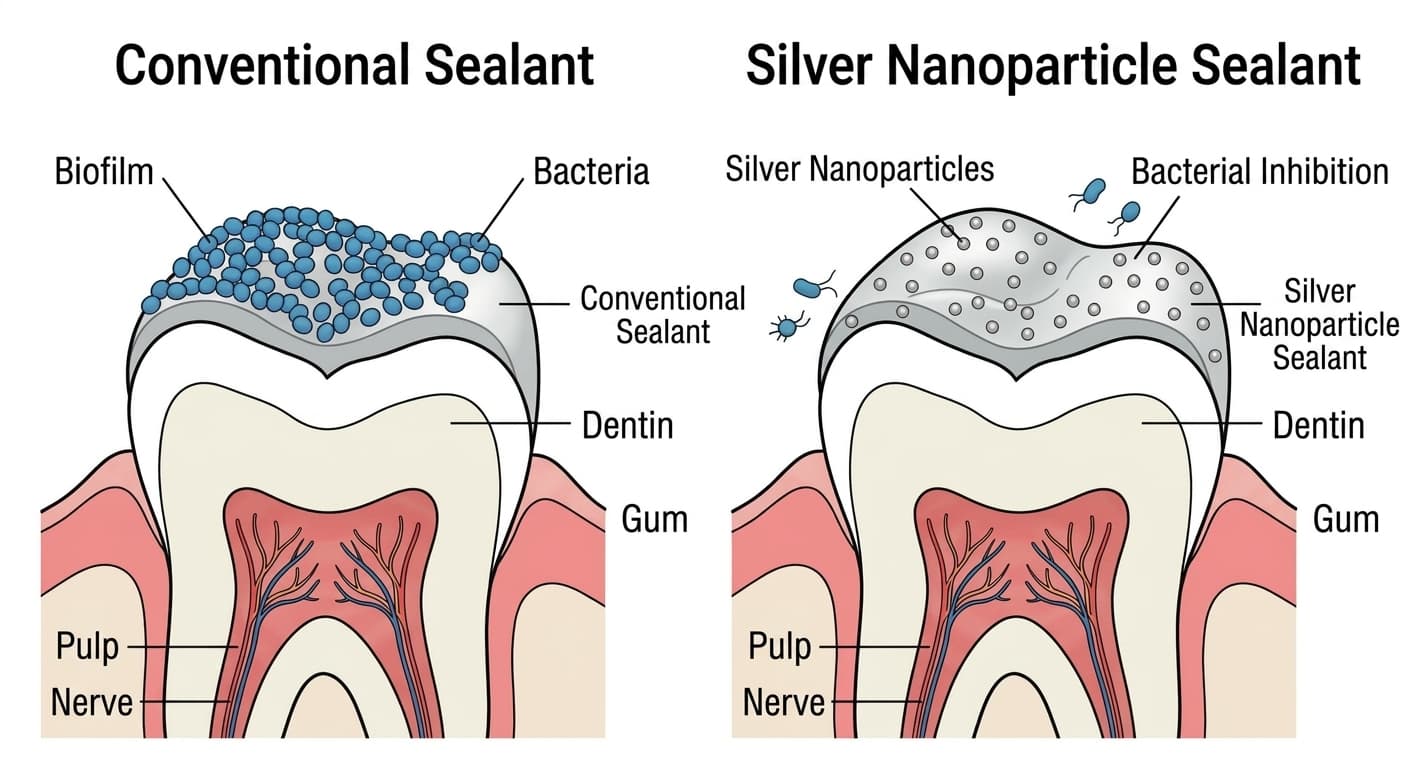
Silver ions act on bacterial cell membranes and internal enzymes to block bacterial growth. They work even against antibiotic-resistant bacteria and have a broad range of action, which is why they're already widely used on the surfaces of medical materials such as wound dressings and catheters. The research team applied the silver nanoparticle sealant (e-fit Sealant) and a silver-free conventional resin sealant (Helioseal F Plus) to different molars in the same children. Their hypothesis was that if silver ions reduced bacteria attaching to the sealant surface and forming a biofilm, the rate of edge damage would also slow down.
After One Year: What Diverged and What Didn't
When the children were re-examined at 12 months, 68.3% of the silver nanoparticle sealant remained intact, compared with only 53.6% of the conventional resin sealant. The degree of surface roughening, marginal lifting, and discoloration was also lower with the silver nanoparticle sealant. However, the rate of new cavities forming underneath did not differ between the two groups. In other words, how long a sealant stays in place and whether cavities form beneath it are two separate questions. Even the silver nanoparticle sealant lost about a third of its coverage within a year, and since these results come from just one hospital followed for a single year, it remains to be seen whether the same difference holds over a longer period and at other sites.
Research is also moving in directions besides silver. Sealants containing calcium fluoride nanoparticles, designed to release fluoride repeatedly over a long period, are being tested at the laboratory stage. This result is part of a broader shift in sealant research toward building antibacterial or remineralizing functions directly into the material itself.
This clinical trial showed that adding silver nanoparticles to a sealant can extend how long it stays in place. But it also confirmed that this doesn't automatically translate into better cavity prevention.