
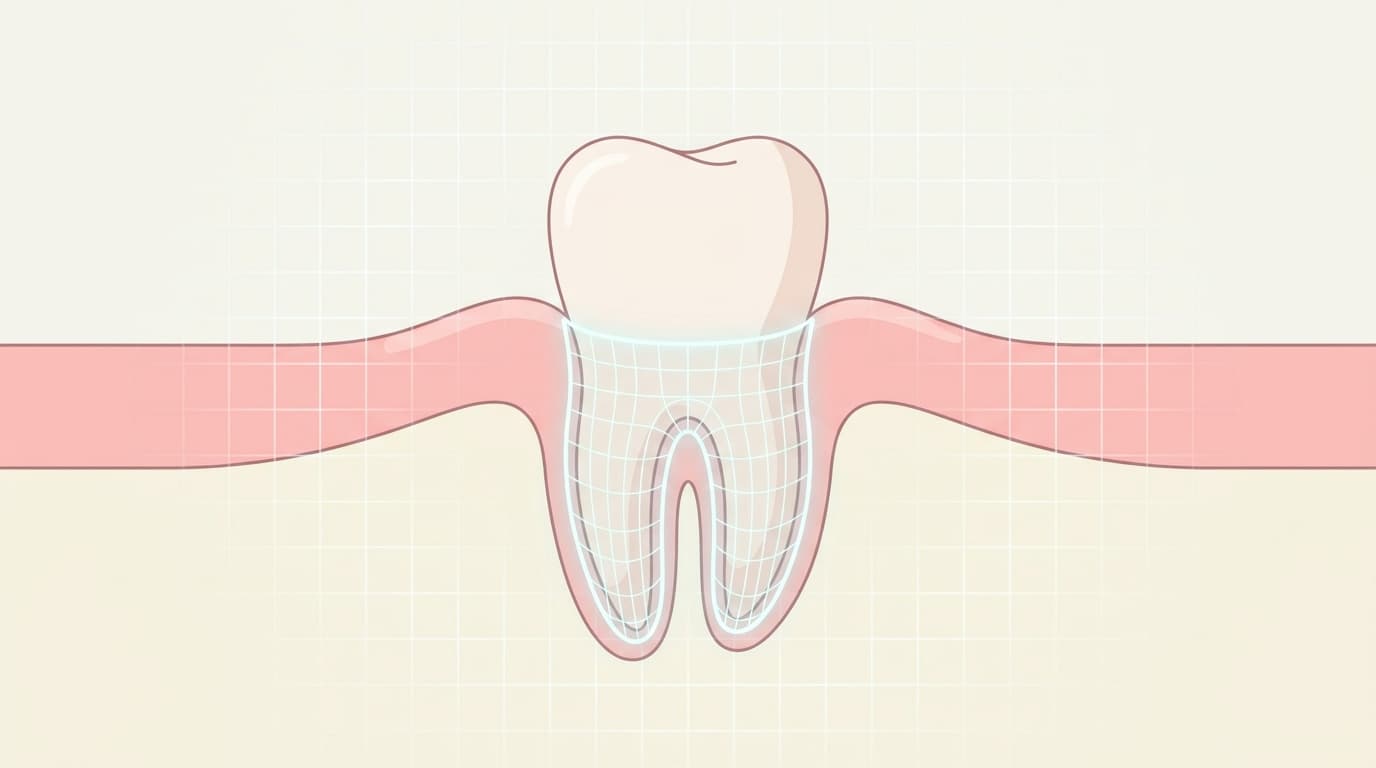
Tooth autotransplantation, moving a spare tooth such as a wisdom tooth into another socket, has long relied on the operator's hand feel. A research team at Magna Graecia University in Italy recently published 18-month follow-up results for 10 patients whose sockets were designed in advance using CBCT (dental 3D X-ray) and an intraoral scanner, with the tooth transplanted through a 3D-printed guide. The gap between the planned position and the actual transplanted position stayed within about 2mm. Around the same time, a Chinese research team published experimental results in which a robot cut the socket directly to match the root shape.
Filling a Molar's Place with a Wisdom Tooth: Tooth Autotransplantation
Tooth autotransplantation extracts a still-usable tooth, such as a wisdom tooth, and transplants it into the site of another tooth that has been lost. It can be considered instead of an implant or prosthesis when a tooth is congenitally missing or lost to trauma, decay, or a failed root canal treatment. Because the periodontal ligament (the fibrous tissue connecting the tooth to the jawbone) is kept intact during the move, the sense of chewing remains, and in young patients whose jawbone is still growing, the bone grows along with it.
The problem is accuracy. The new socket must match the exact shape of the tooth's root, and every tooth's root curves and branches differently. Traditionally, the operator hand-shaped the socket by repeatedly inserting and removing the tooth or a model, and the longer this took, the longer the periodontal ligament cells wrapped around the root stayed outside the mouth, raising the risk that the cells would die. If the periodontal ligament dies, the root fuses directly to the jawbone, a condition called root ankylosis, which leaves the transplanted tooth unable to move.
A Digitally Designed Socket: Accuracy Confirmed in 10 Patients
The research team overlaid CBCT and intraoral scanner data, color-coded the shape difference between the wisdom tooth and the tooth to be extracted, virtually simulated how much jawbone to remove, and then produced a 3D-printed guide and tooth model based on that plan. During surgery, they first used the model to confirm that the socket matched the root shape before transplanting the tooth.
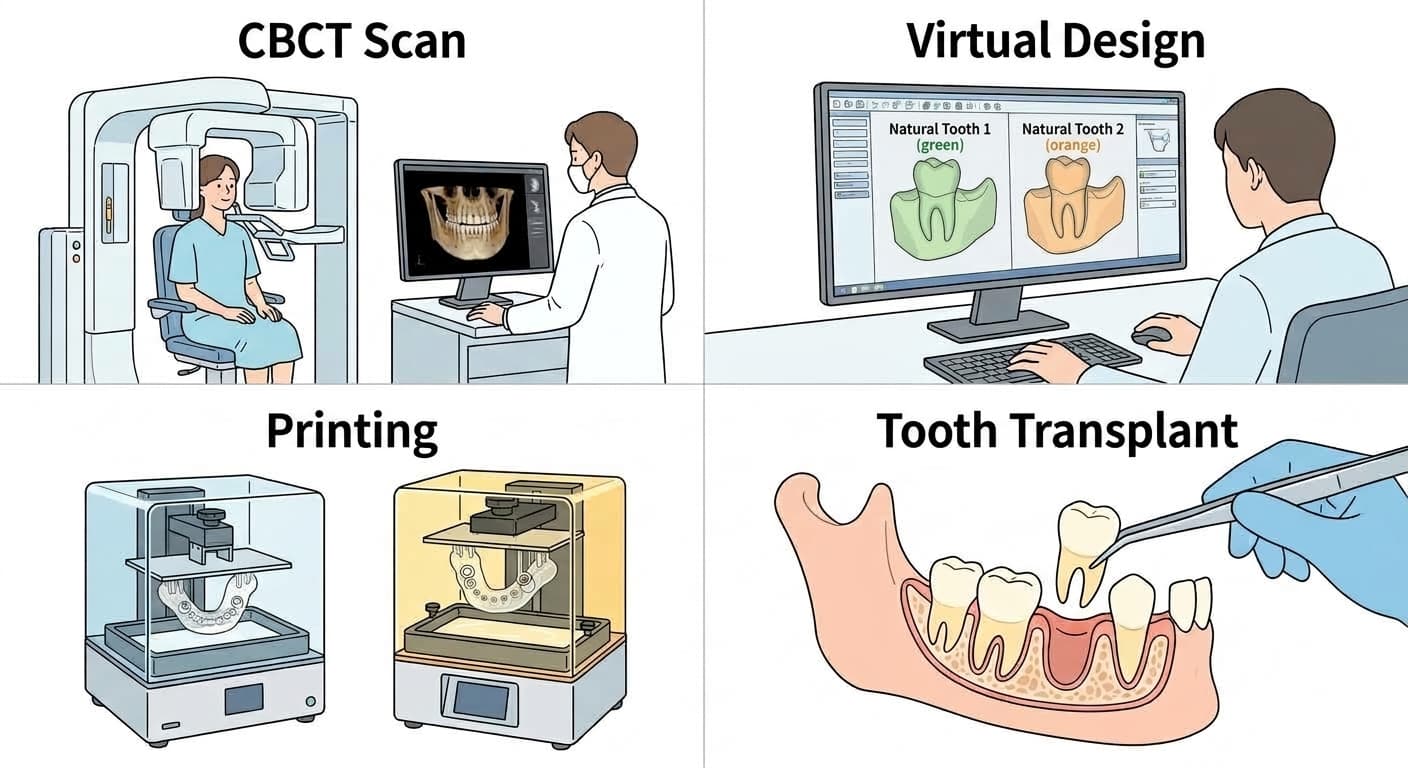
The method was applied to 10 patients in total, 4 with a single-rooted wisdom tooth and 6 with a multi-rooted wisdom tooth. The gap between the planned position and the actual position confirmed by post-operative CBCT was only 0.63mm at the tooth surface and 0.17mm at the jawbone surface. The positional difference was 2.04mm at the crown and 1.36mm at the root tip, and the rotational deviation stayed within 3 degrees. Eighteen months later, all 10 transplanted teeth were stable with no mobility, the gum condition was normal, and there was no sign of root resorption. However, 2 patients showed a lesion at the root tip and received root canal treatment after the transplant.
The research team identified keeping the gap between the root and the socket wall at 0.2 to 0.5mm as the key factor. A gap of this size has been reported to reduce the force placed on the periodontal ligament, lowering early resorption. Conversely, they noted that leaving too much jawbone between the tooth roots or a socket size that does not match leads to root ankylosis or delayed healing.
Guides and Custom Drills: How Do They Compare to Hand-Shaping?
A Chinese research team compared 90 3D-printed models divided into three groups: hand-shaping, using a guide, and using a custom drill made to match the root shape. The time needed to prepare one socket was 12.2 minutes for hand-shaping, 5.3 minutes for the guide, and 3.7 minutes for the custom drill. The gap between the root and the socket wall was also largest with hand-shaping at 1.75mm, narrowing to 0.94mm with the guide and 0.58mm with the custom drill.
The Next Step: A Robot Cuts the Socket to Match the Root Shape
Another Chinese research team published an experiment in which a robot directly moved a bur (a dental drill tip) to cut the socket, comparing socket accuracy between the robot and a conventional guide using 40 3D-printed lower jaw models. Accuracy at the entrance was similar between the two methods, but the gap widened toward the root tip. For multi-rooted teeth, the root-tip error was 0.85mm with the robot method versus 2.38mm with the guide method, a large gap; for single-rooted teeth the gap was smaller, at 1.03mm versus 1.53mm. Regardless of the number of roots, the proportion of jawbone cut away beyond the plan was 7.9% for the robot method and 96.0% for the guide method.
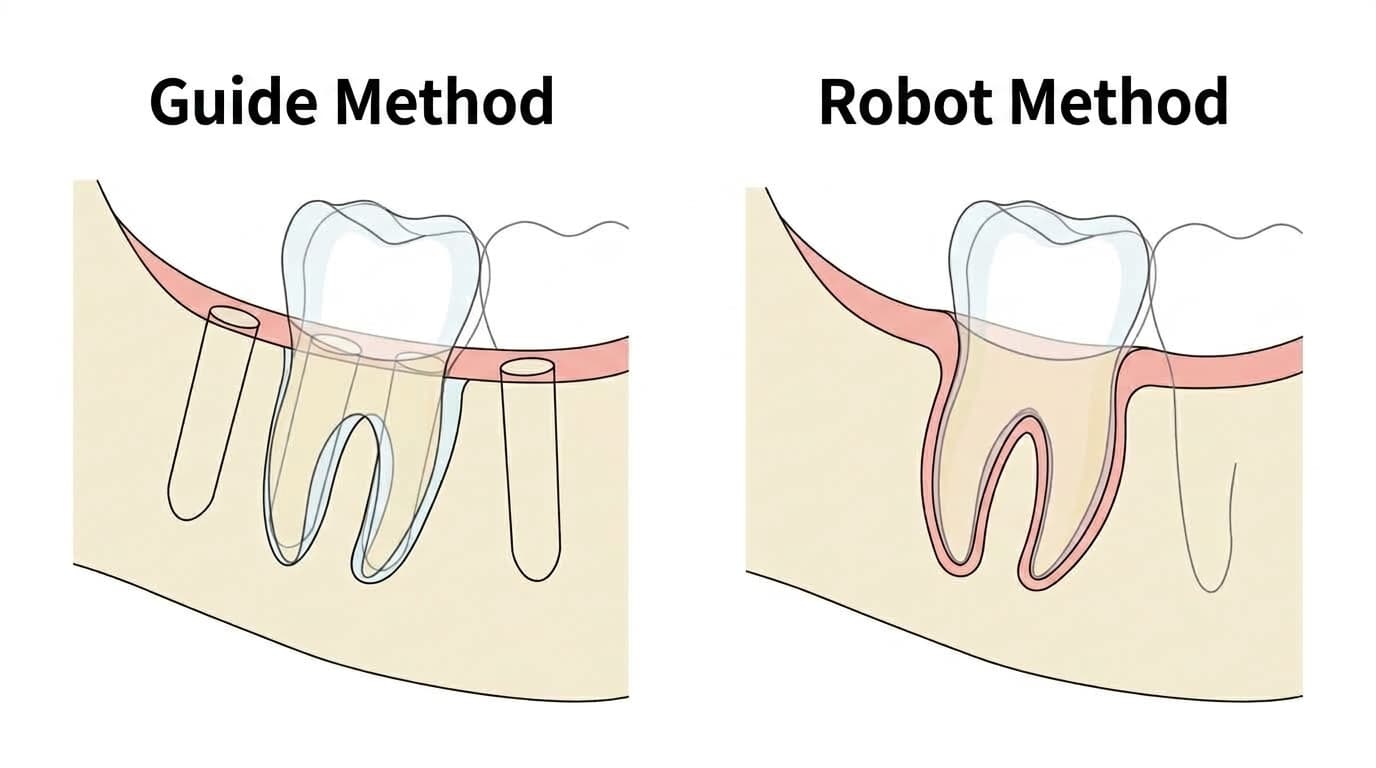
A guide drills straight in the direction set at the entrance and the rest must be widened by hand, so error accumulates toward the root tip; a robot, by contrast, follows a pre-calculated curved path all the way through. This is still an experimental stage tested on 3D-printed models, but the robot's advantage grew larger for teeth with multiple roots.
Tooth autotransplantation, once dependent on the operator's hand feel, has narrowed the gap between plan and outcome to about 2mm through a digital workflow that designs the socket in advance and cuts it exactly as planned. New experimental results suggest that adding a robot can narrow that gap even further, even for teeth with complex roots.