
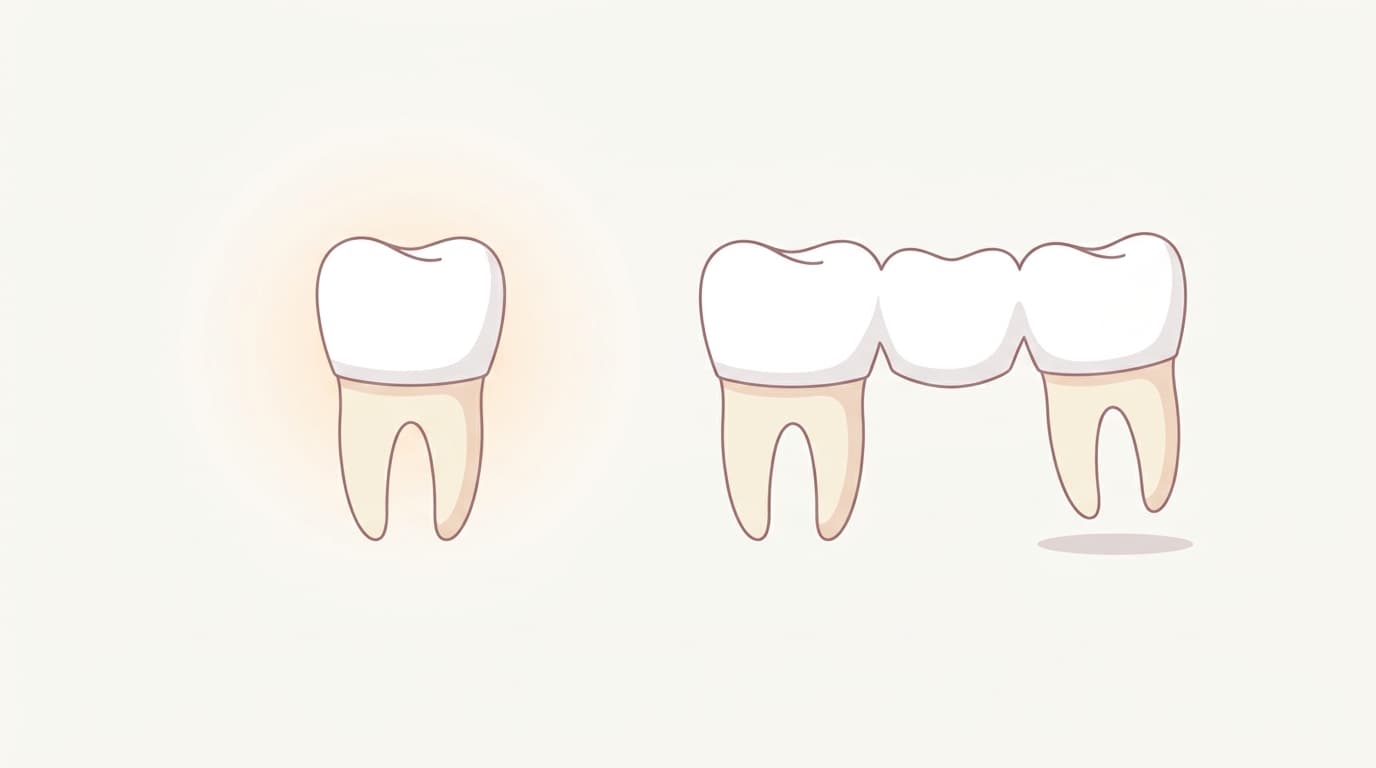
Crowns Lasted Long, but Bridges Did Not
A new review pooling 66 studies published between 2008 and 2025 examined how long zirconia dental restorations actually last in practice. Looking at single crowns placed over a natural tooth, results were strong: 92.9–98.7% remained in the mouth at 10 years. However, this figure only means the restoration "held on without falling out", not that it had "no problems at all." When looking at the rate of restorations that lasted with absolutely no complications at all, not even minor ones like chipping or re-cementation, crowns dropped to 46.1% at 10 years, with mechanical problems such as surface chipping or delamination being the most common, at 53.9%.
When it comes to bridges that fill a gap left by a missing tooth, the differences become much larger.
| Restoration Type | Survival Rate | Complication-Free Rate |
|---|---|---|
| Crown (single natural tooth) | 92.9–98.7% (10 yr) | 46.1% (10 yr) |
| Bridge (both-side abutment support, 10–13 yr) | 77.6% | 40.1% |
| Bridge (single-abutment support, 9–13 yr) | 50.0–52.6% | 12.5–22.6% |
| Adhesive bridge (Maryland bridge, 10–15 yr) | 97.4% | 84.3% |
| Inlay-retained bridge (10 yr) | 89.0% | 70.3% |
Even with the same zirconia material, survival rates varied by as much as 47 percentage points depending on whether the restoration was a crown or a bridge, and if a bridge, which design was used.
Why Did Bridges Show Such a Large Difference?
When placing a bridge over a single missing tooth, the extent of tooth reduction and the direction in which forces are applied differ by design. When both adjacent teeth are used as abutments, chewing forces are distributed across two points, but when only one tooth serves as the abutment, force concentrates on that single tooth and acts like a lever, making the bonded surface prone to detaching or the abutment tooth itself prone to damage. In fact, this design showed biological complications (such as damage to the abutment tooth) in 50.0% of cases and mechanical complications such as chipping in 37.5%.
By contrast, the design that bonds a wing-shaped zirconia framework to the back of adjacent teeth with minimal tooth reduction (commonly known as a Maryland bridge) actually performed best. This is thought to be because there is little tooth structure at risk of damage to begin with, and forces are distributed across the entire bonded surface. However, this design is mainly used in low-force areas such as front teeth and is rarely used in high-force areas such as molars.
Bonding Method Alone Changed Survival Rates
Even with the same zirconia restoration, outcomes differed depending on how it was bonded to the tooth. When the surface was roughened by blasting it with fine particles and then bonded using MDP (an adhesive component that chemically links zirconia to the tooth), crown survival and complication-free rates rose to 98.6% and 97.7%, respectively. Inlay-retained bridges also improved with this treatment, reaching a 98.1% survival rate and a 70.1% complication-free rate. Because this treatment takes place during the clinical procedure, patients cannot verify it visually, but it is clear that outcomes can differ greatly depending on the bonding method even with the same material. However, since follow-up periods and evaluation methods varied across the 66 studies, the overall certainty of this evidence was rated low.
Compared with the Older Metal-Ceramic Crown
Before zirconia crowns became established, metal-ceramic crowns (porcelain fused to a metal substructure) were the long-standing standard. A Canadian study that followed 403 patients for up to 7 years directly compared survival rates between crowns made of the two materials: 93.3% for zirconia and 90.1% for metal-ceramic, a difference that was not statistically significant. The most common cause of crown failure was also fracture of the tooth itself rather than a problem with the material.
For crowns alone, then, there is little meaningful difference between zirconia and metal-ceramic. What determined the longevity of zirconia restorations was not the type of material but whether it was a crown or a bridge, and if a bridge, which design and bonding method were used. The traditional bridge design that fills a single missing tooth using only one abutment tooth appears to warrant particularly cautious consideration compared with other alternatives.