

Question
A parent shares a concern after hearing at their child's regular checkup that the child has a supernumerary tooth (an extra tooth formed beyond the normal number). They want to know whether it needs to be extracted right away or whether it's fine to wait and observe.
Short Answer
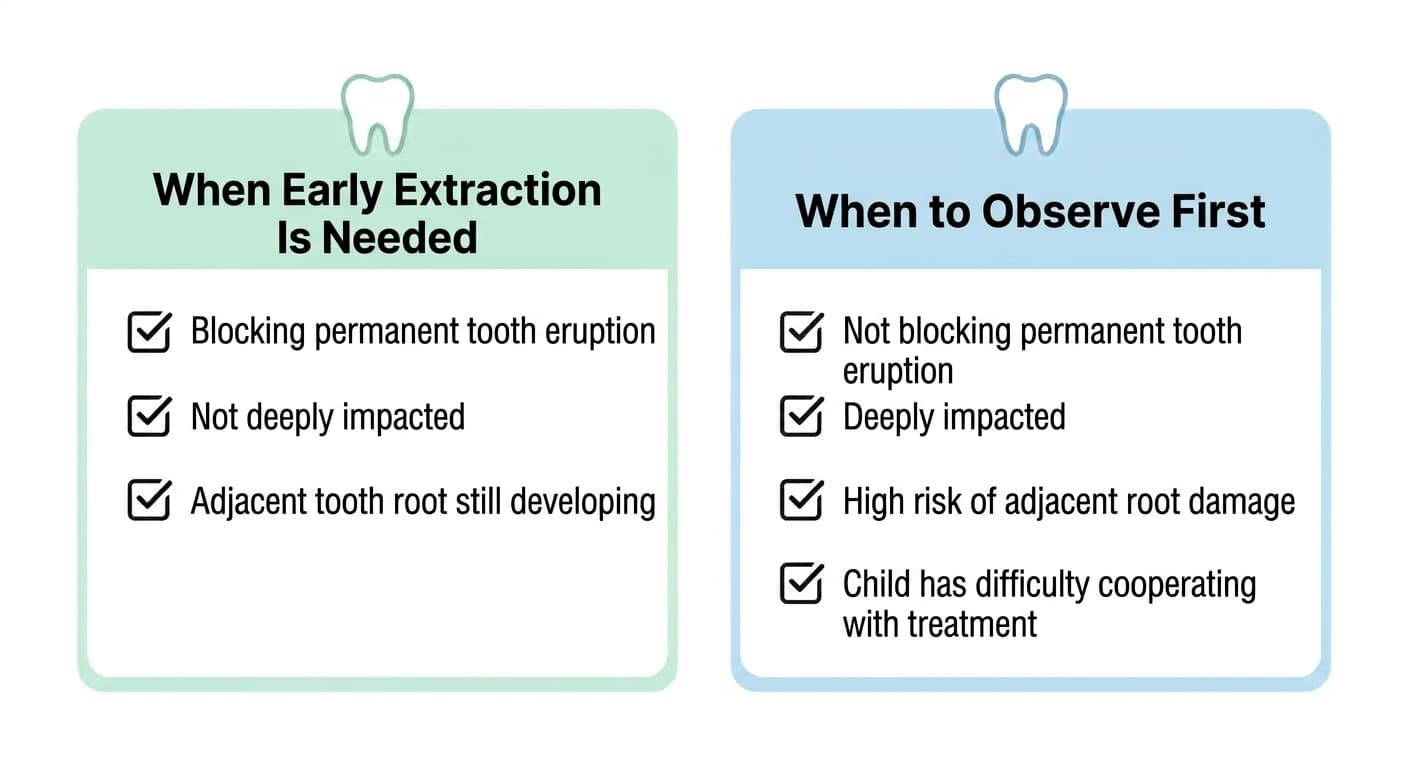
The general rule is to extract a supernumerary tooth as soon as it's found, but that doesn't mean every case leads straight to extraction. What decides the approach is whether the supernumerary tooth is already blocking the path (eruption) of a permanent tooth, and how great the risk is that extraction itself will damage the root of the neighboring permanent tooth. If it's already interfering with eruption, extracting it as soon as possible is the better choice. On the other hand, if the impaction isn't deep and the root of the neighboring permanent tooth hasn't finished developing, the tooth can be extracted and then monitored while waiting for the permanent tooth to erupt on its own. If the impaction is deep or the child has difficulty cooperating with treatment, the dentist may instead take periodic X-rays to track the situation before deciding on timing.
Why Is That?
Where and how does a supernumerary tooth form?
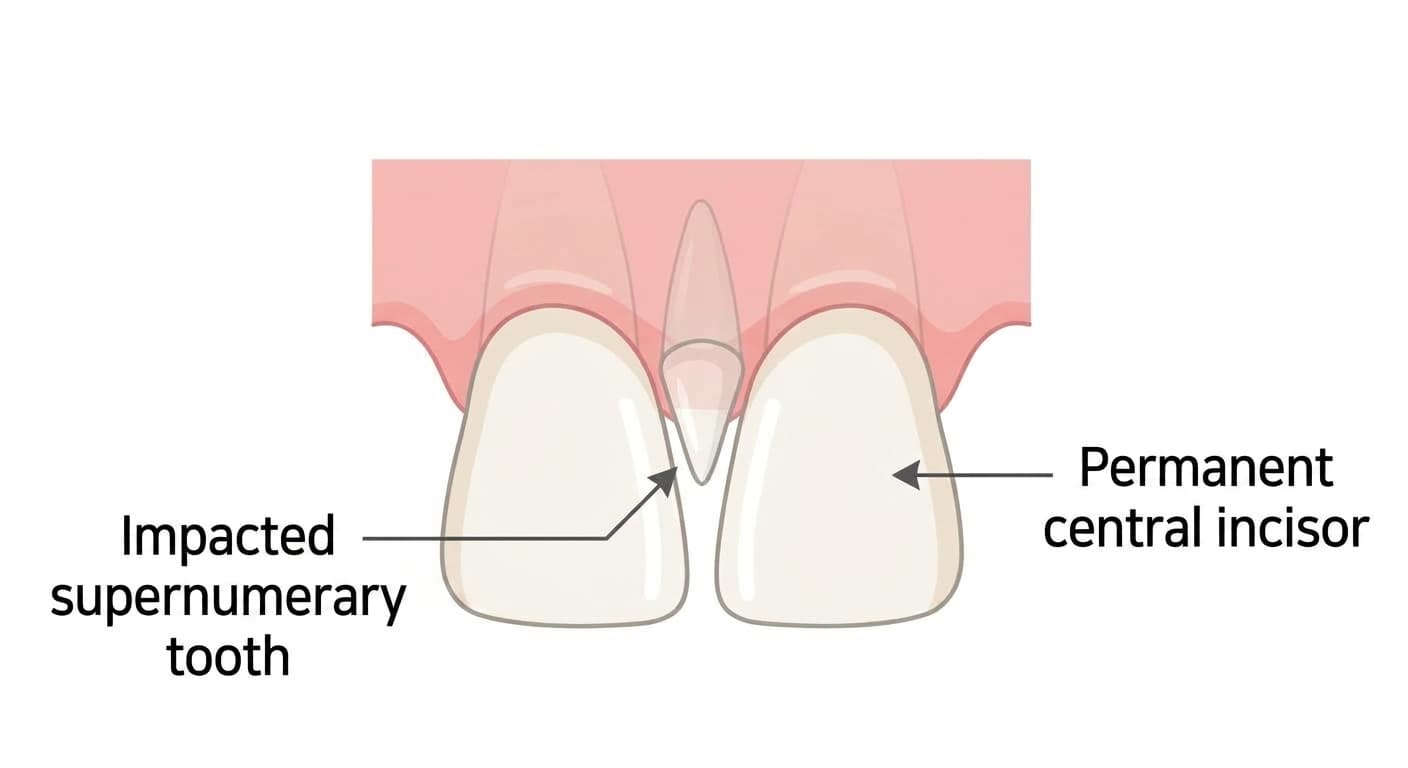
A supernumerary tooth is an extra tooth that forms beyond the normal number of teeth. Among these, one that forms between the two upper front teeth (maxillary central incisors) is called a mesiodens, and it is the most common type of supernumerary tooth. During the primary tooth stage it appears in fewer than 1 in 100 children (0.3-0.8%), but during the permanent tooth stage that rises to 1.0-3.5%, and it appears 2 to 4 times more often in boys than in girls.
More than nine out of ten mesiodens are found in the upper jaw, and most are small with a pointed, cone-like shape. More than three-quarters remain buried in the bone without having erupted through the gum, and of those, roughly two-thirds are inverted, with the root pointing upward. Most are positioned toward the palate. Because the position and orientation vary so much from case to case, how difficult it is to extract a mesiodens and how much it affects neighboring teeth differs from child to child.
What problems can arise if it's left alone?
A mesiodens can cause a gap between the front teeth or an eruption disturbance that keeps a neighboring permanent tooth from coming in on time. If it's left in place for a long time without being extracted, a dentigerous cyst, a fluid-filled lesion, can grow around it. Cases have also been reported where it presses on and resorbs the root of a neighboring permanent tooth. These are the reasons dentists generally recommend extracting a mesiodens early once it's found.
So why do dentists sometimes wait instead of extracting right away?
The problem is that extraction itself can injure the root (tooth germ) of the neighboring permanent tooth. Especially at a young age, when the root of the neighboring permanent tooth hasn't fully developed yet, there's a risk of touching that root during surgery, so dentists don't rush into it without care. On top of that, if the child is young or has trouble sitting still and cooperating in the dental chair (a behavior management issue), that's also factored into deciding the timing of surgery. So even when a mesiodens is found, if it's judged to already be blocking permanent tooth eruption, it's extracted early; but if the risk of damaging the neighboring permanent tooth's root is judged to be high, the dentist observes it periodically for a while before deciding on the timing of surgery.
In practice, here's how the decision plays out
If the impaction isn't deep and the root of the neighboring permanent front tooth is still developing, dentists extract only the supernumerary tooth first, open up space for eruption, and then observe. Cases have been reported where the permanent tooth then found its own way into position. On the other hand, if a mesiodens is present but isn't blocking the permanent front tooth's eruption and isn't causing a gap between the front teeth, it may be possible to skip surgery altogether and manage the spacing with orthodontic treatment alone while observing. If it has already progressed to the point of blocking the eruption of another permanent tooth (a canine, for example), treatment may need to include a space maintainer or orthodontic force to pull the tooth down after the supernumerary tooth is extracted. The criteria for evaluating a permanent tooth that hasn't erupted long after a baby tooth falls out is worth reviewing in a similar context.
When do you need to see the exact position?
Exactly where a supernumerary tooth is located, which direction it's facing, and how close it is to the neighboring permanent tooth's root can be seen in more detail with CBCT (cone-beam computed tomography), a 3D imaging device. However, because a child's still-developing tissue is more sensitive to radiation and the distance to the reproductive organs is shorter, the principle of using only as much radiation exposure as necessary (ALARA) must be followed. So CBCT is used selectively, only when standard radiographs aren't enough to judge the position and orientation, or when 3D information is judged necessary for surgical planning; it isn't a test every child needs.
If extraction is decided, how does it proceed?
Since most mesiodens are located toward the palate, that's the side from which the dentist approaches. After lifting the gum (a full-thickness flap), the dentist trims away only as much of the covering bone as needed, then removes the supernumerary tooth together with the sac surrounding it (the dental follicle). If the follicle is left behind, it can later develop into a cyst, so removing it completely is the standard approach.