
Question
A patient is considering a procedure to close a gap between their upper two front teeth using composite resin (a tooth-colored, adhesive filling material). Having heard that the procedure bonds the material on without cutting the tooth down, the patient wonders whether resin attached this way will easily come off or crack over time.
Short Answer
Filling the gap between front teeth (diastema, a state where the teeth do not touch and a space remains) with composite resin is a restoration that bonds the material onto the tooth with almost no cutting of the tooth. When bonding is done well, it stays in place for a long time, but unlike a typical filling that is placed into a drilled-out hole, this method does not have walls surrounding it to hold it in place mechanically, so retention depends heavily on the bond itself. This means that if strong force repeatedly concentrates on one point of the restored area, the bonded margin may not hold up and the resin can come off or crack. Whether this restoration comes off easily depends less on the material itself and more on how much force concentrates on that spot, and how often.
Why Is That?
Diastema Closure Adds Material to the Tooth Instead of Cutting It Down
A diastema is a state in which there is no contact point between teeth and a gap remains, commonly seen between the maxillary central incisors (the two front teeth in the upper jaw). Causes vary and include a thick labial frenum (the tendon-like tissue connecting the upper lip and gum), mismatched tooth sizes, supernumerary teeth, and a tongue-thrusting habit.
The resin-bonding procedure begins by measuring the width of the gap with calipers and isolating the site with cotton rolls and retraction cord (a thread that gently widens the gum crevice to create working space). Next, the tooth surface is roughened with acid etching, followed by application of adhesive and placement of the resin. If the space to be filled is not large, a direct technique is used, building up flowable resin directly while gently pulling a thin matrix strip to compensate for the tiny gap (about 80 micrometers) created by the strip's thickness. If the space is larger or spans multiple teeth, a pre-made mold (a silicone index) or a thin film together with a temporary restorative material is used to transfer the ideal shape. Because bonding both teeth at the same time risks fusing them together, one side is completed and finished first before the other side is bonded. When the gap exceeds 2.5mm, rather than closing it with resin alone, orthodontic treatment to first move the teeth and divide the space is also considered, finishing only the remaining amount with resin. This reduces the amount of resin added to any one site.
The Bonded Area Is Small, So Retention Depends Heavily on Bond Strength
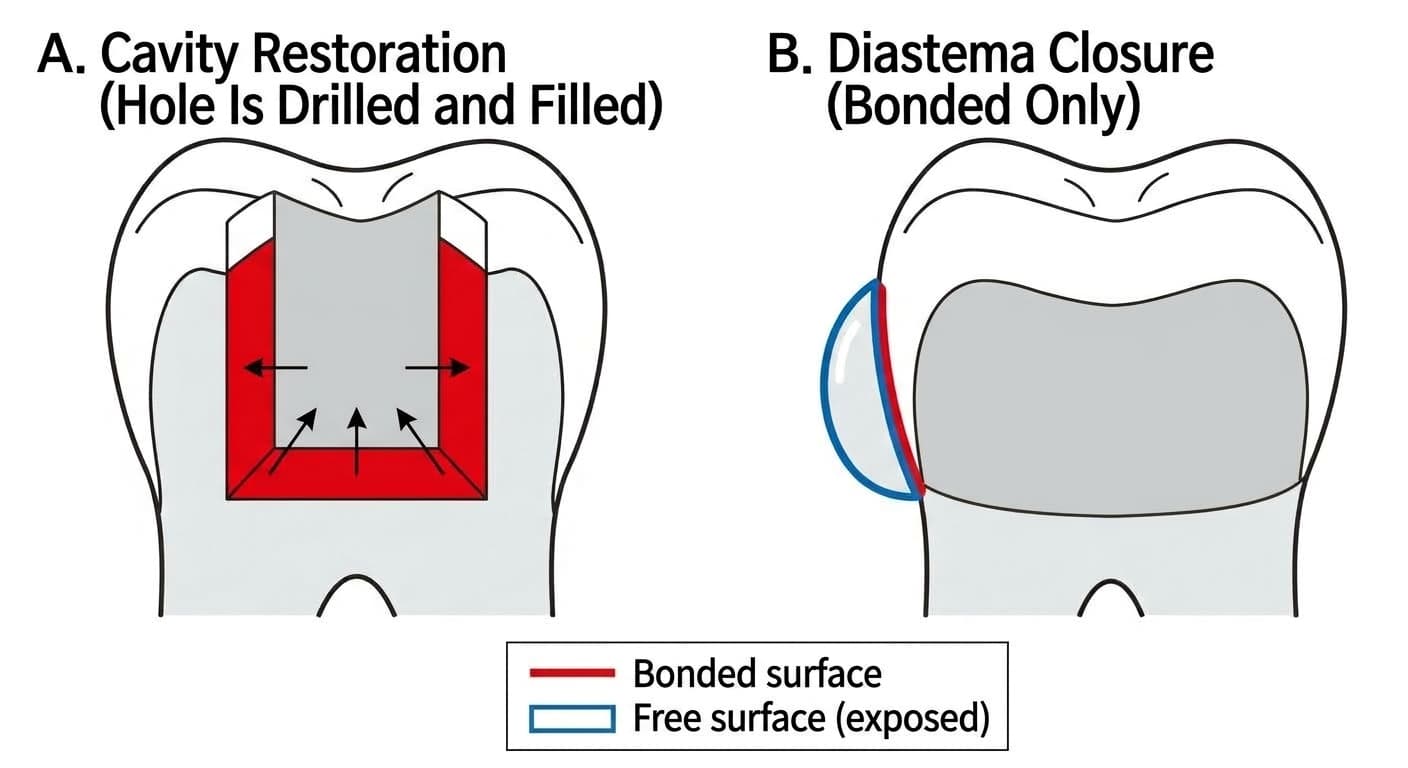
A typical filling restoration makes use of the cavity created by decay, so several walls surround the resin; even if bonding is somewhat weak, the physical grip of the surrounding walls remains. A diastema restoration, on the other hand, adds resin onto the surface of the tooth, so the surface where the resin and tooth meet (the bonded surface) is small, while most of the remaining outer surface is a free surface exposed to air. In a structure with a low ratio of bonded surface to free surface (C-factor), the burden that polymerization shrinkage (the resin's shrinkage as it hardens) places on the bonded margin is said to be smaller, but because there is no wall structure to grip onto in the first place, retention depends heavily on how strong the bond is.
When Force Concentrates at One Point, the Bonded Margin Weakens First
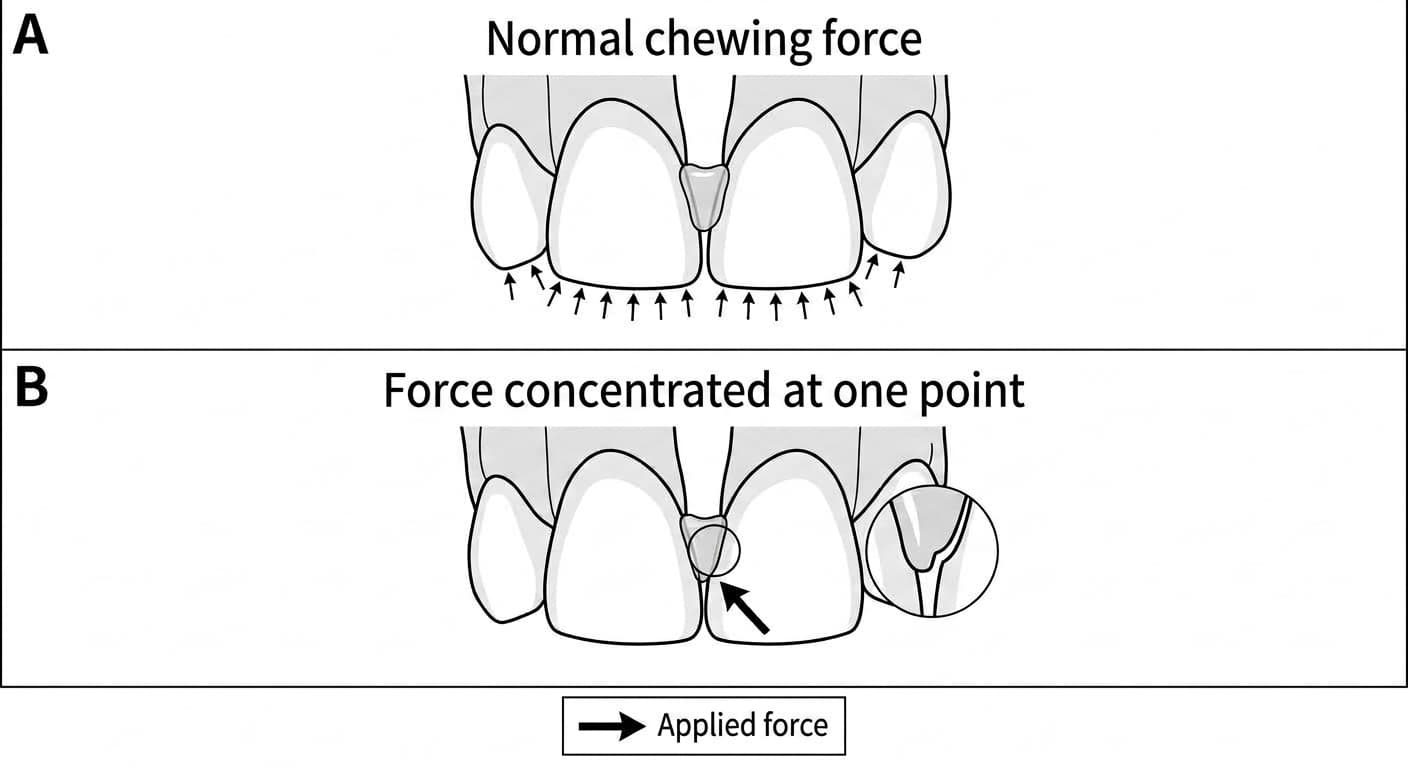
Textbooks list situations where strong occlusal force concentrates on one point, along with situations where moisture control cannot be achieved, as conditions that make the use of composite resin more burdensome. They also note that care is needed when forming a bevel (created at the enamel margin to widen the bonding area) on surfaces that directly bear occlusal force, such as the lingual surface or the labial interproximal space (the space at the front between teeth). Resin used to close a diastema overlaps in location with this labial interproximal space, so it can be said that the amount of force applied at that spot may affect retention.
Front teeth normally bear only the force of biting into food, but the situation is different when force concentrates at one point, such as biting through something hard with the front teeth. If such force is repeatedly placed on the boundary between the resin and the tooth, the bond can gradually open up or the edge of the resin can crack. Conversely, in ordinary chewing habits where force is spread broadly, the burden placed on the bonded margin is much smaller. The same principle explains why, even after a broken front tooth is restored with resin, avoiding habits that concentrate force at one point is what allows it to last longer.