
Question
My front tooth was chipped in a collision, and I had it repaired with composite resin (an adhesive filling material made to match the tooth's color). What should I be careful about in daily life to keep this restoration lasting?
Short Answer
How long a resin-restored front tooth lasts depends on two things: avoiding habits that concentrate force on one point of that area, and getting the pulp (nerve) checked at the dentist at set intervals, regardless of how the tooth looks. Resin is a bonded material, so it is vulnerable when force concentrates on a single spot, and because this tooth has been through trauma, a problem can surface later even if it looks fine right now. A small surface flaw or color change does not necessarily mean the whole restoration needs to be redone; often only that spot needs a localized repair.
Why Is That?
When force concentrates on one point, the resin margin weakens first
Composite resin is bonded by lightly etching the tooth surface with acid (acid etching), applying an adhesive, then curing it with light. This method bonds well enough to be used on most tooth surfaces, but the curing process causes polymerization shrinkage, which reduces the material's volume as it sets and leaves stress at the bonded margin. If a strong force then concentrates on a single point on top of that, the margin can open up or develop micro-fractures. This is significant enough that textbooks list situations where moisture control cannot be maintained, together with situations where strong occlusal force concentrates on one spot, as conditions burdensome enough to make using this material contraindicated. They explain that the effect is even greater in areas that must bear force over a wide surface, such as cuspal restorations covering an entire chewing surface.
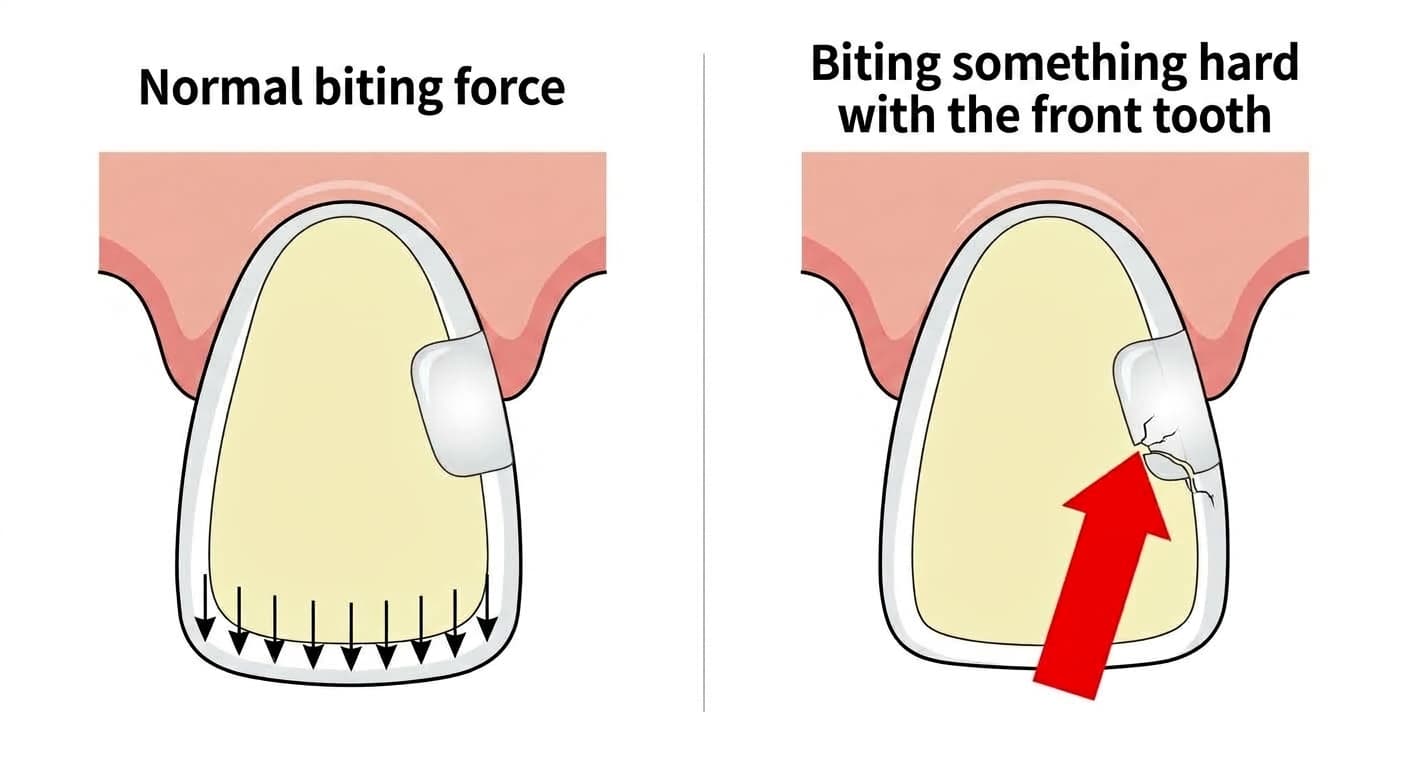
A front tooth normally only bears the force needed to cut or bite off food, but the situation is different when force concentrates momentarily on one point, such as biting down on something hard with the edge of the front tooth, clenching, or grinding habits like bruxism. If this happens repeatedly, the localized impact adds to the stress already remaining at the bonded margin, raising the risk that the resin will crack or a gap will open. Right after treatment, you should also check that the resin does not contact the opposing tooth before other teeth when you bite down, and if a resin filling makes first contact and hurts when you chew, occlusal adjustment can relieve the load at that spot.
Because this tooth has been through trauma, regular checkups must keep confirming pulp status
Whether the current resin restoration was a reattachment of a broken-off fragment or a fresh resin filling, both are the result of bonding with acid etching and adhesive technique. And because this tooth has been injured by impact before, finishing the restoration does not mean the monitoring is over.
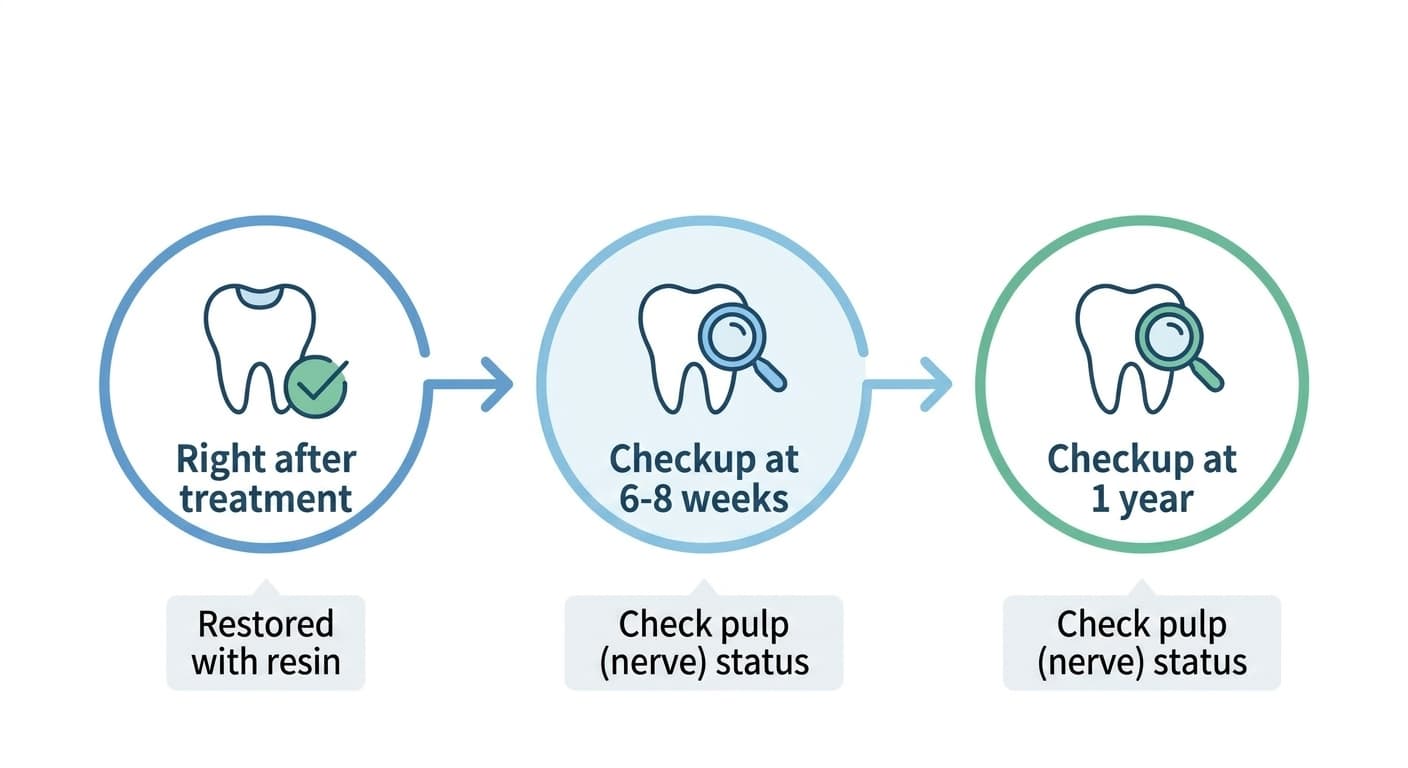
When the fracture is limited to the enamel, percussion testing (tapping) and pulp response tests generally come back normal, and the prognosis tends to be good. Even so, because a traumatized tooth's outcome is unpredictable and problems can appear only after time has passed, the rule is to have it checked again at 6-8 weeks, and then at 1 year if nothing seems wrong. In fact, a study that followed 32 teeth with fully formed roots for 10 years reported no cases of pulp death during that period, suggesting that a mild enamel-only fracture generally has a reassuring course.
A fracture that reaches the dentin needs a bit more caution. Dentin contains microscopic tubules (dentinal tubules) leading toward the pulp, so once this layer is exposed, it creates a pathway for bacteria to invade and can trigger inflammation in the pulp. Even if the pulp responded normally as alive at the first exam, it can die off gradually over time, so follow-up exams at 6-8 weeks and 1 year, plus periodic pulp response tests in between, are essential. What matters here is that pulp death does not necessarily come with pain. In fact, there are cases where the absence of pain leads people to assume everything is fine, only for pulp necrosis to be discovered later at a checkup; in that case, root canal treatment is considered right away.
Whether your tooth's fracture was limited to enamel or reached the dentin, and therefore how often you need checkups, depends on the diagnosis made by the dentist who performed the initial treatment. Even with no particular symptoms, visiting at the recommended times to have the pulp status checked is the single most important habit for keeping this tooth working for a long time.
Even a small surface problem often does not require redoing the whole restoration
For a localized defect, such as a slight opening at the edge of the resin restoration or a small chip on the surface, there is a repair method: roughen just that surface with a diamond bur, then repeat acid etching, adhesive application, resin filling, and finishing. Regular checkups are also a chance to catch these defects before they become noticeable, so if you notice even a small change on the surface, it is best to let your dentist know rather than waiting for the next scheduled visit.