Question
One side of the gum has become swollen and bulging, with what looks like a bump filled with pus. When something like this appears on the gum, periodontitis (an inflammatory disease affecting the gum tissue and the bone that supports the teeth) is usually the first thing that comes to mind. The question is whether this kind of pus-filled bump only forms in people who actually have periodontitis, or whether it can form for other reasons as well.
Short Answer
A pus-filled bump on the gum can occur with periodontitis, but it is also common for one to form independently of periodontitis, when the tooth's nerve (pulp) dies from decay or trauma. In both cases, the gum can bulge and swell, or pus can seep out through a small opening, so appearance or the location of the pus alone is not enough to tell them apart. Dentists check whether the tooth's nerve is still alive, tap or press on the tooth, and look at radiographs together to determine which is the cause. This distinction matters because the treatment differs: some cases resolve with gum treatment, while others require root canal treatment.
Why Is That?
In dentistry, a collection of pus in the gum or bone is called an abscess. Abscesses fall into two broad categories depending on where they originate, and the treatment needed differs accordingly.
A Bump That Starts in the Gum Itself
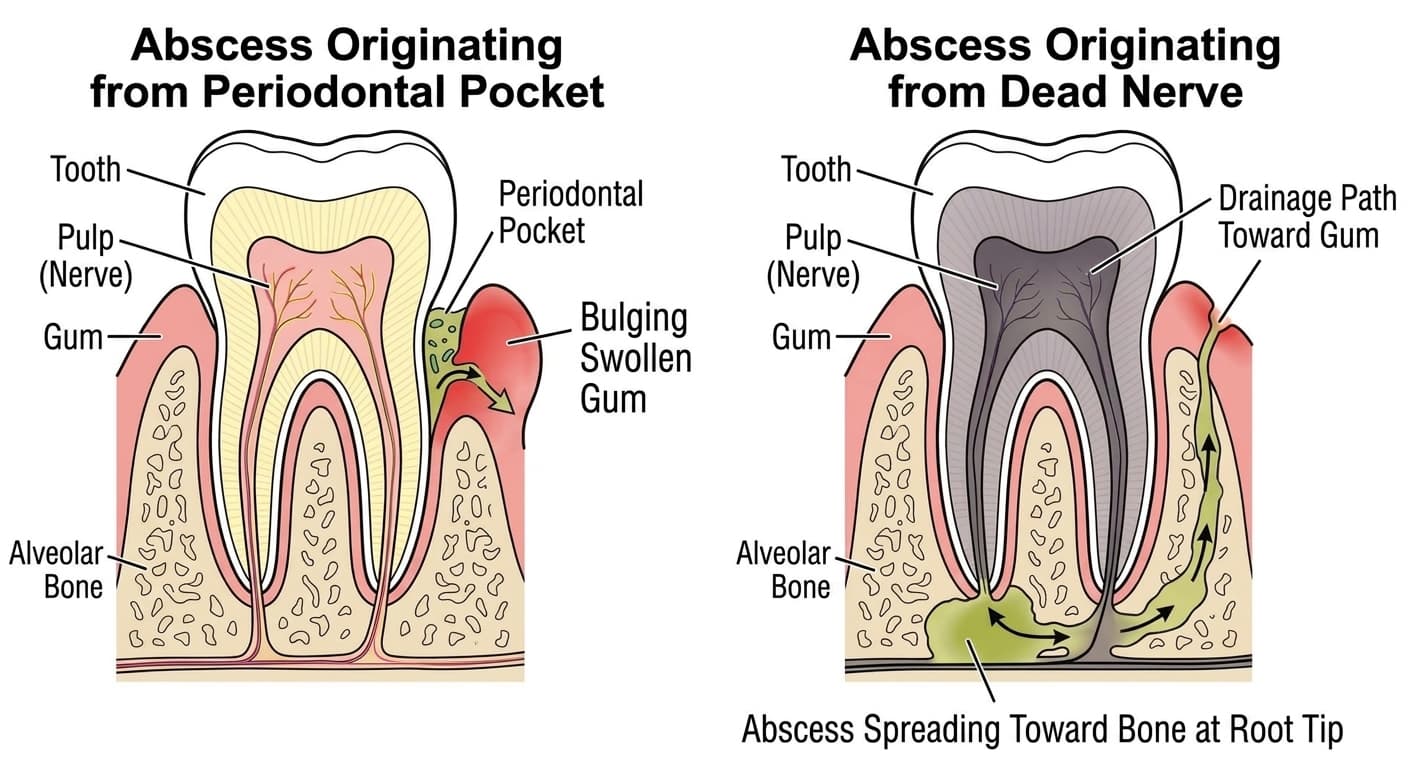
When tartar and bacteria build up in a periodontal pocket (a narrow, deep gap that forms between the tooth and the gum) and cause a purulent inflammation in the tissue supporting the gum, the result is an acute periodontal abscess. The swelling appears mainly midway between the gum margin and the root, not at the root tip, and pressing on it releases pus through the gum crevice. In this case the tooth's nerve is generally still alive, so pulp vitality testing shows a normal response, and there is no nerve-related cause such as decay. Instead, bone destruction extends broadly along the side of the root, and the periodontal pocket is found to be deep and wide. So in this case, symptoms resolve not with root canal treatment but with gum treatment that cleans out the pocket and removes tartar.
A Bump That Starts from a Dead Nerve
When the nerve (pulp) inside a tooth dies from decay or trauma, bacteria and their byproducts in the dead tissue can pass through the small opening at the root tip (the apical foramen) and spread into the bone surrounding the root. This inflammation of the tissue around the root tip is called apical periodontitis, and when it becomes an acute purulent inflammation, the result is an acute periapical abscess (also called an acute alveolar abscess). It can present with severe spontaneous pain, pain on tapping, a feeling that the tooth is raised or floating, tissue swelling, and sometimes systemic symptoms such as fever or chills. At this point the nerve is already dead, so pulp vitality testing shows no response, and radiographs show bone destruction around the root tip. Since the cause lies in the nerve, root canal treatment must remove the dead nerve tissue and bacteria before the swelling and pain will subside.
There are also cases that progress slowly without clear pain. A chronic periapical abscess may leave little pain at all, only an intermittent drainage path (a sinus tract) through which pus occasionally seeps. A sinus tract looks like a small pimple-like opening on the gum, and pressing on it may reveal a hint of pus.
Why Appearance Alone Cannot Determine the Cause
A sinus tract can appear as the same pimple-like opening on the gum whether it comes from chronic inflammation caused by a dead nerve or from a periodontal infection. It can even open at a spot on the gum or facial skin away from the source tooth, so the visible location may differ from the actual tooth or tissue responsible. For this reason, dentists sometimes thread a thin material that shows up clearly on radiographs into the opening and then take a radiograph to trace which tooth and which path the pus is actually coming from.
Both causes can also appear together in the same tooth: a nerve problem may develop first and spread toward the gum, a gum problem may develop first and spread to the nerve, or the two problems may start independently and later merge into one. These combined cases call for more careful treatment planning. Root canal treatment may need to be done first, followed by re-evaluation a few months later, with gum surgery added if still needed.
How Is It Actually Distinguished in Practice
Dentists don't rely on a single test but look at several together: a vitality test that stimulates the tooth to check whether the nerve is still alive, a test that taps the tooth lightly to check for inflammation in the tissue around the root, a test that presses with a finger to check for soft swelling, and radiographs that show the location of bone destruction and the depth of any periodontal pocket, all considered together to determine the cause. Only after this process can it be decided whether root canal treatment is needed or gum treatment alone will suffice, so it is difficult to conclude one way or the other just because a pus-filled bump is visible.