

Question
I had root canal treatment, and some teeth were finished in two visits, while for others I'm told I need to go back to the dentist several more times after the root canal treatment is done, just to get a crown or other restoration placed. I'm wondering whether it's okay for root canal treatment to be finished in just two visits, and on the other hand, whether needing several more visits for the restoration means the treatment is being needlessly drawn out.
Short Answer
How many visits root canal treatment takes depends on the condition of the pulp (the nerve tissue inside the tooth) and the anatomical characteristics of the root canals. If the pulp is still vital and the canal anatomy isn't complex, finishing in a single visit shows no difference in success rate or post-treatment pain compared to spreading treatment across multiple visits. Conversely, when the pulp has died and pain is severe, when the canal anatomy is complex, when there is acute inflammation that reacts strongly to percussion, or when it's a retreatment case, spreading treatment across multiple visits is recommended. And the final restorative visits that follow root canal treatment, such as fitting a crown, are a separate stage from the root canal treatment itself. There's no need to add that visit count to the number of root canal visits and judge it as too many.
Why Is That?
Cases That Can Be Completed in One Visit
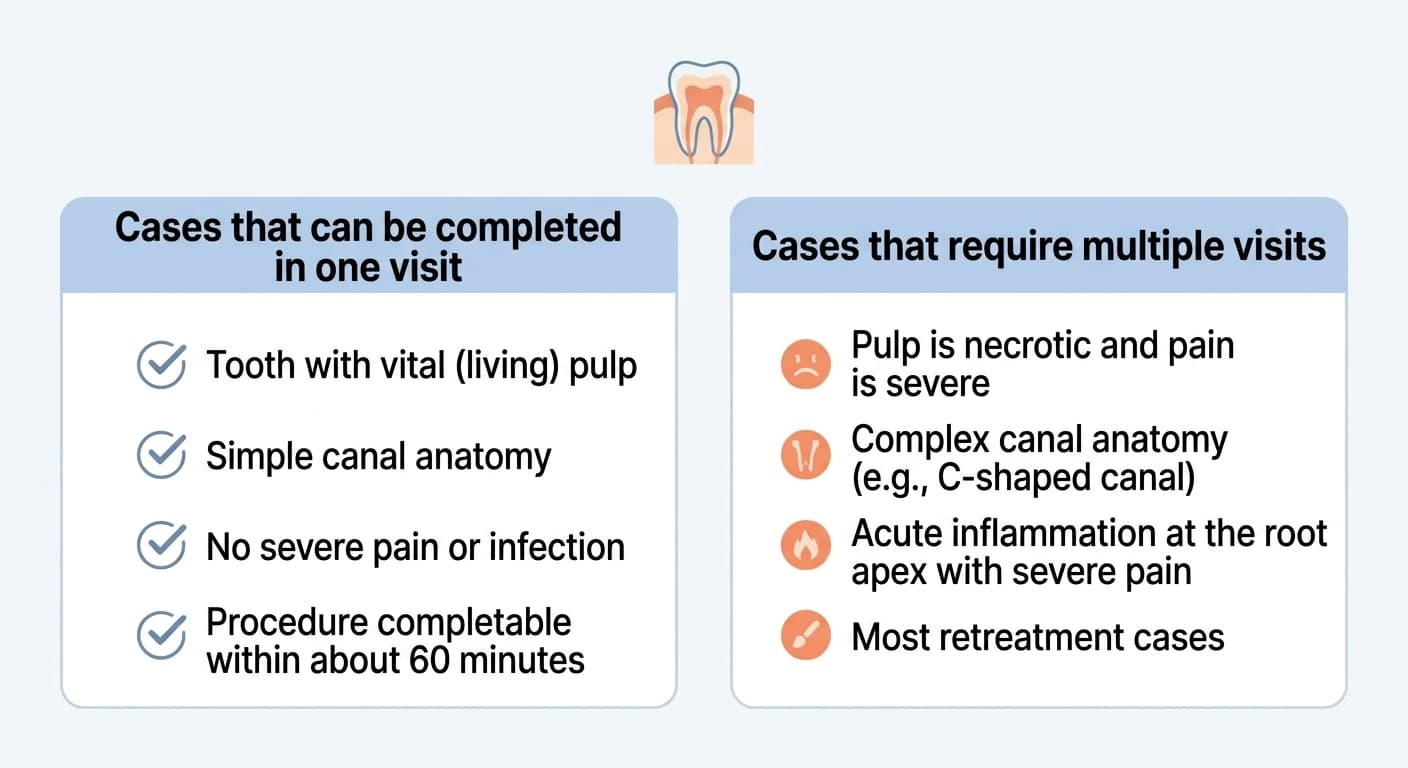
Completing canal shaping, cleaning, and filling all in a single visit is called single-visit root canal treatment. In teeth where the pulp is still vital, this approach shows no difference in success rate or post-treatment pain compared to root canal treatment (endodontic treatment) performed over multiple visits, and it also reduces the risk of bacteria re-entering through a temporary filling between visits. That said, this approach can only be carried out safely when the practitioner can complete everything from canal shaping to filling within about 60 minutes, so it is decided based on both the condition of the tooth and the difficulty of the procedure.
Cases That Require Multiple Visits
Even within the same root canal treatment, under the following conditions a single-visit approach is not recommended, and treatment is instead spread across multiple visits.
This applies when the pulp has already died and causes severe pain, when the canal anatomy is anatomically complex, when there is acute apical periodontitis that reacts strongly to percussion (the response to tapping on the tooth), or in most retreatment cases. A representative example of complex canal anatomy is the C-shaped canal often seen in mandibular second molars, where the internal structure branches into multiple channels or is discontinuous, making it difficult to fully remove tissue and bacteria in a single pass using instruments and irrigating solution alone.
Cases with acute apical periodontitis showing severe pain on percussion already involve acute inflammation in the tissue around the root tip, so it is considered difficult to fully eliminate the source of infection in a single visit, which is why these cases are excluded from single-visit root canal treatment. For infected canals or teeth with necrotic pulp, the traditional approach is to complete cleaning and canal shaping at the first visit, then fill the canal with a medication such as calcium hydroxide to allow a disinfection period before the next visit (multi-visit root canal treatment). Retreatment involves first removing the existing filling material or post before reshaping, cleaning, and refilling the canal, so the procedure itself has more steps, often requiring several visits.
During or after root canal treatment, the tissue at the root apex can become suddenly irritated, causing pain and swelling to worsen (occurring in 2-6% of cases, with some studies reporting over 20%), and one of the causes is substances produced by bacteria along with the body's immune response. Filling the canal with calcium hydroxide to allow a disinfection period is sometimes used as one way to reduce this risk.
Meanwhile, for elderly patients or those who have difficulty traveling, a single-visit approach may be considered first to reduce the number of visits. However, if the canals are calcified, the anatomy is complex, or existing restorations remain, and the procedure time becomes excessively long, it becomes a burden for both patient and practitioner. In such cases, the plan may shift instead to disinfecting the canal with calcium hydroxide midway through, sealing it securely with a temporary filling, and finishing at the next visit rather than forcing everything into one session.
The Restorative Visits After Root Canal Treatment Are a Separate Matter
Finishing the root canal treatment itself doesn't mean all treatment is complete. The root canal procedure alone doesn't significantly reduce a tooth's strength, but when a lot of tooth structure has been lost to decay or to creating access to the canals, the tooth's strength can be substantially reduced, requiring measures to prevent the crown portion from fracturing. That's why an immediate restoration is placed right after canal filling to prevent bacteria from re-entering, and for teeth that bear heavy chewing forces, such as molars, a restoration that covers the entire chewing surface is recommended as the approach that improves long-term success. Whether the remaining tooth structure calls for a resin restoration or a crown varies, and there's a separate article that covers when a crown is needed after root canal treatment in more detail.
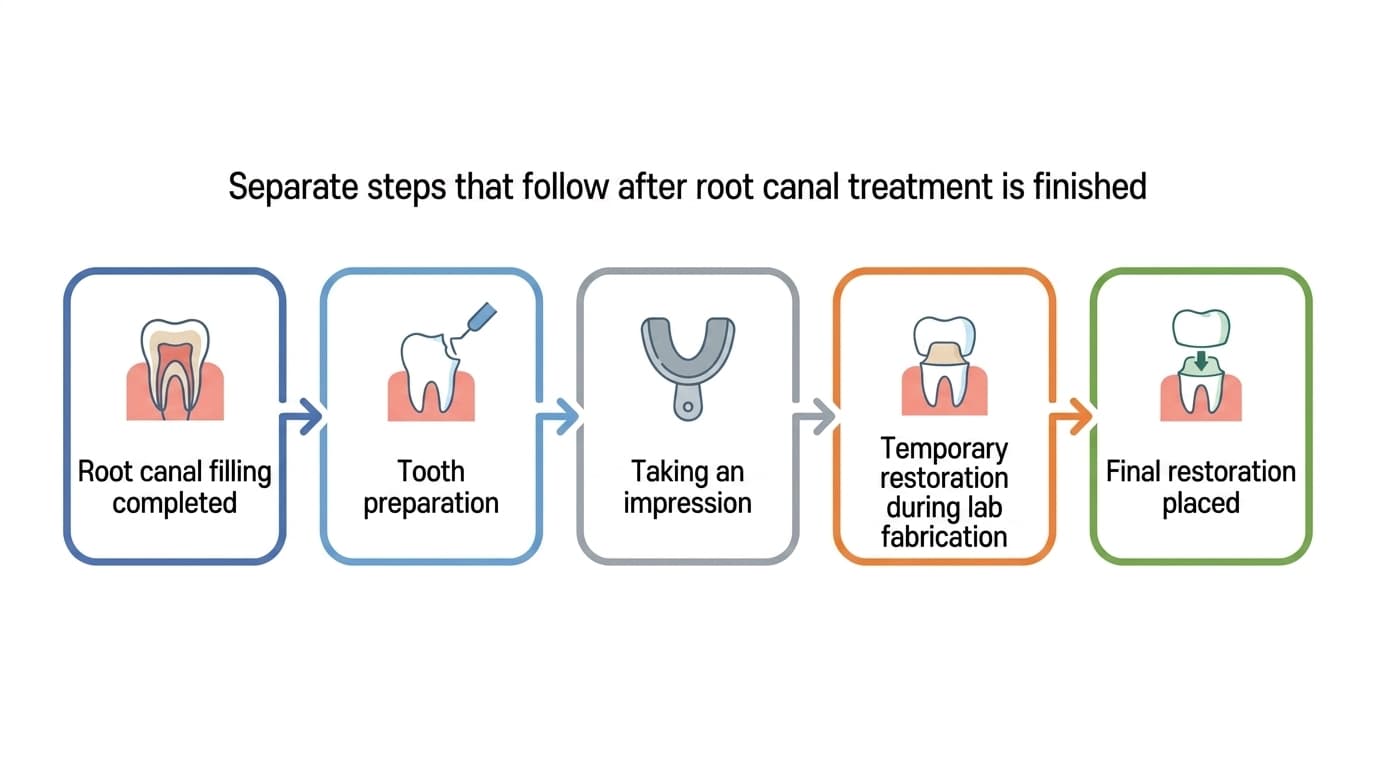
Restorations like crowns, which must be fabricated separately at a dental lab, begin with shaping the tooth and taking an impression. During the period until the restoration is finished, a temporary restoration is attached to protect the tooth and the tissue beneath it, and once fabrication is complete, the finished restoration is permanently placed. If this temporary restoration isn't properly secured, irritants and bacteria can pass through the gap and cause problems, so contacting the dentist right away rather than waiting until the next appointment if the temporary filling comes out is the safer choice. In other words, needing several visits at this stage isn't because the root canal treatment is being drawn out; it's because fabricating and fitting a restoration is inherently a multi-step process.
Ultimately, how many visits root canal treatment takes is determined by the condition of the pulp and the anatomical characteristics of the canals; the number itself doesn't indicate whether the treatment was done well or poorly. Root canal treatment finished in two visits can be entirely adequate treatment when the conditions call for it, and needing several more visits afterward for the restoration is a separate, normal process.