

Question
I've decided to get a dental implant, and the dentist mentioned I might also need a bone graft. Is a bone graft always necessary when getting an implant?
Short Answer
Getting an implant doesn't always mean a bone graft is required as well. An implant places an artificial tooth root into the alveolar bone (the jawbone that surrounds a tooth's root) at the site of a missing tooth, so if the bone at that site is thick and tall enough, the implant can proceed without any separate grafting. Conversely, if the bone is too thin or too short to leave enough room for the implant, or if part of the bone has already collapsed into a defect, that area needs to be built up first, or reinforced with a bone graft at the same time as the implant. Whether a graft is actually needed is decided only after assessing the bone condition at the implant site.
Why Is That?
Why bone quantity and shape are assessed before implant placement
An implant is a treatment that places an artificial tooth root into the bone and gum tissue at the site of a missing tooth, without cutting into neighboring teeth, and then attaches a tooth-shaped restoration on top. For the artificial root to stay stable and function properly, there must be enough alveolar bone and gum tissue to surround it. That's why, when planning an implant, the first step is to check how much bone remains at the site and in what shape it's deficient.
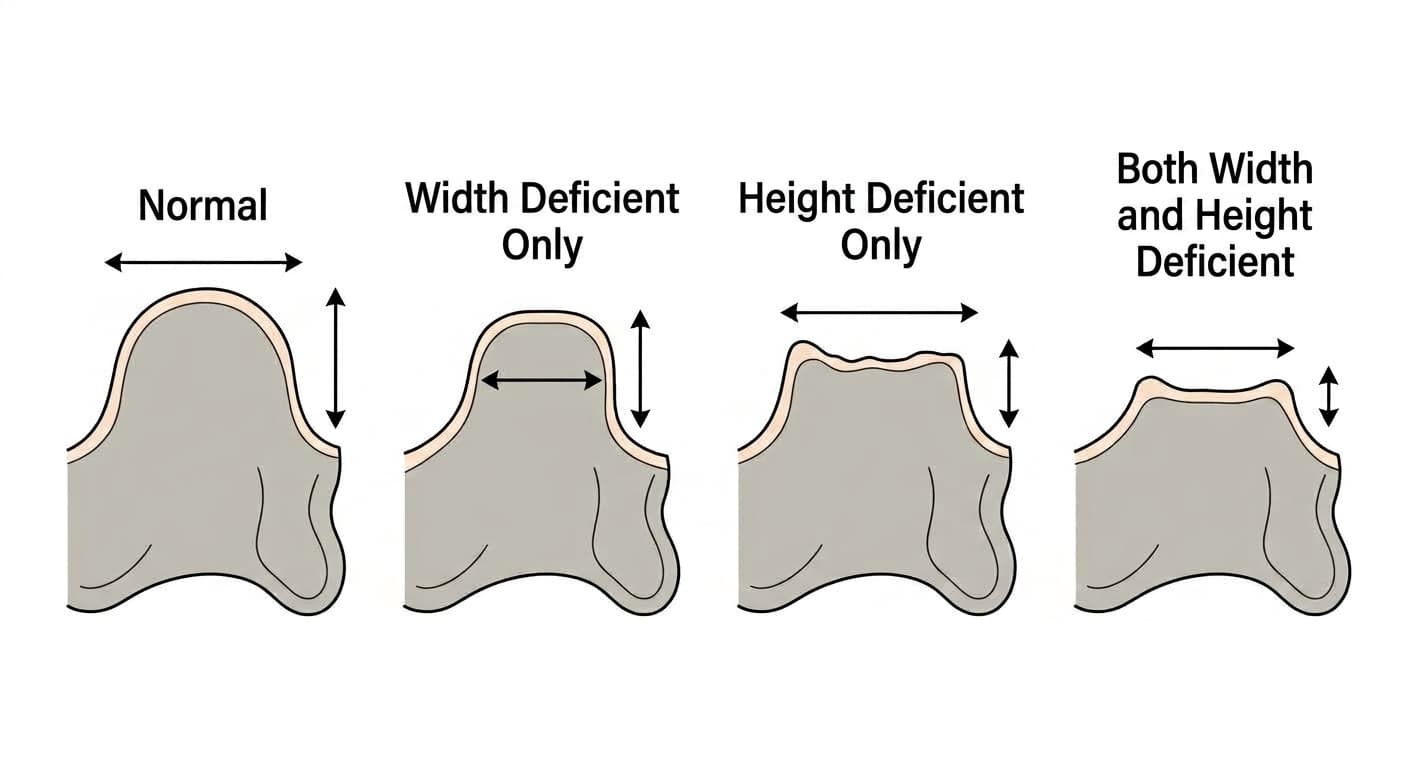
Bone deficiency doesn't take just one form. Viewed from the side, sometimes only the width is narrowed; other times the width is fine but the height (top-to-bottom) is reduced; and sometimes both width and height are deficient together. Because the extent and method of reinforcement needed depends on which dimension is lacking, whether a bone graft is needed starts from this assessment.
When bone is insufficient or there's a defect: guided bone regeneration (GBR)
If the assessment finds the bone's thickness or height insufficient, or part of it collapsed, guided bone regeneration (GBR) is used to reinforce that area. GBR fills the deficient area with a bone-forming material (graft material) and covers it with a thin membrane (barrier membrane). This membrane helps bone-forming cells grow in to fill the space, while also blocking gum tissue from moving in first and occupying it.
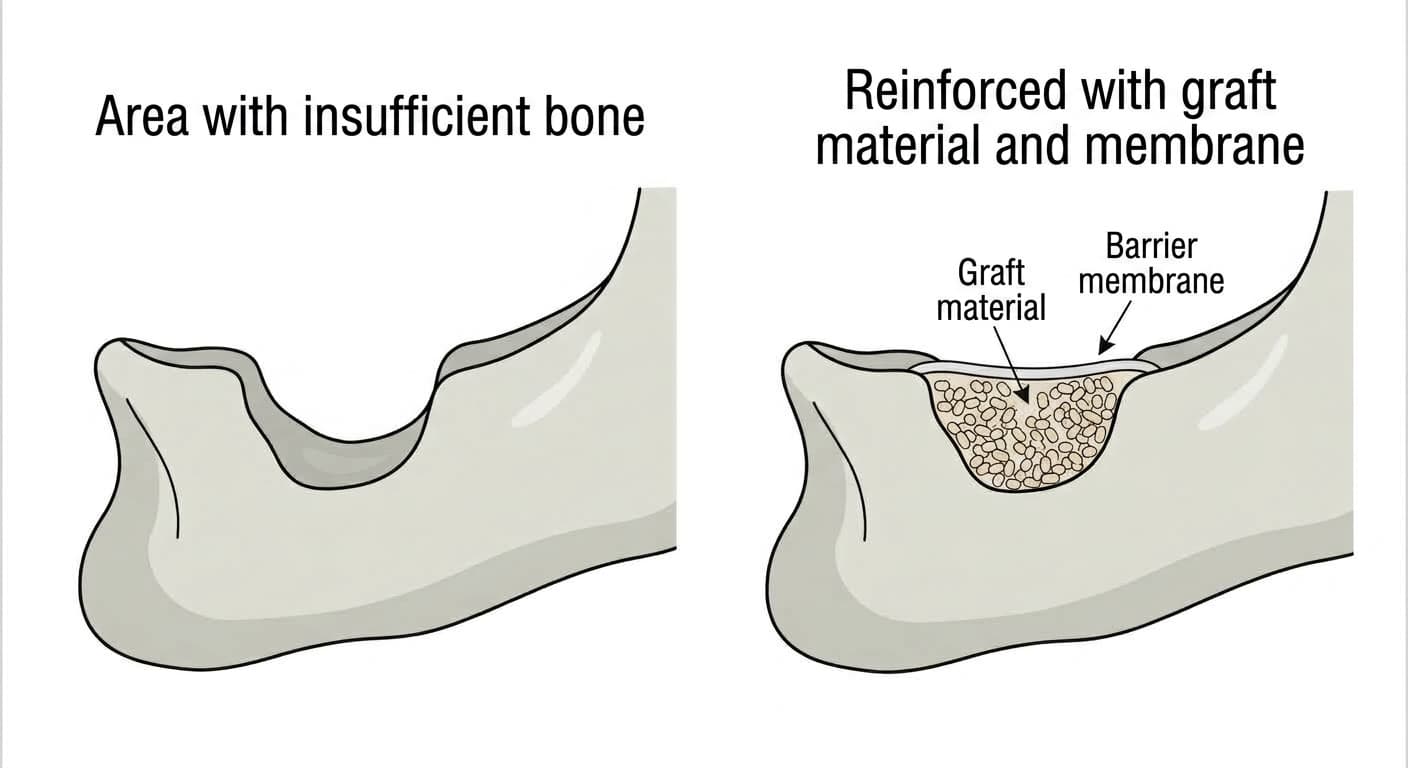
This method is also used to restore the thickness and height of the alveolar bone before an implant is placed. It's also used to reinforce an area after an implant has been placed, when part of the threads (the spiral grooves on the implant surface) is exposed outside the bone, or when a gap remains around it where bone hasn't fully filled in. The timing of a bone graft can be before the implant is placed or at the same time it's placed, depending on the bone condition assessed beforehand.
Even when bone looks sufficient: socket preservation
After a tooth is extracted, the bone at that site shrinks over time. The alveolar bone shrinks fastest during the first 6 months after extraction. The outer (lip/cheek side) bone, which is thin and has a thinner dense layer, can lose nearly half its thickness within 3 months of extraction. So even if the bone looks sufficient right now, if an implant is planned for later, socket preservation (filling the extraction socket with graft material right after extraction to preserve bone volume) is sometimes considered together.
This involves extracting the tooth with minimal damage, then filling the socket with graft material sourced from another person, an animal, or a synthetic material, and covering the opening with a collagen dressing or membrane. What determines whether to graft the socket first or place the implant immediately after extraction is covered further in Can a tooth being extracted due to gum inflammation still get an immediate implant the same day?.
Ultimately, whether a bone graft is truly necessary isn't a fixed step dictated by implant treatment itself, but a choice that depends on assessing the amount and shape of bone at the site.