
Question
I want to improve the shape or color of my front teeth with laminates, but I'm worried that a lot of healthy tooth structure will need to be removed. I'd like to know what criteria determine how much of the tooth gets reduced.
Short Answer
Laminates are designed to remove the minimum amount of tooth structure, staying within the enamel (the hard layer covering the tooth surface) on the facial side of the tooth. Standard reduction amounts exist, but they don't apply identically to every tooth. The actual amount removed varies from tooth to tooth, depending on how the incisal edge is finished, how much space is needed for the porcelain, and the tooth's original shape.
Why Is That?
Reduction Must Stay Within the Enamel for Good Bonding
Laminates can be attached as thin porcelain plates through bonding alone, without any additional retentive structure, because of the enamel. Etching the enamel surface with phosphoric acid creates microscopic grooves, and resin cement flows into these grooves to form a strong mechanical bond. This bonding occurs reliably on enamel, but it becomes less reliable if too much of the underlying dentin is exposed. For this reason, reduction for laminates is done within a range that preserves as much enamel as possible. Enamel thickness is about 2mm near the incisal edge, and the reduction depth is kept within that range.
Reduction Thickness Varies by Site and Incisal Edge Design
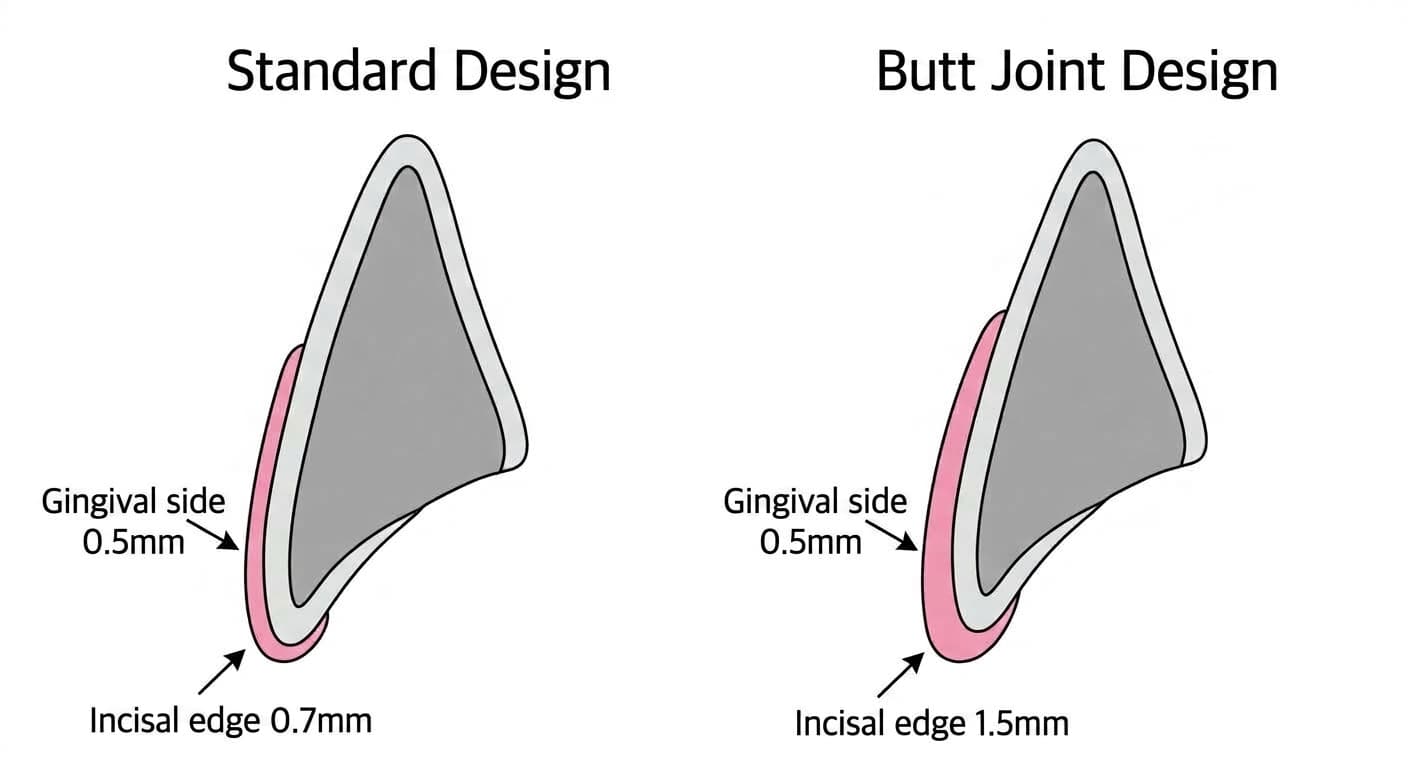
The standard reduction for laminates is at least 0.5mm at the gingival area (cervical region) of the facial surface and about 0.7mm at the incisal edge. However, there is more than one way to finish the incisal edge, and depending on how it is shaped, the design is classified as window, feather edge, butt joint, or palatal chamfer. Among these, the butt joint design requires at least 1.5mm of reduction at the incisal edge to create enough space for the porcelain.
The Final Reduction Amount Depends on the Condition of the Tooth
The reduction amount is not determined solely by the space needed for the porcelain. It is also decided by considering the condition of the pulp (the nerve tissue inside the tooth), the condition of the gums, how the upper and lower teeth meet when biting, and susceptibility to caries (cavities). In the past, wider reduction was used to help restorations last longer, but now that bonding technology has advanced, the approach has shifted toward preserving as much of the remaining original tooth structure as possible. This same principle applies when preparing a full-coverage restoration such as a front tooth crown.
If the goal is only to slightly broaden the tooth's shape or close a gap between teeth, bonding resin to close the gap without reducing the tooth is also an alternative worth considering. However, once laminates are chosen, the final reduction amount is determined individually for each tooth, taking into account the pulp, periodontal, and bite condition together, within the reduction ranges and incisal edge designs discussed above.