
Question
My jaw joint area has been throbbing and I've had trouble opening my mouth wide for several days now. I'm wondering whether having a dentist make an occlusal stabilization appliance (a splint worn between the upper and lower teeth to reduce the load on the jaw joint and chewing muscles) would improve the pain and limited mouth opening (not being able to open the mouth fully).
Quick Answer
How much a splint can help with jaw joint pain and limited mouth opening depends on the cause, so the condition of the joint needs to be checked first. This is because the goals and methods an appliance can target differ depending on whether the articular disc (the tissue that cushions between the bones inside the jaw joint) has shifted out of place and returns to its normal position when the mouth opens, whether it fails to return, or whether degenerative changes have developed in the joint itself. A splint can help reduce the load placed on the jaw joint and chewing muscles, lowering pain and improving how far the mouth opens, but it is not a treatment that guarantees restoring bone or disc that has already changed shape or been damaged back to its original state.
Why Is That?
First, Distinguish the Cause of the Limited Opening and Pain
When evaluating the jaw joint and chewing muscles, the dentist presses on painful areas to check for tenderness and looks at whether the joint makes sounds when the mouth opens, along with how far the mouth can open. Normally the mouth opens more than 40mm, and opening less than that is considered limited mouth opening. If needed, imaging such as tomography, arthrography, or CT scans may be added to check the condition inside the joint. This same approach to evaluating the jaw joint and chewing muscles together when pain and limited opening are present was also covered in When Your Jaw Feels Stiff in the Morning.
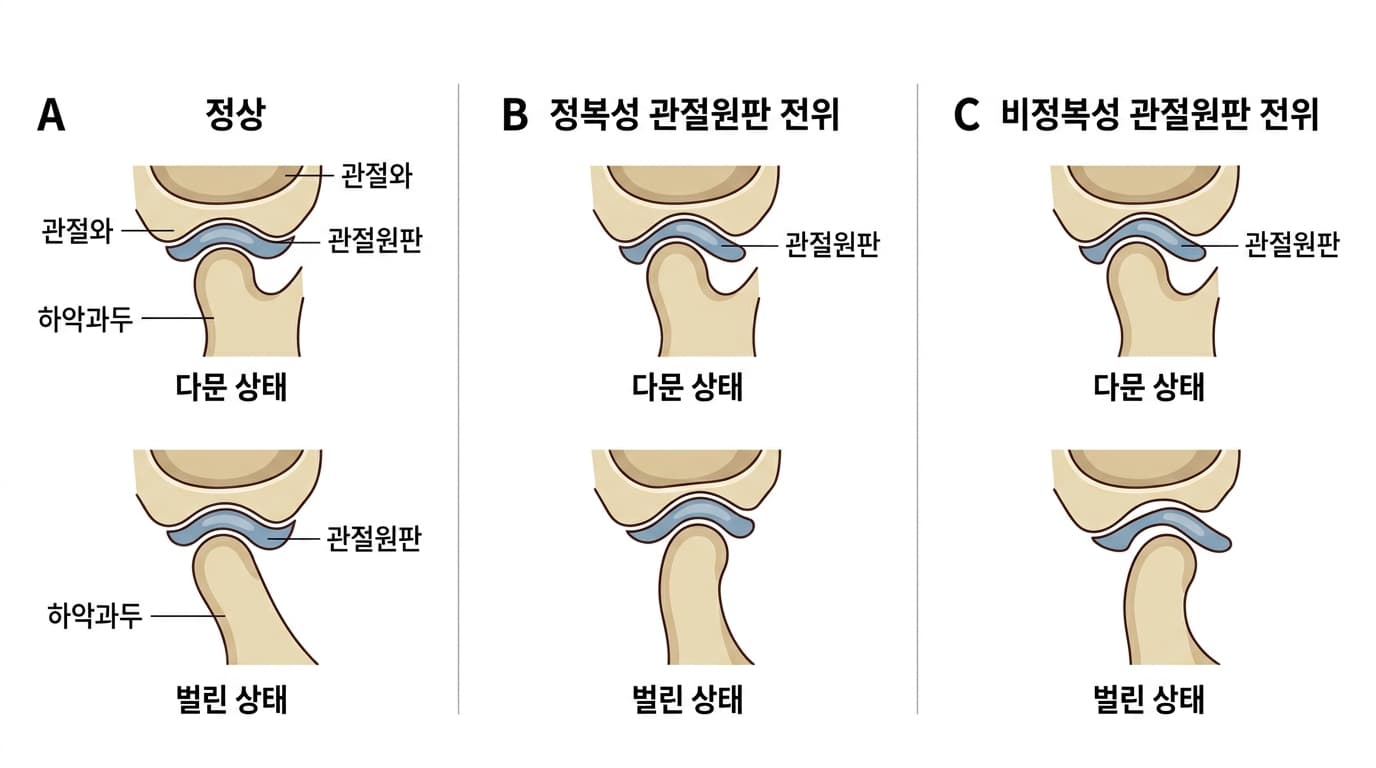
Depending on the results of this evaluation, the case may involve the way the articular disc moves, or it may involve degenerative changes in the joint itself, and the goal of using a splint differs accordingly. The three states of articular disc movement are summarized in the illustration below.
When the Articular Disc Does Not Return to Its Normal Position
If a clicking sound that used to occur when opening the mouth actually disappears, the mouth only opens to 25 to 30mm or less, and there is a firm, locked feeling when trying to open further, this may indicate a state in which the articular disc has shifted in front of the condyle (the rounded part of the mandible that forms the joint) and does not return (closed lock). This state develops as the tissue behind the disc loses its elasticity, and in this state an anterior repositioning appliance (a device that guides the mandible forward) is considered contraindicated.
In this case, the dentist first performs manual reduction of the jaw, then follows up with an occlusal stabilization appliance. The appliance's role is to reduce the load on the jaw joint and chewing muscles in the reduced position; it does not guarantee in advance how well the reduction will be maintained or whether the articular disc will fully recover.
When the Disc Returns to Position, and When Degenerative Changes Are Present
If there is a reciprocal click that occurs both when opening and closing the mouth, and the limited opening is not severe, this may indicate a case where the articular disc shifts out of place and then returns to its normal position when the mouth opens. In such cases, an occlusal stabilization appliance is used together with anti-inflammatory medication and warm compresses, and if needed, an anterior repositioning appliance may be used alongside it for a short period (2 to 3 months). However, prolonged use of an anterior repositioning appliance can cause a side effect called posterior open bite, in which the back teeth no longer meet, so its duration is limited. Habits that repeatedly apply strong force to the chewing system, such as bruxism or clenching, are considered one of the factors that cause this kind of disc displacement, and in these cases an occlusal stabilization appliance is also used to protect the teeth and joint.
On the other hand, if the pain persists on one side, worsens in the afternoon or evening, and produces a grating sound (crepitus) rather than a click, this may indicate that the joint has been overloaded and progressed to degenerative arthritis. In this state, X-rays may also show bone structure changes such as flattening of the condyle or glenoid fossa surface, osteophytes, or erosion. Even at this stage, an occlusal stabilization appliance is used to manage pain by reducing excessive muscle activity, but it is not a treatment that reverses the bone changes seen on X-ray.
What to Check After Starting to Use the Appliance
An occlusal stabilization appliance is made from a clear resin plate fitted to the teeth, adjusted so the teeth are separated by about 3 to 5mm at the front and about 2mm at the back, working by suppressing excessive tension in the chewing muscles.
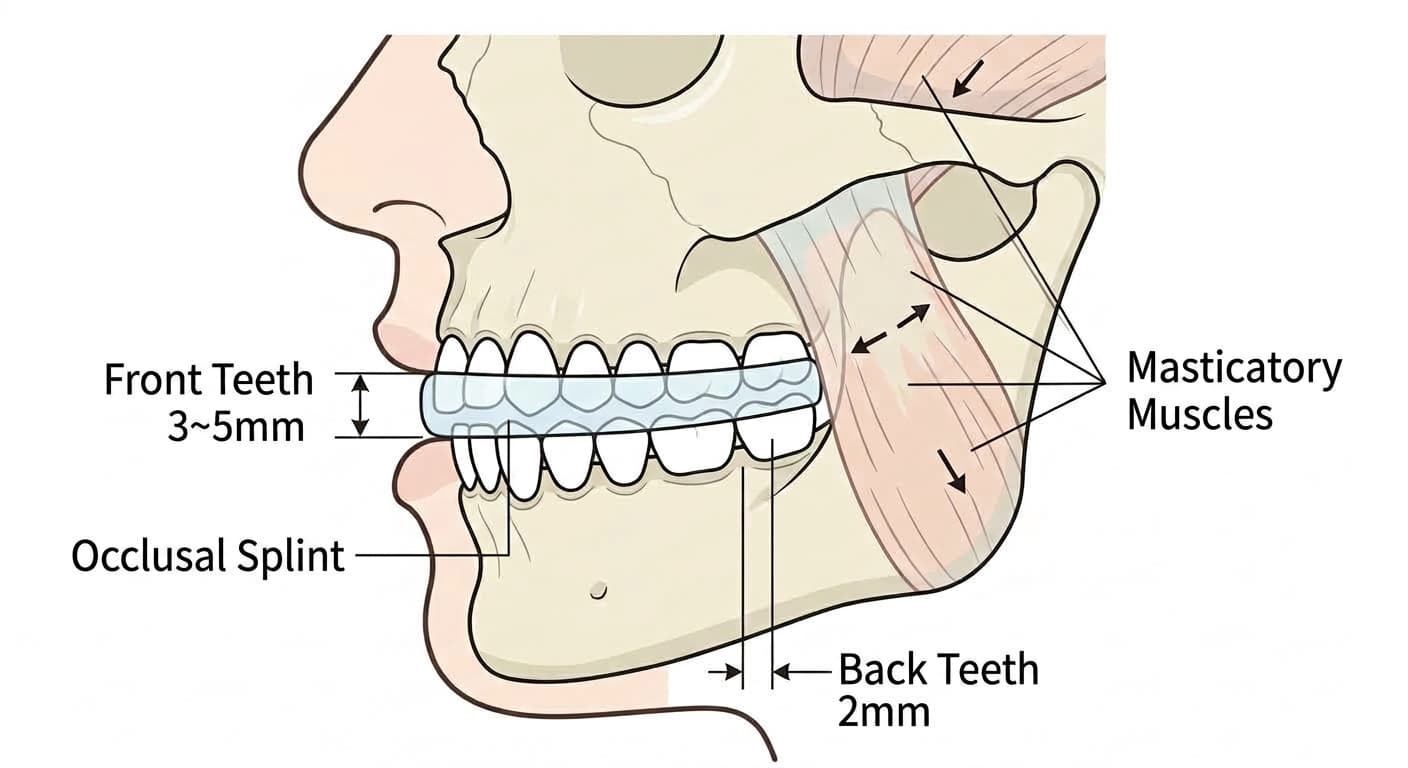
After the appliance is fitted, the dentist periodically rechecks how the pain and mouth-opening range are changing and whether the teeth make even contact when biting on the appliance, adjusting the contact surfaces if needed. When an anterior repositioning appliance is used together with it, the dentist also monitors whether the set duration is being exceeded and whether the back teeth are losing their bite contact. Because the speed and degree of improvement depend on the cause and joint condition identified during the evaluation, wearing the appliance does not mean the same degree of improvement within a set time frame can be determined in advance.