
Question
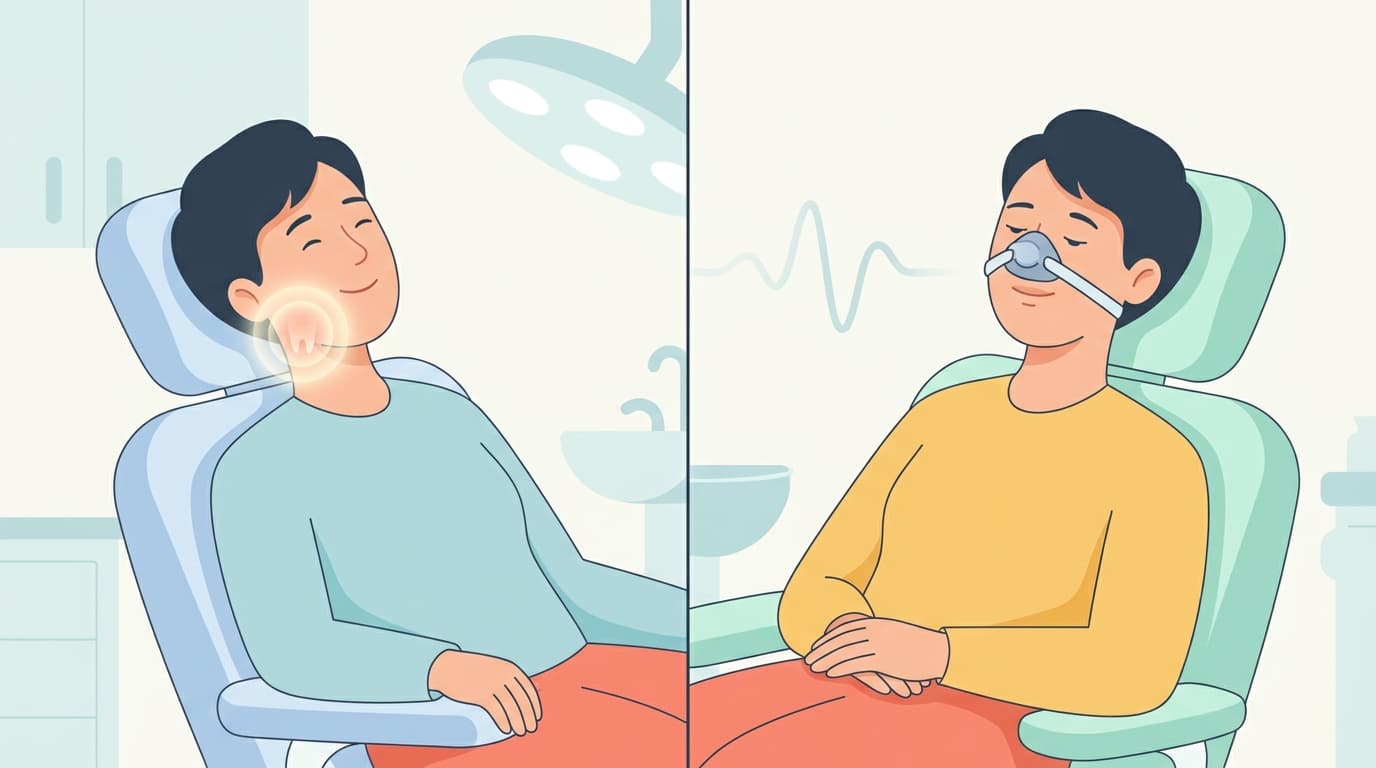
I've been told it's time to remove my wisdom tooth. I'm not sure whether I just need a local anesthesia injection or whether I also need something called sedation. I'd like to understand what each of these does and why they're used together.
Short Answer
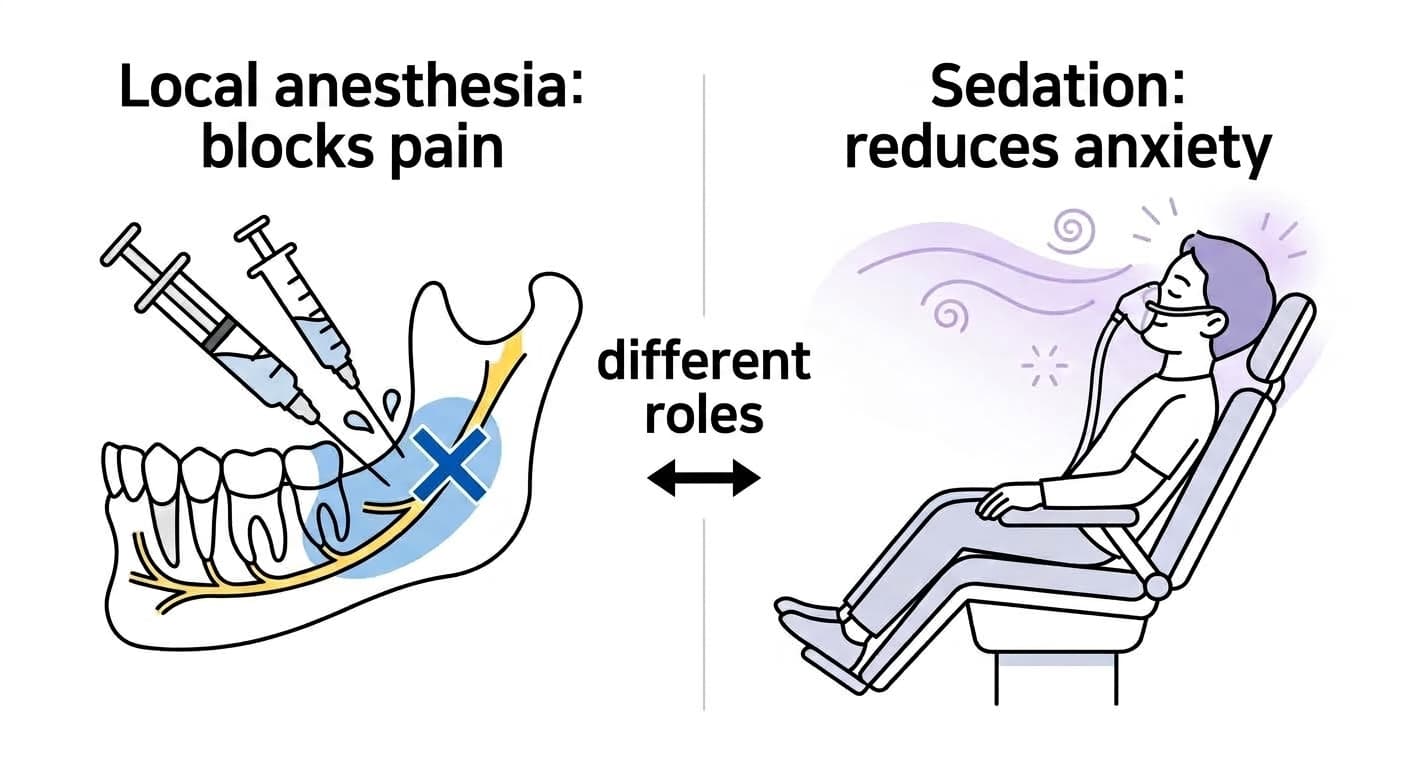
Local anesthesia and sedation serve different roles. Local anesthesia is the method that blocks pain around the wisdom tooth, while sedation is the method that reduces anxiety and fear about the treatment. Sedation methods that keep the patient conscious are known to provide incomplete pain relief on their own, so even if you receive sedation, the pain at the extraction site still needs to be blocked separately with local anesthesia. That said, as the depth of sedation increases, the ability to breathe independently and maintain an open airway can decline as well, which is why deeper sedation requires more careful monitoring of breathing.
Why Is This the Case?
Local Anesthesia: Blocking Pain at the Extraction Site
Local anesthesia is the most basic method of controlling pain in dental treatment. When working on teeth in the lower jaw (mandible), nerve block anesthesia, which numbs the area where the nerve trunk passes, is the standard approach, and infiltration anesthesia, which soaks the area to be numbed directly with the drug, is added when needed. A similar principle, in which the anesthesia method changes depending on tooth position, can also be seen in other treatments.
The injectable solution commonly contains a vasoconstrictor (epinephrine). This ingredient keeps the anesthetic from being washed too quickly from the injection site into the bloodstream, which extends the anesthetic effect and also reduces bleeding. However, if the anesthetic drug itself enters a blood vessel directly, it can lead to systemic side effects. For this reason, before injecting, an aspiration test is performed by gently pulling back on the syringe to check that the needle tip is not inside a blood vessel, and the drug is injected slowly so as not to exceed the maximum allowed dose. Warming the anesthetic solution to body temperature before injecting is also known to reduce the discomfort of the injection itself.
Sedation: Reducing Anxiety and Fear, Not Pain Control
Unlike general anesthesia, which causes loss of consciousness, sedation is a method that uses medication to lower anxiety and fear while keeping the patient conscious, helping them cooperate with treatment. A representative example is inhalation sedation, in which nitrous oxide (laughing gas) and oxygen are inhaled together. This method is safer than general anesthesia, but because its pain-relieving effect is incomplete on its own, it must always be used together with local anesthesia. Receiving sedation does not mean the anesthetic injection at the extraction site can be skipped. The same principle is discussed in more detail in an article explaining the relationship between laughing gas and local anesthesia.
Why the Degree of Breathing Monitoring Changes With Sedation Depth
Sedation is not a single fixed state but exists on a continuum running from minimal sedation to moderate sedation, deep sedation, and general anesthesia. In minimal sedation, the shallowest level, patients breathe on their own and respond normally when spoken to, with no effect on breathing or circulatory function. In moderate sedation, consciousness is further reduced, but patients can still respond purposefully to verbal commands or light stimulation, and spontaneous breathing remains sufficient without any additional measures to maintain the airway.
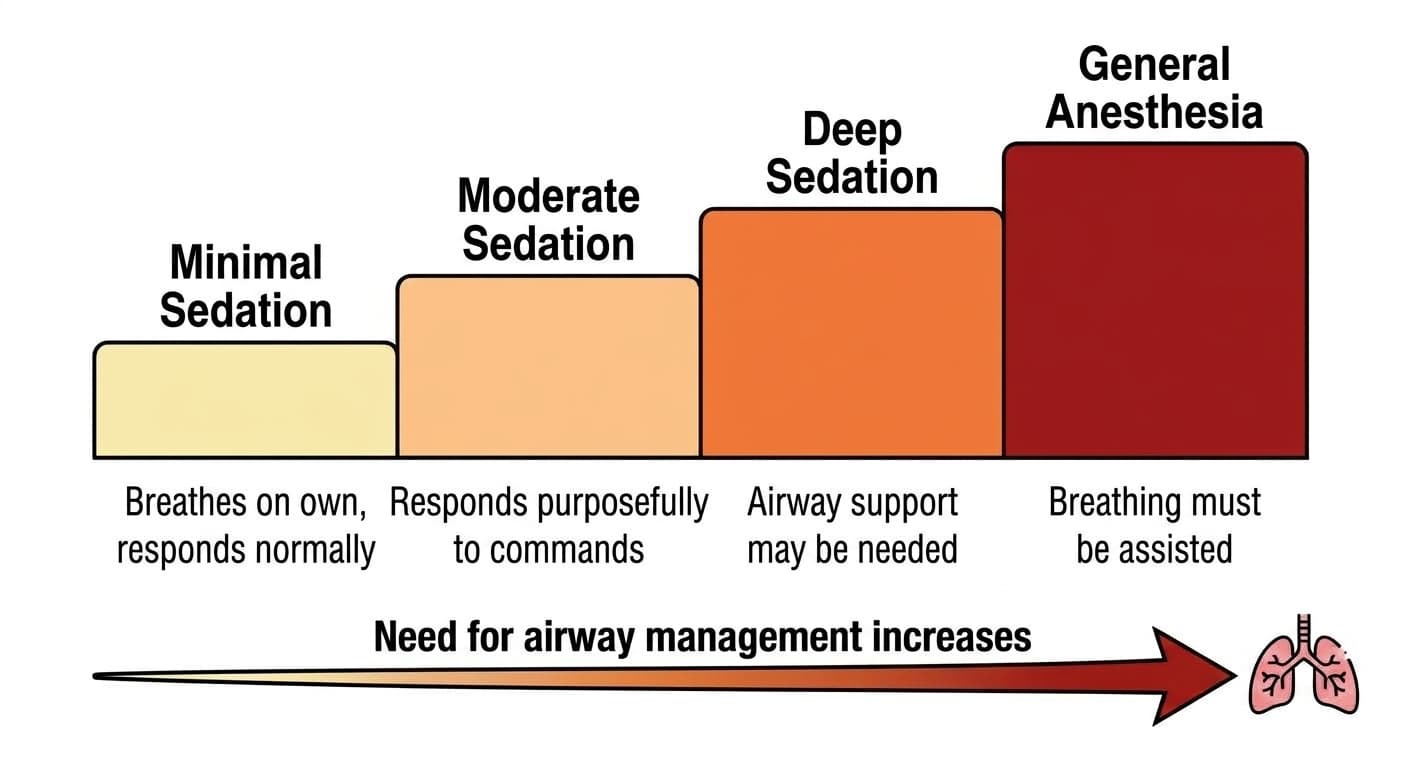
In contrast, once a patient enters deep sedation, they cannot be easily awakened and respond purposefully only to painful stimulation, and spontaneous breathing may be impaired, which can require measures such as tilting the head back and lifting the chin to open the airway. General anesthesia is a state in which consciousness is completely lost and there is no response even to surgical stimulation; protective reflexes, including those of the airway, are lost, requiring breaths to be delivered artificially.
The reason breathing management becomes more important as sedation deepens is that sedative drugs suppress the central nervous system, which also lowers the muscle tone of the muscles around the throat, including the base of the tongue. As muscle strength decreases, the airway space can narrow (pharyngeal obstruction). Protective reflexes to stimulation can also become excessive, causing the vocal cords to narrow, a condition known as laryngospasm. Devices that measure blood oxygen saturation alone have a time lag in detecting reduced breathing. This is why, as sedation depth increases, monitoring equipment and the frequency of checks are increased to also track breath sounds or the carbon dioxide concentration in exhaled air.
For this reason, when sedation is used together with wisdom tooth extraction, it helps to understand local anesthesia, which blocks pain, and sedation, which reduces anxiety, as having separate roles, while also keeping in mind that the deeper the sedation, the more closely breathing must be monitored.