
Question
The cavity isn't very big, and it seems like it would only take a little drilling and filling, but many people wonder whether they still need an anesthetic injection beforehand. It seems like such a small area could just be treated without anesthesia. Is this tooth-cutting-and-filling treatment actually capable of hurting, and what determines whether anesthesia is used?
Short Answer
For restorative treatment that removes decayed tooth structure and fills the cavity, local anesthesia is the most well-established and universal method used to control pain. This is because the act of cutting into the tooth can itself stimulate the nerve tissue that transmits pain. That said, the exact anesthesia technique used depends on whether the tooth being treated is in the upper jaw (maxilla) or the lower jaw (mandible).
Why Is That?
Why cutting a tooth transmits pain
At the center of a tooth is soft tissue called the pulp. The pulp contains nerve components that transmit pain: Aδ fibers, which carry fast, sharp pain, and C fibers, which carry dull, lingering pain, work together to produce this sensation. Treating dental caries requires removing the damaged tissue, and this process can transmit stimulation all the way to the pulp. That is why textbooks describe local anesthesia as the most well-established and universal method of pain control for the entire process of cutting a tooth to create a restorative cavity and the restorative treatment that follows.
The anesthesia method depends on the tooth's location
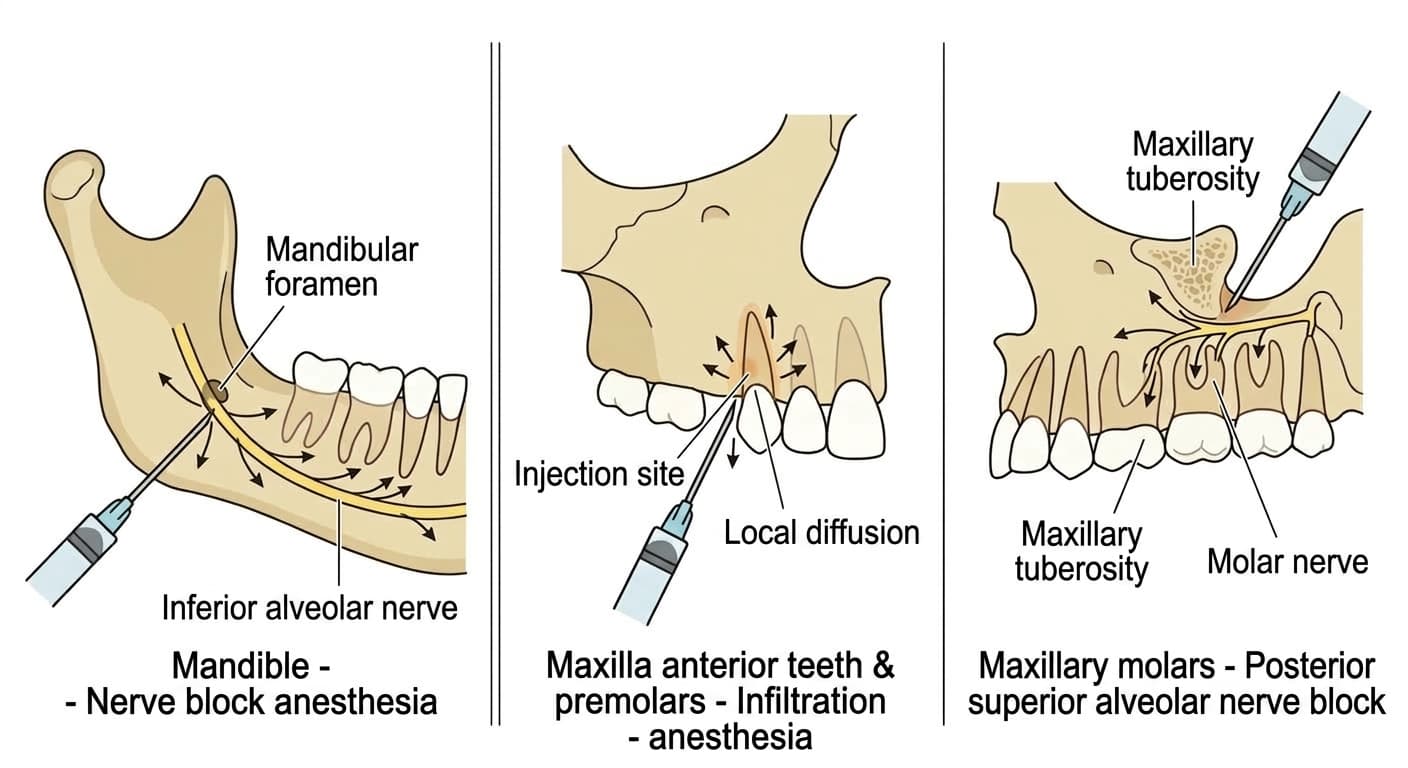
Local anesthesia is divided into nerve block anesthesia, which numbs a wide area served by a nerve by blocking the nerve trunk itself, and infiltration anesthesia, which injects the drug directly into the area being treated. For mandibular teeth, the standard approach is an inferior alveolar nerve block, which blocks the nerve passing through the mandibular foramen (the opening on the inner surface of the lower jawbone through which the nerve travels), adding infiltration anesthesia if needed. For maxillary teeth, infiltration anesthesia is the standard approach, but for the maxillary molar region, a posterior superior alveolar nerve block at the maxillary tuberosity (the bony prominence behind the upper molars) is used, and for the first molar, infiltration anesthesia at the premolar area just in front of it is added as well. In other words, even for the same cavity treatment, the standard anesthesia technique itself differs depending on which tooth is being treated.
Ways to reduce the pain of the injection itself
Methods are also used to reduce the sting of the anesthetic injection itself. Recommended techniques include using a thin needle, avoiding injecting the drug directly beneath the periosteum (the thin membrane covering the bone), vibrating the mucosa at the injection site to distract from the stimulus, and injecting with the patient in a reclined position. Computerized delivery devices that mechanically apply this same principle by slowly pushing the drug in at a constant rate are also used. If you have significant anxiety about the anesthetic injection itself, you may also find it helpful to read this comparison of laughing gas and local anesthesia, which looks at how pain control and anxiety relief are each addressed.