
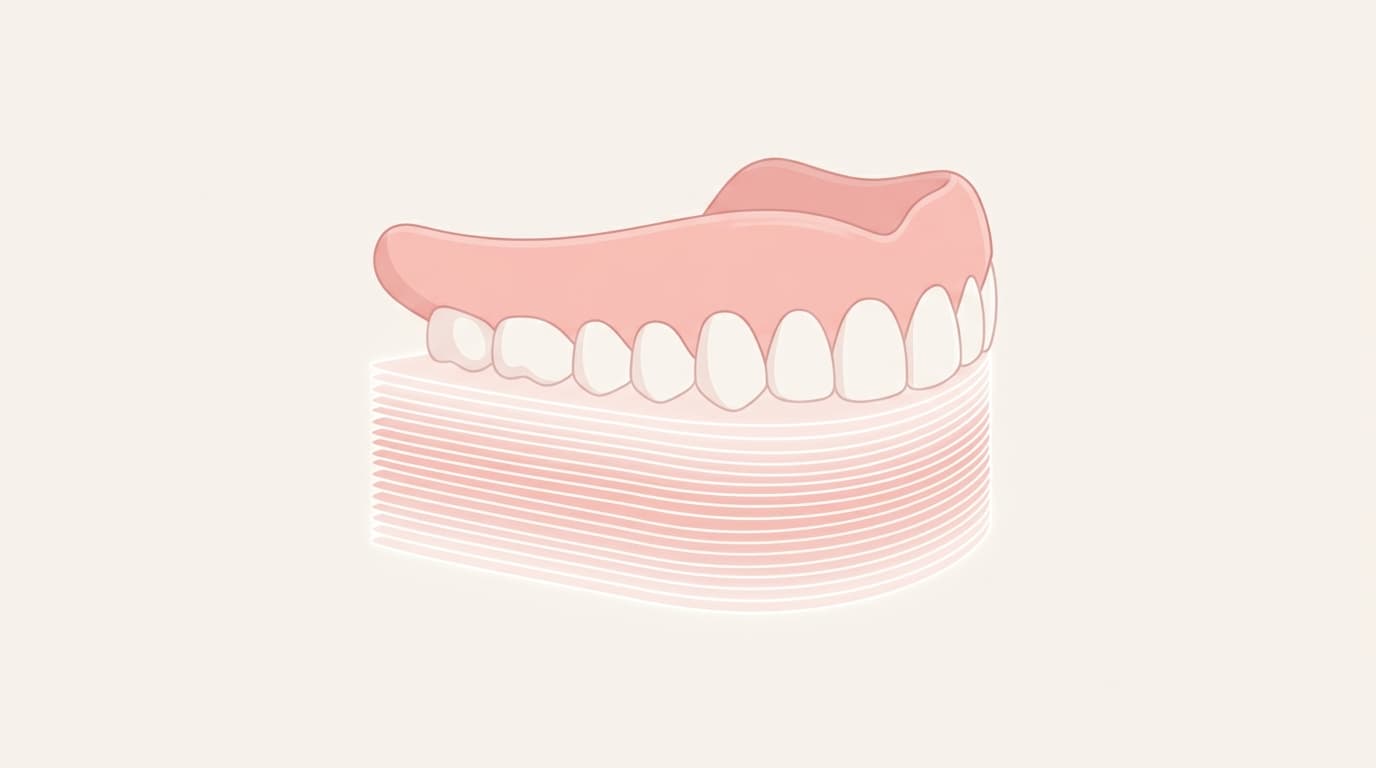
Denture fabrication is moving from the era of hand-packed, heat-cured resin to a digital era of computer-controlled milling and 3D printing. But not all digital methods are the same. Milling, which carves a denture base out of a resin block, and 3D printing, which builds one up by curing liquid resin layer by layer, work on fundamentally different principles. Pooling several recent meta-analyses shows that milling comes out ahead of 3D printing in strength, surface quality, and resistance to bacterial adhesion.
How Milling and 3D Printing Work
Milling loads a resin block, already cured uniformly under heat and pressure at the factory, into a cutting machine and carves it to the shape of the gums. Because the material starts out uniformly cured, that uniformity carries through to the finished piece. 3D printing works the opposite way: it builds up the base by curing liquid resin with light, one layer at a time, repeating the process hundreds of times. The boundary between layers may not fully fuse into one, and the degree of curing can vary subtly from layer to layer. Studies have also confirmed that the properties of the final piece can differ even among 3D-printed dentures, depending on the build angle, layer thickness, and the post-curing step that exposes the finished piece to additional light. Both methods start by creating a digital file, either by scanning the mouth with an intraoral scanner or by scanning an impression model. In the past, resin was packed by hand into a plaster model and cured; milling and 3D printing both move that manual work onto a computer, but the underlying principles differ.
Milling Wins on Strength, and Stays Ahead Over Time
A study pooling more than sixty experiments across four fabrication methods (hand-packing, injection molding, milling, and 3D printing) found that milling ranked first or second on most measures of flexural strength, surface smoothness, and impact resistance, while 3D printing scored lowest. Another study that compared milling and 3D printing head-to-head found milling clearly better on both fit accuracy to the gums and surface smoothness. The same held true when 3D printing was compared with the older hand-packed method. Water absorption and roughness didn't differ much, but the value showing how rigidly a material holds up under load was higher for the older hand-packed method than for 3D printing. In aging tests that mimicked repeated exposure to hot and cold foods and staining substances, all three methods lost strength over time, but the drop was smallest for milling and largest for 3D printing. 3D-printed dentures also absorbed the most water. This means that performance that looks similar right after fitting can diverge much more between methods after a few years.
Bacteria Stick More to 3D-Printed Dentures
Pooling twelve studies that compared how much bacteria grow on and adhere to milled versus 3D-printed dentures found that both bacterial growth and the number of bacteria attached to the surface were markedly higher for 3D printing. Interestingly, surface roughness alone doesn't explain it. When smoothness was examined separately, it failed to account for the difference in bacterial adhesion. This suggests the cause may lie less in the visible surface than in microscopic gaps between layers or residual substances left in the material.
Why 3D Printing Is Growing Anyway, and What to Ask
There's a reason 3D-printed dentures are becoming more common even though they fall behind milling on both strength and hygiene. Unlike the conventional process, which required multiple visits for taking impressions, making models, and try-in with wax, designing from a digital file is reported to cut out much of that process and shorten fabrication time to roughly a third of what it used to take. That difference matters a great deal for elderly patients or those in care facilities who find it hard to visit the clinic. Keeping the digital file also means that if a denture is lost or breaks, a replacement can be produced again without taking a new impression. Materials are continuing to improve as well: a recent review found that 3D-printed artificial teeth are no worse than conventional ones, at least in terms of wear resistance. So it's unlikely that today's gap will simply stay as it is. Patients aged 65 or older can receive national health insurance coverage for a hand-packed traditional denture once every seven years, but whether digital dentures qualify for the same coverage can vary by clinic, so it's worth asking in advance. It's also worth asking whether the base of your denture is milled or 3D-printed, and what material is used. Since 3D-printed dentures tend to attract more bacteria, regular cleaning and checkups can be especially helpful.