
When you start clear aligner treatment, your dentist shows you a computer simulation of your current teeth and how they'll look once straightened. This simulation is a plan the software generates automatically from a digital impression captured with an intraoral scanner. But several recent studies have taken a closer look at how closely this plan actually plays out. The conclusion: it depends heavily on the type of movement. Relatively simple movements, like pulling or pushing a molar, tend to reach 80-90% of the plan, while rotating a tooth or pulling it outward often falls short of even half.
"Accuracy" here means how much of the planned angle or distance was actually achieved. If the software planned to rotate a tooth by 10 degrees but it only rotated 6 degrees, that's 60% accuracy, with 4 degrees left unmoved. This gap comes down to tooth shape and the direction forces are transmitted through; it doesn't mean the aligner was made incorrectly.
Molars Move Well; Canines Resist Rotation
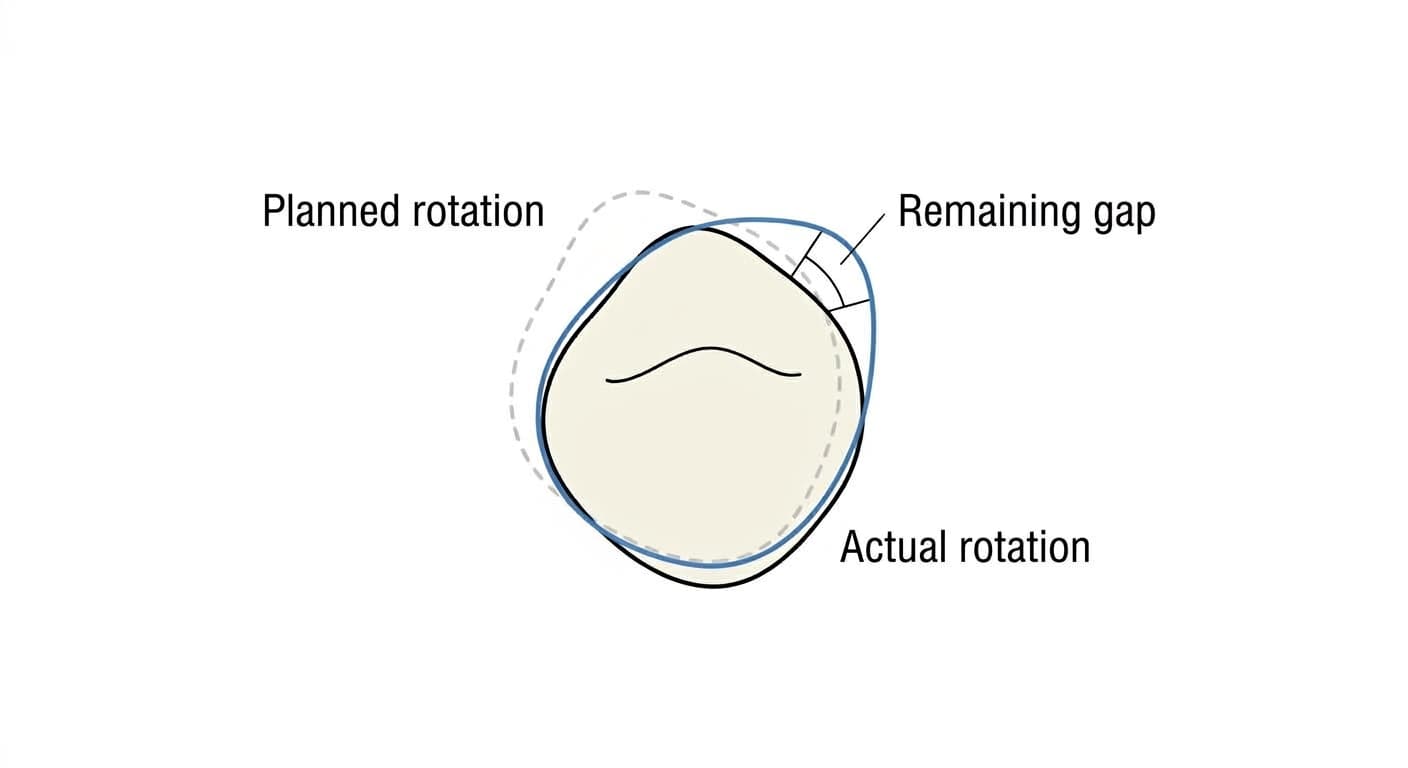
Pooling results across studies, outcomes split sharply by movement type. Pulling a molar forward to close a gap came out relatively accurate, reaching about 86% of the plan. Pushing a molar backward was accurate up to 88% of the plan for larger movements over 1.5mm, but once smaller movements were included the average dropped to 61%, and lower-jaw molars were even harder to predict. Rotating a tooth around its long axis, by contrast, varied widely across studies, from 36% to 85%, averaging around 65%. Canines and premolars, which have rounder cross-sections, were flagged as the hardest teeth to rotate because aligners struggle to get a grip on them; teeth with more angular cross-sections, like incisors and molars, rotated comparatively well. Extrusion (pulling a tooth outward/downward) proved even trickier: older studies found it reached only 30% of the plan, and even recent studies put it at just 57-62%. Intrusion (pushing a front tooth inward/upward) was, by contrast, relatively well controlled.
| Movement | Share of plan achieved |
|---|---|
| Pulling a molar forward (closing a gap) | ~86% |
| Pushing a molar backward (≥1.5mm) | up to 88% (61% average including small movements) |
| Rotating a tooth | 36-85% (65% average) |
| Extrusion (pulling outward) | 30-62% |
Attachments Help, But Don't Fully Close the Gap
Bonding small bumps called attachments onto the tooth surface gives the aligner a better grip, which raises accuracy somewhat. But pooled studies comparing conventional attachments with specially shaped, "optimized" attachments found no clear difference between the two. For canine rotation, conventional attachments reached 61% of the plan and optimized attachments reached 72%; for extrusion, the figures were 58% and 62% respectively. Either way, no study found movement that fully matched what the computer screen showed. If you have attachments, you may notice the small bumps are slightly visible when you smile; that's not a side effect, but simply the device doing the job of generating that force.
That's Why Aligners Get Rescanned Midway
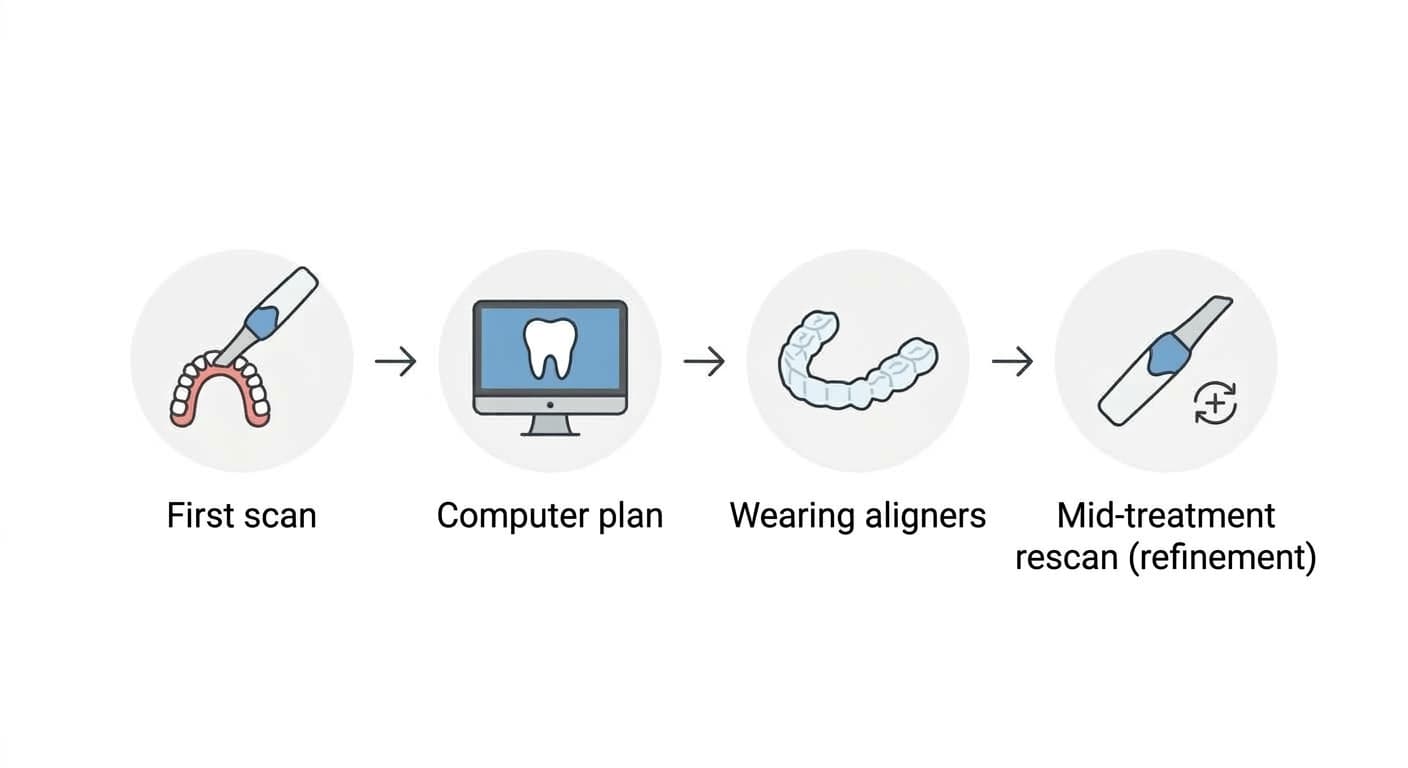
Refinement is how this gap gets closed. From the outset, the plan builds in extra rotation or movement beyond the target for difficult movements, and partway through treatment, a new scan is taken so a fresh set of aligners can be made to cover whatever gap remains. If your teeth haven't moved as much as expected once you've finished your first set of aligners, that isn't a sign something went wrong; it's a commonly built-in step in this approach. That said, how many refinement scans are included by default, and whether there's an extra charge, varies by clinic, so it's worth checking before you start treatment.
Most studies so far have small sample sizes and use different measurement methods, so these figures shouldn't be applied directly to any individual case, and many of the studies rated their own evidence quality as still low. Even so, which movements tend to go as planned and which need more attention showed up consistently across multiple studies. If you're about to start treatment, it can help to ask your dentist whether the movements you need are mainly rotations or extrusions, and to work out an attachment and mid-treatment check-in plan together.