
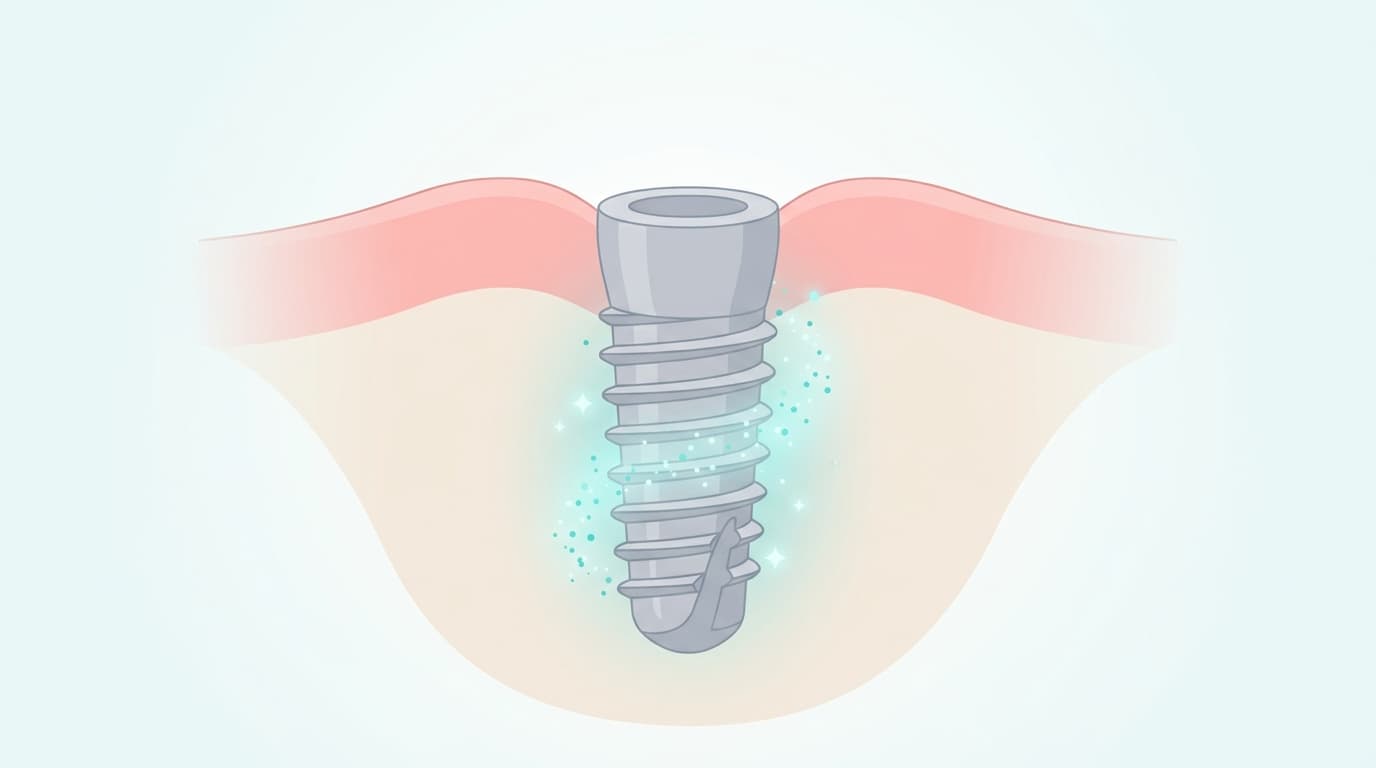
After an implant is placed, it takes several weeks to fuse firmly with the bone. Stability doesn't rise in a straight line during this period; it typically dips at one point. A team from Kahramanmaraş Sütçü İmam University in Turkey reported in May 2026, in a clinical trial on human implants, that activating the surface with cold plasma right before placement prevents this dip. Untreated implants lost stability four weeks after placement, while plasma-treated implants kept rising at the same point in time.
The Surface Ages Like It 'Rusts'
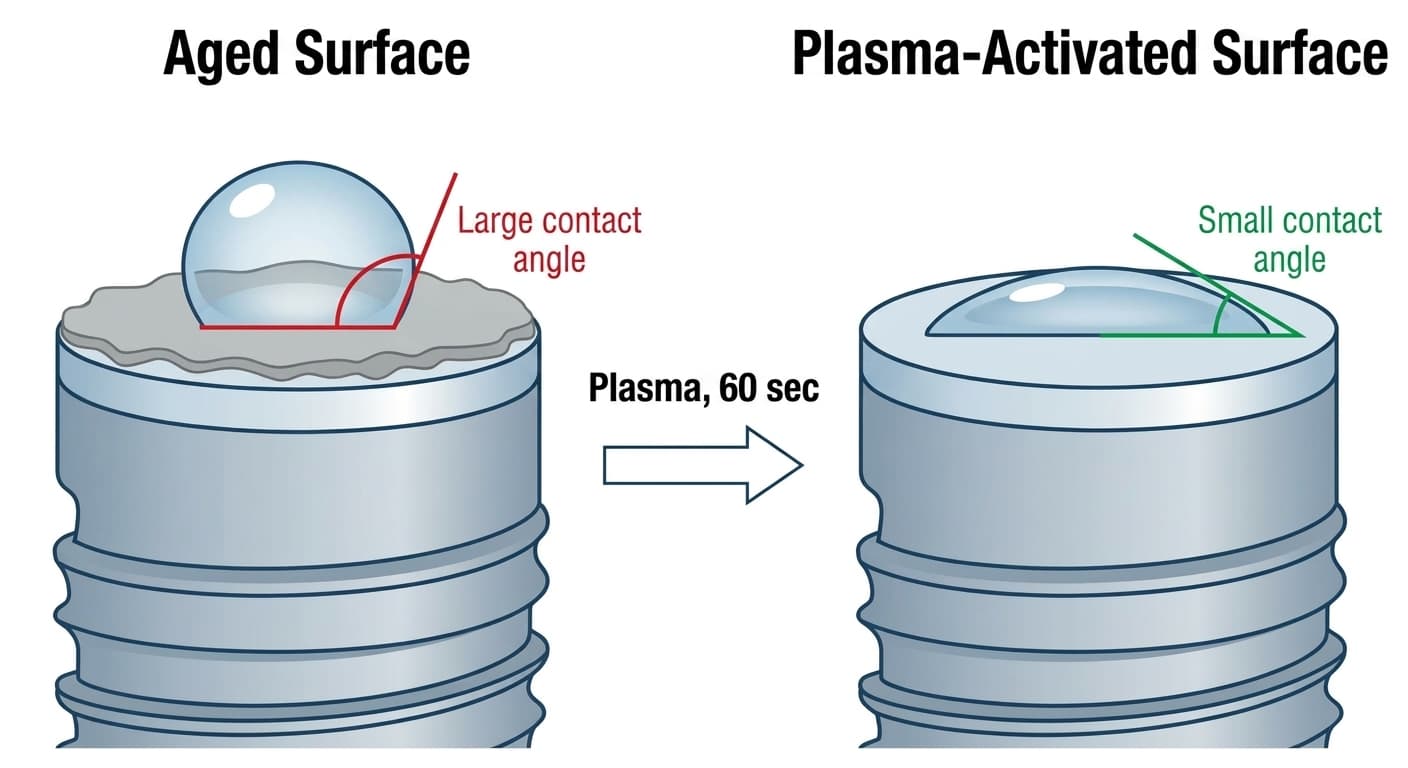
Titanium implants are most reactive right off the factory line. Over time, hydrocarbons from the air build up on the surface, lowering its surface energy and hydrophilicity (how well water spreads across it), which makes it harder for proteins from blood and tissue, and for the osteoblasts that build bone, to attach. The research team calls this 'biological aging' and notes that the longer an implant sits in storage after manufacturing, the more it ages.
Cold plasma reverses this aging. When a gas mixed with ions and radicals touches the titanium surface, it strips away hydrocarbons and raises the oxygen content. X-ray photoelectron spectroscopy (XPS) analysis showed carbon decreasing and oxygen increasing after treatment, and this shift has been reported to restore protein adsorption and osteoblast attachment.
Reworking Chemistry, Not Roughness
Existing surface treatments mostly worked by roughening the surface. A moderately rough titanium surface increases the contact area with bone and gives good initial fixation, but that roughness is fixed at the manufacturing stage and doesn't change, so reactivity still drops as hydrocarbons accumulate during storage.
There has also been research on photofunctionalization, which uses ultraviolet light to break down hydrocarbons. A UCLA team's experiment confirmed in a quartz vessel that vacuum ultraviolet light broke down more than 90% of organic matter within a minute, but it ended by noting that the actual effect on implants placed in patients still needed to be confirmed separately. This study went a step further, all the way to application in actual patients, and used plasma instead of light. UV equipment is hard to set up in a dental clinic, but plasma only needs to be applied for 60 seconds right before placement.
40 Implants, and the Week-4 Dip Disappeared
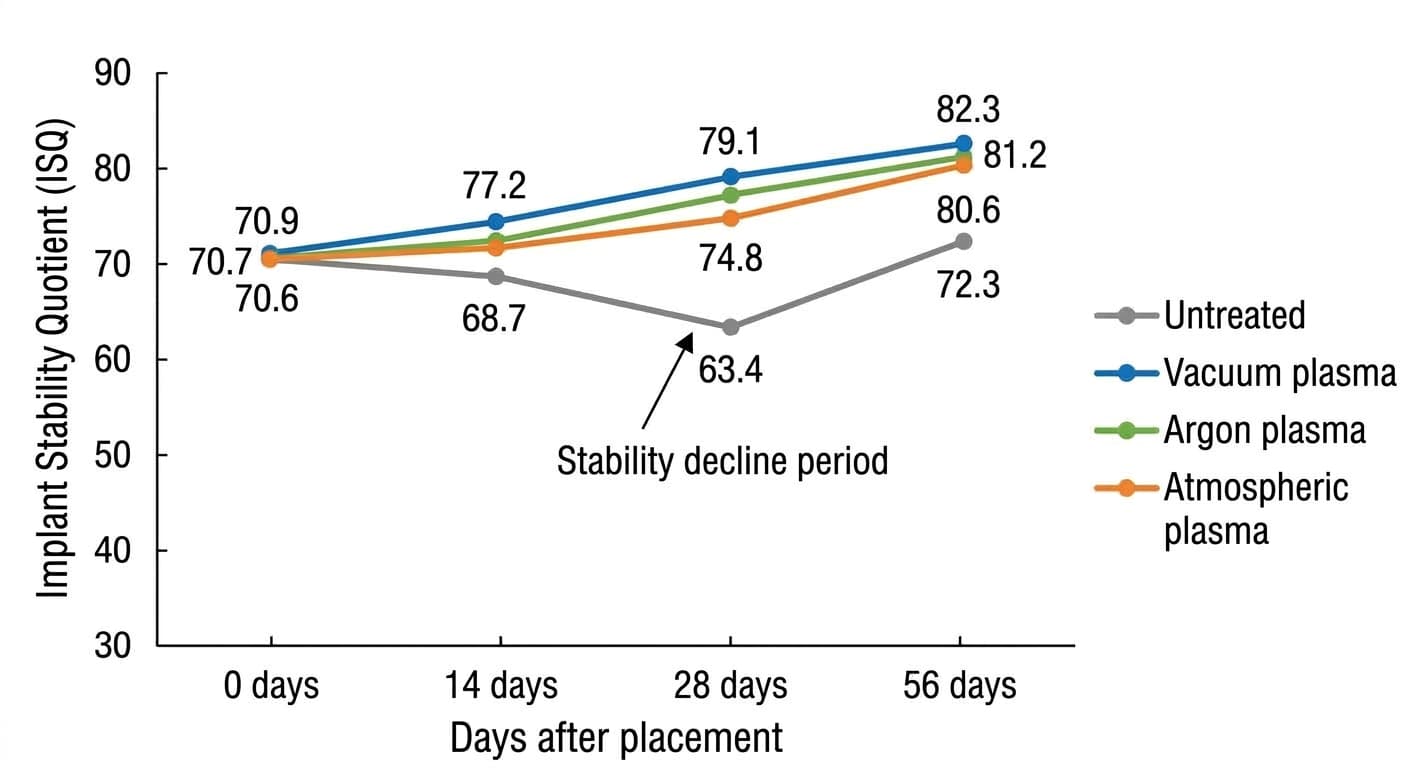
The research team recruited 11 patients who each needed four implants and assigned a different treatment to each implant placed in the same person. One implant per patient was left untreated as a control, while the other three received 60 seconds of plasma using a vacuum chamber method (Plasma Active), an argon gas method, and a room-temperature atmospheric-pressure method (all with piezobrush equipment). The implants were Straumann Group's Medentika Quattrocone, and stability was measured with the Implant Stability Quotient (ISQ, on a 1-100 scale where 70 or above is considered stable) using an Osstell device. One patient dropped out due to insufficient initial fixation, leaving a final 10 patients and 40 implants measured at 0, 14, 28, and 56 days.
On the day of placement, stability was similar across all four groups, at 70.6-70.9. But the control group's score fell to 68.7 by day 14 and dropped further to 63.4 by day 28, crossing from the 'stable' range into the 'moderate' range. The three plasma-treated groups, by contrast, held at 74.2-78.0 by day 28 and actually kept rising. By day 56, all four groups were back in the stable range, but the plasma-treated groups were at 80.6-82.3, 8 to 10 points higher than the control group's 72.3. Among the three plasma methods, there was no clear difference by day 56.
A Higher Stability Score Isn't the Same as More Bone Contact
The research team itself cautioned that these results should be read carefully. ISQ is not a microscopic measurement of how much bone actually contacts the implant, and because implant position was determined by the prosthetic plan, the jaw location and length weren't completely identical across groups. The trial was registered only after it was completed, and with just 10 patients, the team itself flagged it as hypothesis-generating evidence rather than confirmatory.
Even so, this study consistently showed, across three different methods, that cold plasma surface activation works to reduce the early stability dip in real human implants. It marks a step beyond existing treatments that only roughened the surface, moving toward one that restores the chemical state of the surface right before placement. Whether this rise in stability actually translates into faster osseointegration or better long-term success, however, still needs to be confirmed in larger follow-up studies.