
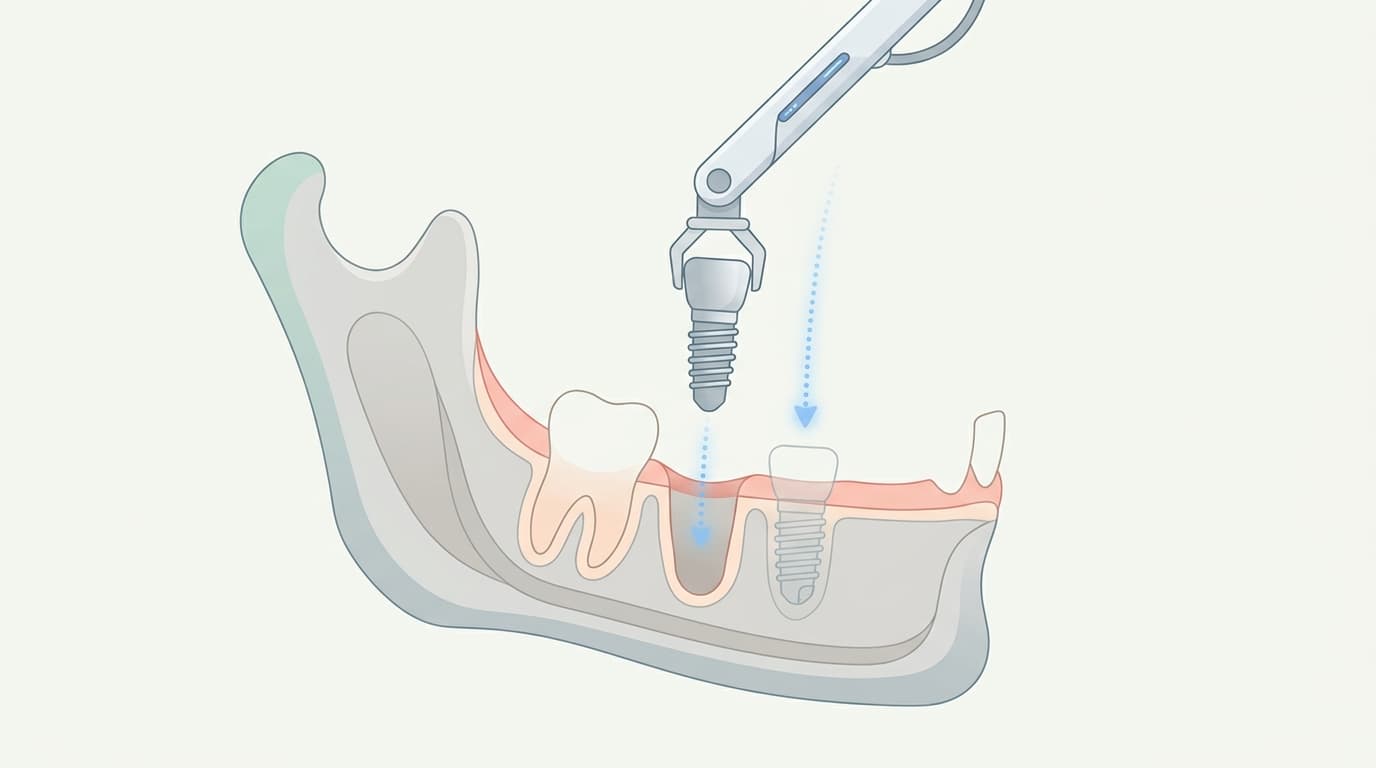
Planning the position and angle of a dental implant on a computer beforehand and carrying that plan directly into surgery is becoming increasingly common. Dental clinics describe this approach using terms such as navigation implant surgery, guided implant surgery, and, more recently, robotic implant surgery. Pooling the large-scale analyses published in recent years gives a fairly clear answer: computer-assisted surgery is clearly more accurate than surgery that relies on hand feel alone, but the difference between the various computer-assisted methods themselves is smaller than one might expect.
Clearly More Accurate Than Freehand Surgery
According to a 2025 analysis that pooled forty-five studies, computer-assisted surgery reduced the average error at the implant entry point by 0.65 mm, the error at the apex by 1.10 mm, and the angular error by 3.87 degrees compared with freehand surgery performed by hand feel alone, without a guide. A figure of around 1 mm may look small, but in tight spaces near the nerve canal, an adjacent tooth root, or the maxillary sinus, this margin of error can determine whether the implant actually reaches the planned position or not. Even in an analysis limited to cases where an implant had to be placed immediately into a freshly extracted socket (where the shape of the bone is hard to predict), computer-assisted methods still reduced the entry-point error by about 0.70 mm and the apex error by about 0.86 mm compared with freehand surgery. For a single molar implant in ample, straightforward bone, this difference may not be strongly felt, but in sites like the front teeth, where even a slight change in angle alters how the gumline looks, or in lower molar sites just a few millimeters from the nerve canal, this difference translates directly into the outcome.
Guided vs. Navigation: No Clear Winner
Computer-assisted methods split further into two types: a static approach, which transfers the pre-surgical plan onto a 3D-printed surgical template that fixes the drilling direction, and a dynamic approach, which shows the drill's position in real time on a screen. In Korea, the former is usually called guided implant surgery and the latter navigation implant surgery. A 2026 analysis that pooled data from more than 3,000 implants found no statistically significant difference between the two approaches. When only randomized controlled trials were pooled, both methods were clearly more accurate than freehand surgery, but when compared head-to-head, neither came out ahead. The practical difference is that a template must be printed in advance, so the plan has to be finalized several days before surgery, whereas the screen-based approach allows small adjustments to the plan during the procedure itself, but their final accuracy is similar. In Korea, the template-based static approach is more widely used, and it typically adds an extra cost of around 1,000,000 to 1,500,000 won. Because implant surgery itself is not covered by national health insurance, this additional cost also varies from clinic to clinic.
Robots Are the Most Accurate, but the Difference Is Small
In an analysis pooling twenty-seven studies, robotic-arm-assisted drilling showed the lowest average errors among the three approaches: 0.67 mm at the entry point, 0.71 mm at the apex, and 1.68 degrees in angulation. In an analysis limited to studies that directly compared robotic assistance with static and dynamic methods, the robotic approach again showed lower error: by 0.73 mm at the entry point, 0.84 mm at the apex, and 1.51 degrees in angulation. However, these differences amounted to no more than 1 mm in position and 2 degrees in angulation, and the researchers themselves noted that it is not clear whether a difference of this size is large enough to change real-world clinical outcomes. In Korea, robotic implant surgery is still in its infancy. Robotic systems commercialized abroad don't fully fit the domestic clinical environment, and so far only one university hospital has set up Korea's first dedicated operating room for the procedure. Anyone recommended robotic implant surgery should first ask the clinic what equipment it actually uses and how much surgical experience it has with it.
| Method | What It Uses | Error vs. Freehand |
|---|---|---|
| Guided (static) | 3D-printed surgical template | Positional and angular error markedly reduced |
| Navigation (dynamic) | Real-time position tracking on screen | Reduced to a level similar to guided surgery |
| Robotic assistance | Robotic arm assists with drilling | Smallest of the three methods, but the difference is minor |
Questions Worth Asking in the Clinic
- Which method (guided, navigation, or robotic) will be used for this surgery
- Why that method is being recommended: insufficient bone volume, proximity to the nerve canal, or an esthetically sensitive site
- How much extra it costs and exactly what that cost covers