
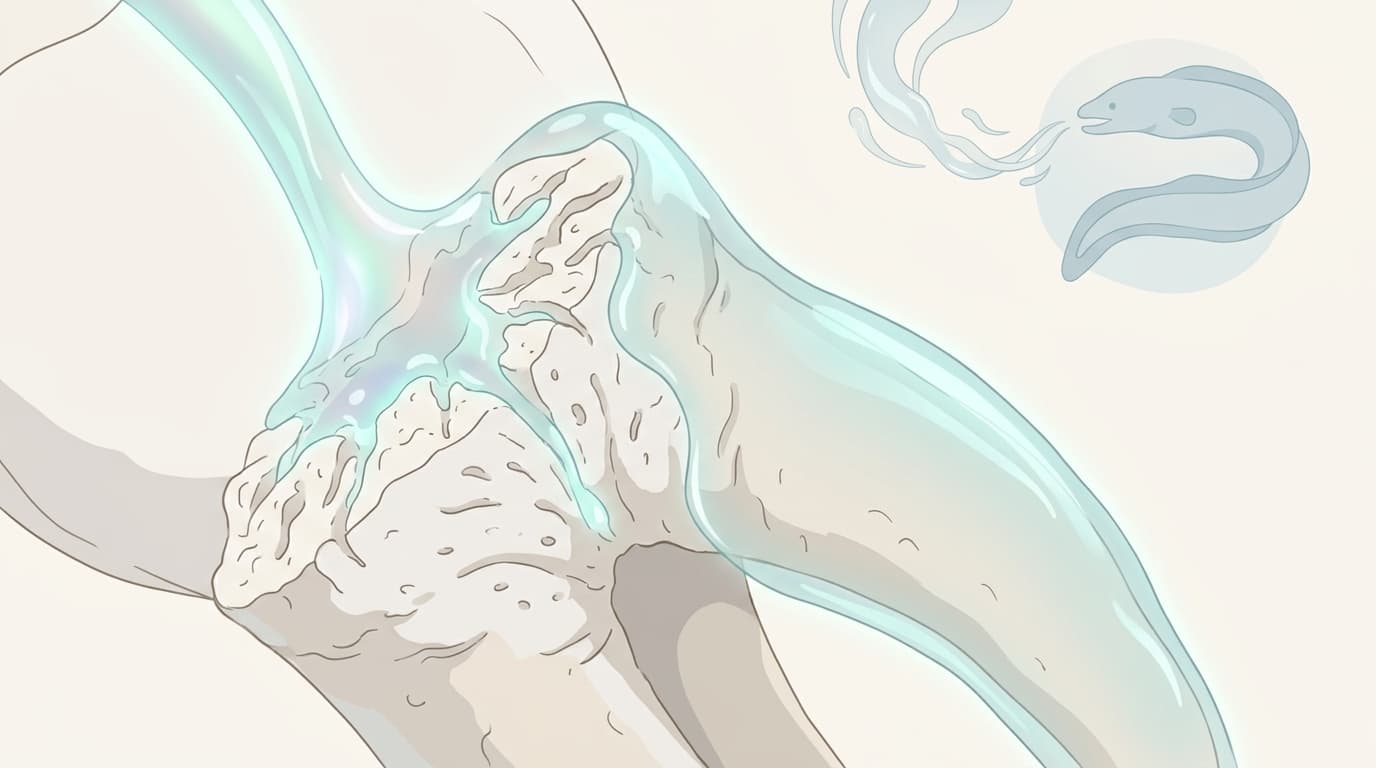
Caries that form on tooth roots begin on the root surface exposed when the gums recede. Lacking enamel, this surface is soft, uneven, and constantly wet with saliva, making it hard for any material to stay attached for long. In 2024, a research team at Sichuan University in China borrowed a mechanism from the defensive slime hagfish release when threatened, developing a root caries material that hardens on its own from liquid into gel upon contact with water.
Why It's Hard to Treat
A 2020 international expert Delphi consensus statement noted that root lesions are difficult to access by location and that patient cooperation is often limited, so clinicians commonly favor a palliative approach: managing plaque and applying fluoride instead of conventional fillings, and if that isn't enough, using glass ionomer cement for long-term stabilization. A 2024 Cochrane review also found moderate-confidence evidence that silver diamine fluoride (SDF) can arrest new root caries, though evidence comparing it with fluoride varnish or glass ionomer remains very uncertain. Existing methods focus on suppressing bacteria or replenishing minerals, but none has separately solved the problem of keeping a material attached to a rough, wet surface.
Borrowing a Principle from Hagfish Slime
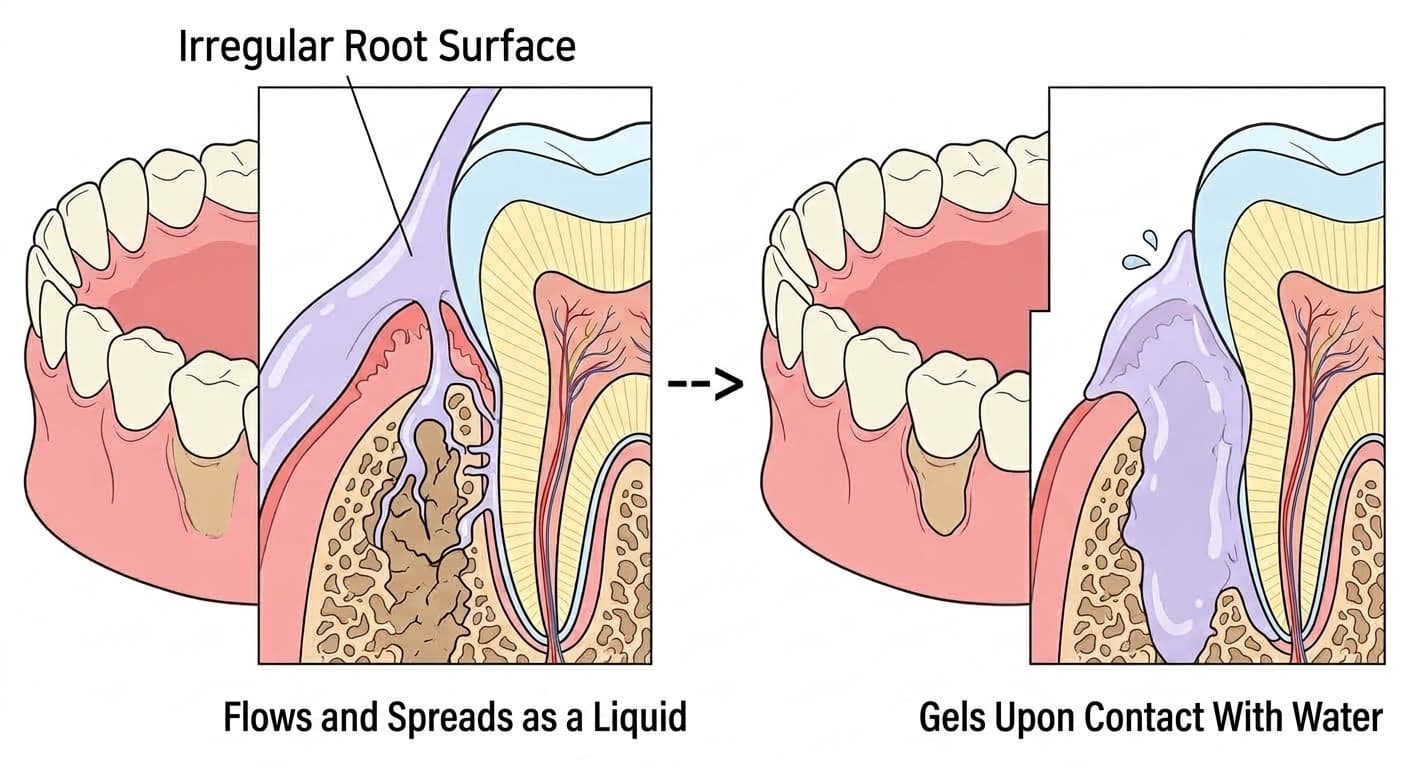
When a hagfish encounters a predator, it releases slime that turns into a gel on contact with seawater, clogging the attacker's gills. A team at Sichuan University's West China Hospital of Stomatology borrowed this water-responsive mechanism to create a liquid material combining silk protein (fibroin), tannic acid, black phosphorene (a thin two-dimensional material made of phosphorus atoms), and urea. Because urea keeps the hydrogen bonds between fibroin and tannic acid broken, the material stays liquid long enough to seep into the gaps of the root surface and into dentinal tubules (the microscopic channels within dentin). Once it contacts saliva, the urea diffuses away, the hydrogen bonds re-form, and the material hardens into a gel on the spot, interlocking with the surface's contours. Black phosphorene tightens the connections in this network, giving the material adhesive strength that resists detaching even in a wet environment.
Killing Bacteria and Replenishing Minerals
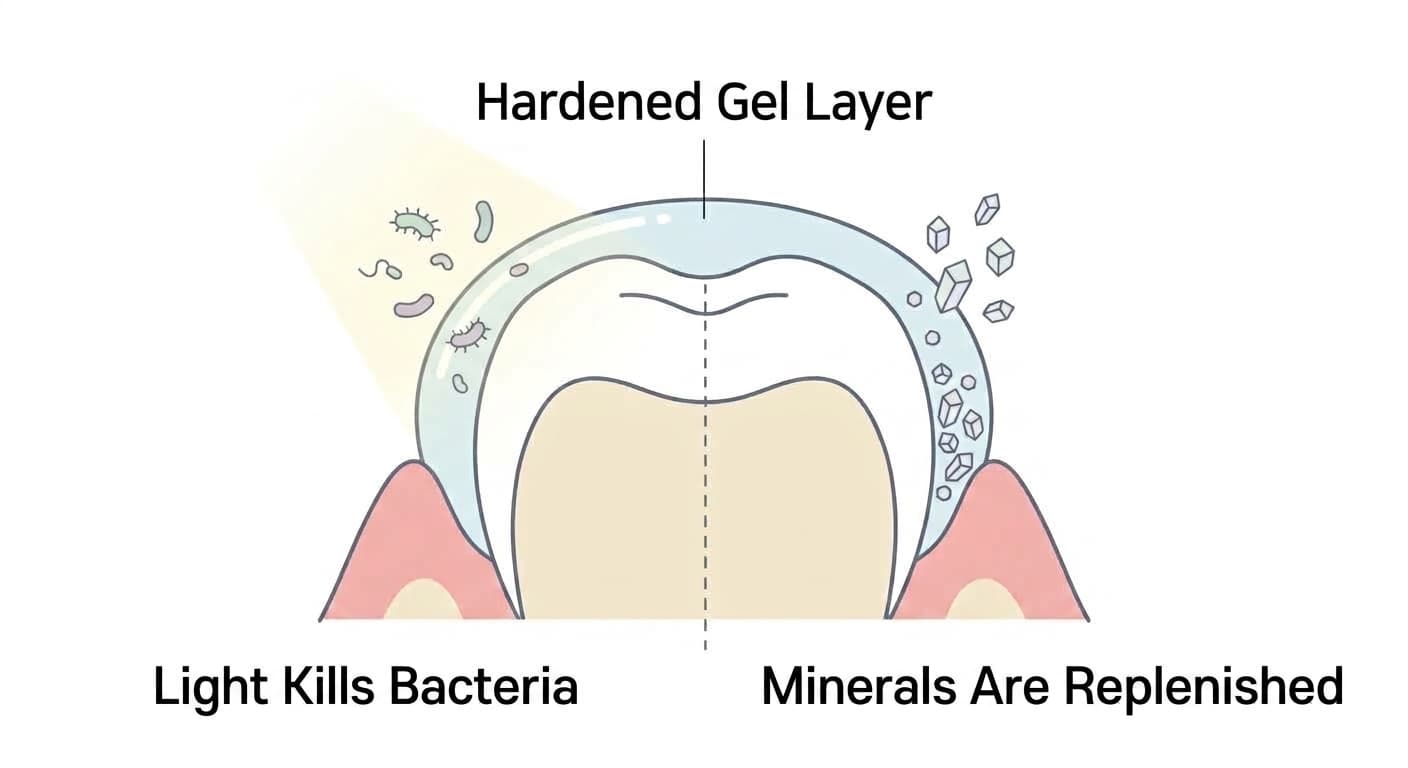
Once in place, the gel layer produces a phototherapy effect that kills bacteria when exposed to light, while simultaneously promoting remineralization of tooth dentin. This means the adhesion problem had to be solved first before the other functions could take effect. The real power of black phosphorene-mediated phototherapy can be gauged from a result reported around the same time by a team at Wenzhou Medical University. When a similar black phosphorene hydrogel inspired by mussel adhesive proteins was exposed to light, it eliminated roughly 99 percent of Streptococcus mutans and Streptococcus sanguinis, and a preventive effect was also confirmed in a mouse caries model. That study targeted enamel on the tooth crown, but the underlying principle of black phosphorene-mediated photo-sterilization is the same.
Still a Petri-Dish Experiment, With a Follow-Up Improvement
This material is still a laboratory-stage result tested on extracted teeth, and no animal or human trial has been reported. The same team followed up in 2025 with a next-generation material that adds guanidine hydrochloride and calcium phosphate nanoparticles. Even after 90 days of storage as a freeze-dried powder, it could be extruded smoothly from a syringe with as little as 0.8 newtons of force, fill in cavitated areas, and harden in place to seal dentinal tubules, with this performance confirmed in the lab. This points to continued progress toward a form that can be handled directly in the clinic.
Until now, managing root caries has meant repeatedly applying materials with only one function, either suppressing bacteria or replenishing minerals, to surfaces that are hard to reach. This material, which borrows the hagfish's water-responsive adhesive mechanism, takes a different approach: it solves the adhesion problem first, then layers sterilization and remineralization functions on top. Whether the same performance holds up inside the human mouth is a question the next stage of research will need to answer.