
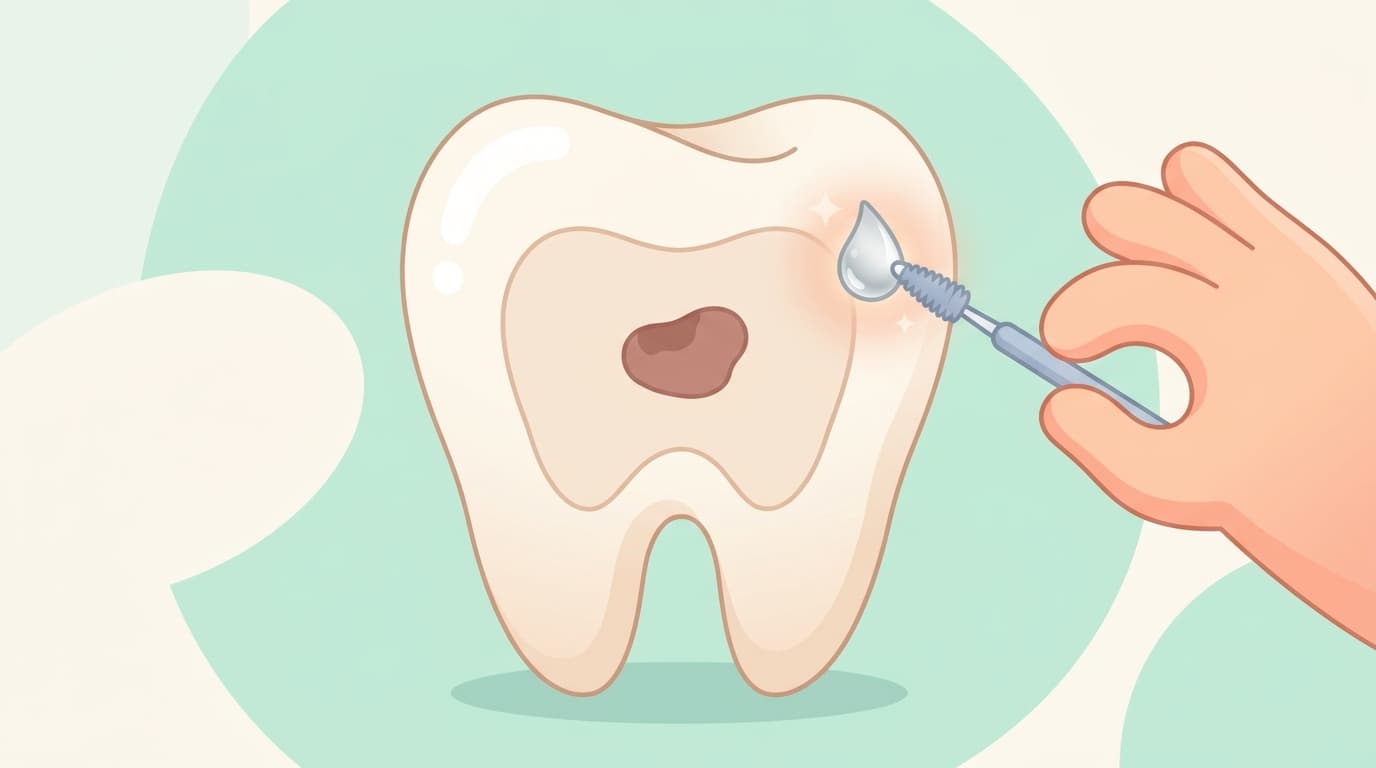
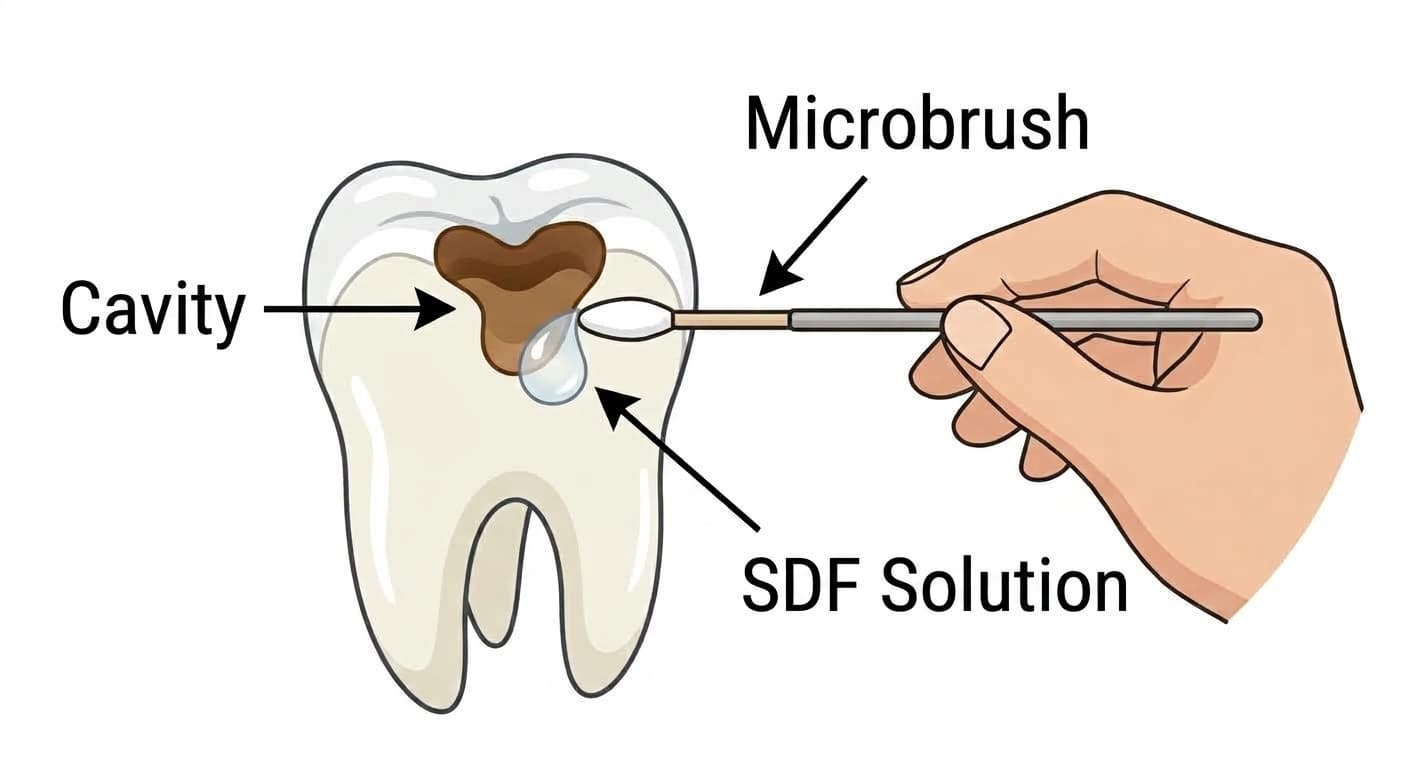
In young children, cavities, especially ones that have already broken through into a baby tooth, are hard to treat without anesthesia and a drill. Children who are especially fearful or too young to sit still in the dental chair sometimes need general anesthesia just to get through treatment. A large clinical trial recently conducted on 830 children in the United States has offered one answer to this problem: simply brushing a liquid called silver diamine fluoride (SDF) onto the cavity with a small brush-tipped applicator for about 10 seconds can substantially stop its progression.
Stopping Cavities Without Drilling
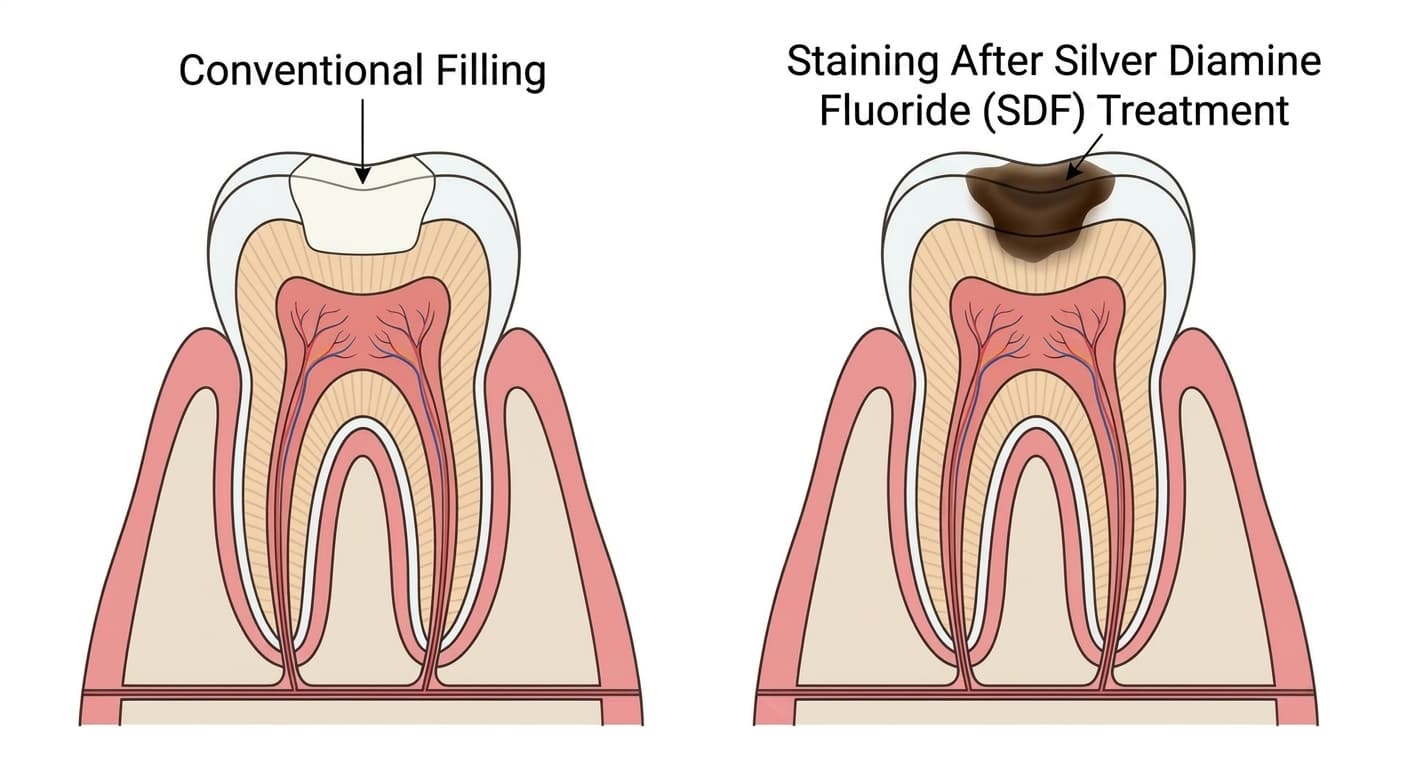
SDF is a clear liquid that combines silver ions and fluoride ions. The silver ions suppress the growth of the bacteria that cause cavities, while the fluoride ions re-harden the tooth surface (dentin) that has been dissolved by acid. Unlike a conventional filling, which grinds away the decayed tissue and fills the space with material, SDF leaves the decayed tissue in place and is brushed onto the surface to halt bacterial activity. That is why it requires neither an anesthetic injection nor a drill.
What a Trial of 830 Children Found
Funded by the U.S. National Institute of Dental and Craniofacial Research (NIDCR) and conducted jointly by the University of Michigan and other institutions, this phase 3 clinical trial enrolled 830 children aged 12 to 71 months who already had severe cavities. The product used was Advantage Arrest, a 38% concentration SDF product made by Elevate Oral Care in the United States, and children were randomly assigned to receive either this product or a visually identical placebo liquid. When re-examined six months later, cavity progression had stopped in 54.0% of those who received SDF, compared with only 22.5% of those who received the placebo. By the eight-month mark, following a second application, the gap held steady at 50.2% for SDF versus 17.4% for placebo. There was no difference between the two groups in reports of increased pain, and the rate of side effects was similar (47.3% in the SDF group and 43.3% in the placebo group), with most being mild to moderate.
Interestingly, even with just the placebo, roughly one in five cavities stopped progressing on its own, a reminder that cavities can sometimes halt spontaneously when brushing habits or diet change. However, because the children in this trial were young and already at high risk with severe cavities, the arrest rates were lower than the 64–90% reported in other studies of older preschool-age children. The researchers suggested this may be because it is harder to keep a young child's teeth dry during treatment, and habits that promote cavities, such as falling asleep with a bottle, are more likely to persist at that age.
How It Compares with Fluoride Varnish and Fillings
Separate studies have also examined whether SDF outperforms other preventive treatments. One study divided 139 early-stage cavities (not yet cavitated) in the molars of 6- to 12-year-olds into a group treated with SDF plus potassium iodide and a group treated with 5% fluoride varnish. Six months later, 88.1% of the SDF group's lesions had returned to a cavity-free state, compared with 65.6% in the fluoride varnish group. Both methods worked, but SDF came out ahead.
A meta-analysis also compared SDF against Atraumatic Restorative Treatment (ART), which lightly removes decay without anesthesia and then fills it, instead of applying a liquid. Pooling six randomized controlled trials, SDF showed slightly better outcomes than ART, but with so few studies included, the authors concluded that both approaches can reasonably be considered viable options.
The Trade-off: Teeth Turn Dark
SDF has one clear drawback. As the silver ions react with the decayed part of the tooth, they stain it a dark brown or black. This discoloration does not fade. In fact, it grows darker the more effectively the treatment works. For that reason, SDF is mainly used on less visible sites, such as molars or baby teeth that will soon fall out, rather than on front teeth that are on display.
In a study that tried applying potassium iodide on top of SDF to reduce staining, the discoloration looked lighter for about the first two weeks, but the difference disappeared over time, and parents' satisfaction varied widely. Another point worth remembering is that SDF stops cavity progression rather than eliminating the cavity itself. In this clinical trial as well, nearly half of the cavities did not stop progressing even after one or two applications. So rather than being a complete solution on its own, SDF is establishing itself as one tool to be used alongside brushing and regular checkups.
In the United States, this compound has been approved since 2014 only for treating tooth sensitivity in adults. Using it for children's cavities has, until now, been off-label. This clinical trial was conducted to build the evidence base for expanding that approval, and for children whose parents can accept the dark staining, it adds a real, drill-free option for stopping cavity progression.