
A new study has found that even in one-year-olds with perfectly healthy teeth, a gene-sequencing look at the bacterial makeup of their saliva already reveals whether they will develop cavities by age two. The finding comes from a team at Chulalongkorn University in Thailand that analyzed children's saliva, and it starts from a different point than the methods used until now, which gauged risk from brushing habits or signs of cavities that had already formed.
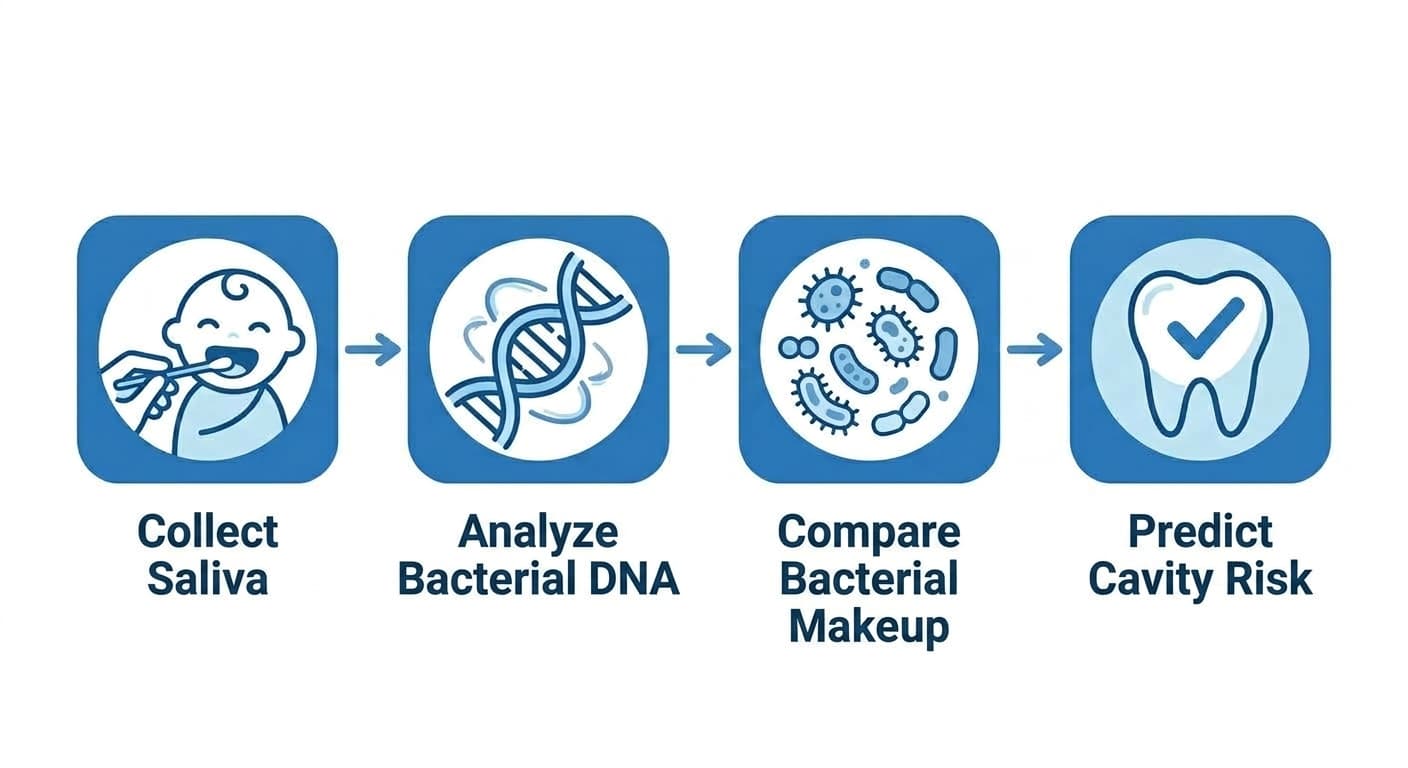
By Age One, Saliva's Bacterial Makeup Has Already Diverged
The research team followed children until age two and split them into three groups based on whether cavities developed: 10 children with no cavities at all, 10 with early, invisible decay, and 10 with a cavity that had progressed all the way to a hole in the tooth. All three groups had saliva collected in advance, at around age one, before any of them had a single cavity. Analyzing the bacterial genes in this saliva showed that the bacterial makeup itself differed, with statistical significance, between the saliva of children who went on to develop a cavity with a hole by age two and the saliva of children who stayed cavity-free. In particular, four species, Prevotella nanceiensis, Leptotrichia, Prevotella melaninogenica, and Campylobacter concisus, were especially abundant in the saliva of children who remained cavity-free. When the ratio of these four species was fed into a machine-learning model, it correctly identified, in roughly 8 out of 10 children, whether a child would develop a cavity with a hole by age two. However, this accuracy comes from a small sample of just 30 children, so its confidence interval is wide, running from 44% to 98%, and could shift with a larger group.
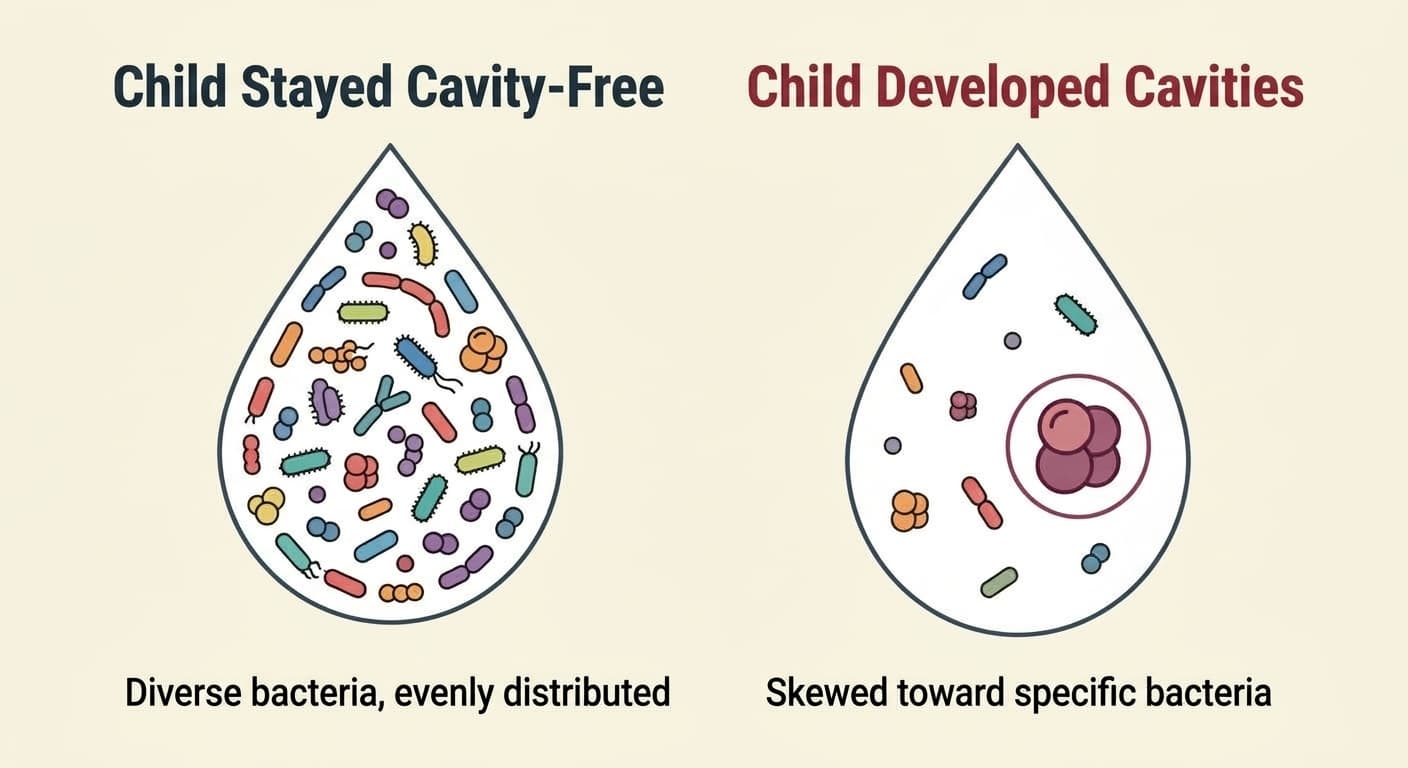
It Starts Up to Three Years Before a Cavity Appears
A joint Dutch-American study that followed 266 children for more than six years points to a similar timeframe. The bacterial makeup of saliva and dental plaque had already diverged from that of healthy children up to three years before a cavity was diagnosed at the dentist. The difference showed up first in saliva around age one, then in the plaque on tooth surfaces around age two and a half. However, exactly which bacteria raise the risk and which lower it came out differently between the two studies, so no single, settled picture exists yet. What the two studies do agree on is the timing itself: the oral microbial ecosystem shifts before a cavity becomes visible.
The Old Way: Brushing Habits and Culturing a Single Bacterium
The cavity risk assessments commonly used at dental clinics combined behavioral and clinical information, such as how often a child brushed, whether fluoride toothpaste was used, and how many cavities had already formed. A 2025 review that pooled and re-analyzed 11 such prediction models found accuracy ranging from 57% to 91% across studies, with a model that combined six pieces of information reaching around 79%. That is not far off from the 80% accuracy of the saliva-bacteria prediction model above. Bacteria were not entirely ignored, either. An older method used by a Hiroshima University team in 2025 on patients about to begin orthodontic treatment involved smearing saliva on a culture plate and scoring how much a single cavity-related bacterium, Streptococcus mutans, grew. In that study too, the lowest-risk group had abundant Fusobacterium in their saliva, while the highest-risk group showed a prominent presence of Actinomyces; this same pattern, bacterial makeup tracking with risk grade, repeated in a different age group as well. However, that method cultures and scores just one bacterium, while the new approach reads a single stretch of DNA (16S ribosomal RNA) all at once to capture the full compositional ratio of bacteria in saliva. And while the older assessment can only be used once brushing habits are established and teeth have erupted, the bacterial-composition test can judge risk from saliva alone at around age one, before more than a few teeth have even come in. Much as the aMMP-8 self-test kit, which checks for gum disease in advance from saliva, measures the concentration of just one enzyme, existing bacterial tests have likewise narrowed their target to a single marker.
This prediction model has not yet left the lab as a commercial test. The research team itself has said that further validation is needed before it can be developed into a supplementary tool to aid prevention and management. Since this is a preliminary study comparing three groups of just 30 children in total, it remains unconfirmed whether the same results would hold in other populations or with larger numbers. What these studies show in common is that, before a cavity becomes visible, the bacterial makeup of saliva has already diverged. Alongside the existing approach of gauging risk from brushing habits or signs of cavities that have already formed, an additional axis is now taking shape: reading the bacterial makeup of saliva.