
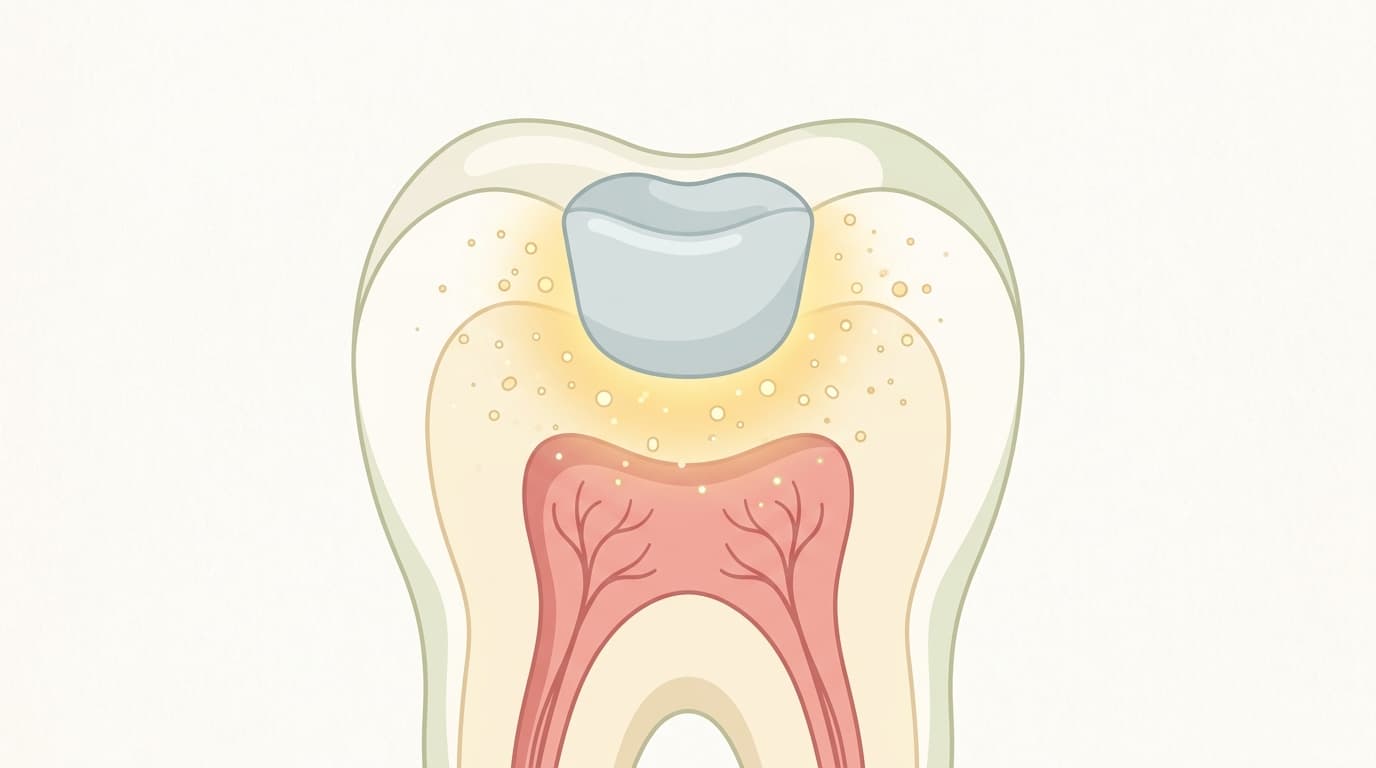
A tooth that has been drilled out and filled can still decay again over time. This so-called secondary caries is considered the most common reason a restoration has to be removed and retreated. To prevent it, dentistry has increasingly turned to 'bioactive' restorative materials that release ions such as calcium, phosphate, and fluoride on their own. But when three recent meta-analyses are placed side by side, whether these materials actually prevent secondary caries turns out to depend heavily on which material is used.
We previously covered how self-assembling peptides can remineralize early lesions that haven't yet cavitated. The materials discussed here are a different story: protecting the interface after a cavity has already been drilled out and filled.
Why Filled Teeth Decay Again
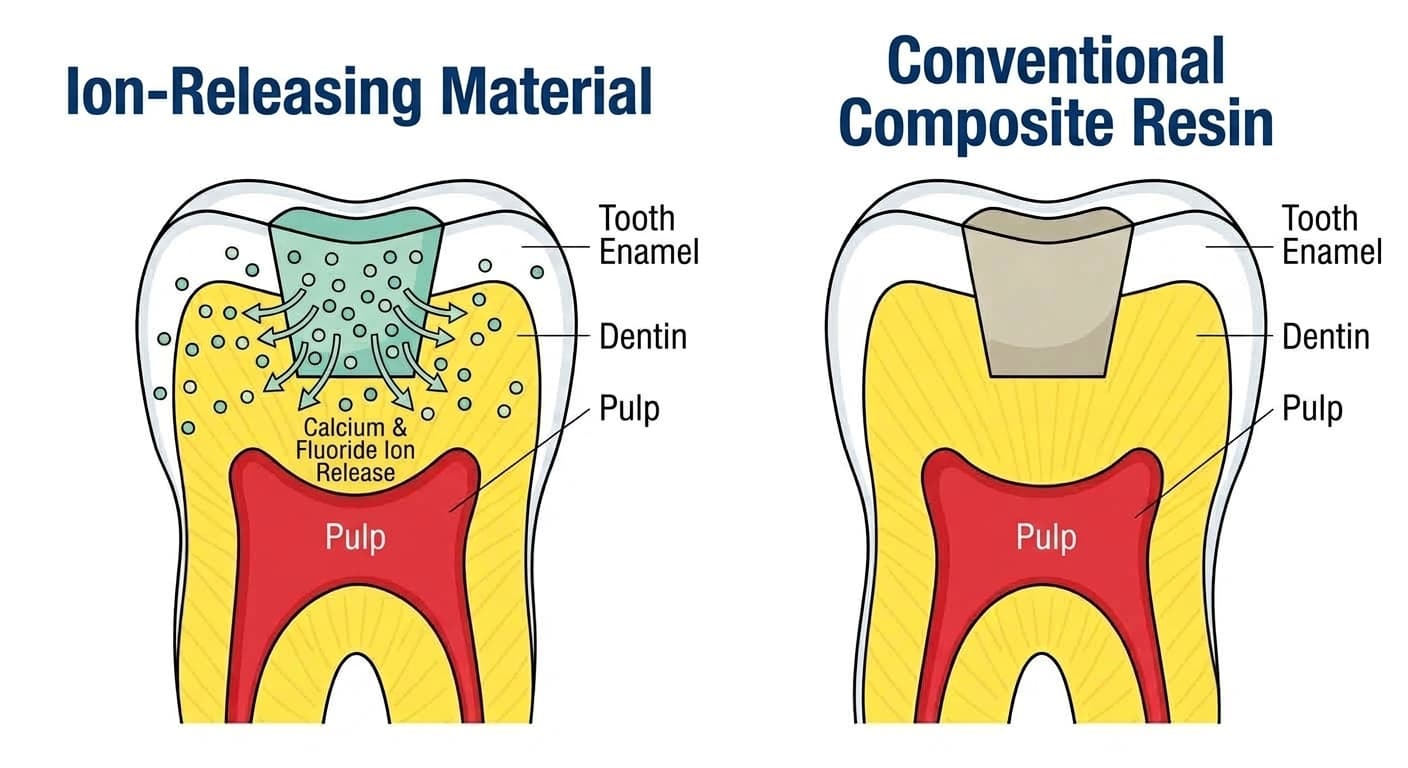
Plaque can build up around a restoration too, and when tooth structure is damaged by acid, secondary caries results. Beyond the condition of the restoration margin, factors such as oral hygiene, diet, saliva flow, and a person's individual caries risk all play a role. Composite resin, long the most widely used material, is an inert material that does not chemically react with the tooth once it has set. While it excels in strength and color match, it has no ability to seal that gap on its own or push back against bacteria.
How Ion Release Differs by Material
Ion-releasing restoratives emerged to address this problem. The oldest, glass ionomer cement (GIC), steadily releases fluoride and calcium ions that help remineralize the surrounding tooth structure. Resin-modified glass ionomer (RMGI) adds a resin component to boost its strength. More recently, a material called giomer has come into wide use. It's made by blending surface pre-reacted glass (S-PRG filler) into a resin matrix, giving it an appearance and strength close to conventional composite resin while still being designed to release ions like glass ionomer. A material class called alkasite is also known to release ions in a similar way. In a 2022 policy statement, the FDI World Dental Federation set out criteria for calling a material 'bioactive': its mechanism of action must be clear, and its effect must be confirmed in laboratory or clinical studies. In other words, releasing ions is one thing; whether those ions actually prevent decay is another.
Three Meta-Analyses, Different Conclusions
The first meta-analysis, pooling multiple studies, found that bioactive materials lowered the risk of secondary caries by 45% relative to conventional materials, with no statistical heterogeneity observed. But broken down by material, glass ionomer clearly reduced the risk, while giomer showed no statistically significant difference. Another meta-analysis, drawing on studies from multiple countries, looked at ACTIVA BioACTIVE, giomer, and the alkasite material Cention N, and found no significant difference from conventional composite resin in either secondary caries or retention loss. The most recent network meta-analysis pooled 13 randomized controlled trials with follow-up periods ranging from one to eight years, comparing giomer and alkasite against conventional composite resin and resin-modified glass ionomer. Across every measure, including secondary caries, no material showed consistently superior results. Because the number of secondary caries events was small, there were limits to judging differences in preventive effect.
What a 12-Month Clinical Trial Found
A randomized controlled trial from Cairo University's Faculty of Dentistry in Egypt, which tracked cervical lesions on upper anterior teeth for 12 months, illustrates this pattern concretely. Teeth were filled with either the giomer Beautifil II LS (Shofu) or the resin-modified glass ionomer Fuji II LC (GC), and compared. After 12 months, clinical performance was similar between the two materials on most measures. Giomer scored better only on surface gloss and texture, and the resin-modified glass ionomer lost its gloss over time. A cost-effectiveness analysis found that giomer had a higher upfront cost but a lower cost per successful outcome, confirming both materials as practical options for clinical use.
Taken together, the three meta-analyses and the clinical trial suggest that containing ion-releasing components and actually preventing secondary caries are two separate things. One meta-analysis did observe a reduction in secondary caries risk with glass ionomer. But that reflects a comparison of the material's overall clinical performance, not evidence isolating the effect of ion release alone. Choosing a material also involves weighing strength, aesthetics, and lesion location. The giomer and alkasite materials that have become more common in recent years keep strength and color closer to composite resin, but their ability to prevent secondary caries has yet to be consistently proven.