
Anyone who has gone through a whitening treatment knows what it is like to keep a thick gel in the mouth for a long stretch of time. The gel's main ingredient, hydrogen peroxide, works reliably, but it can irritate the gums and weaken the enamel (the hard outer layer of the tooth). Because of this, catalytic approaches that use light, vibration, or temperature change to trigger the same reaction instead have emerged one after another in recent years. In 2026, a research team at Huazhong University of Science and Technology in China added a magnetic field to this lineup, introducing a new catalytic system that triggers the reaction inside the gel wirelessly, without connecting any wires to the body.
After Hydrogen Peroxide, Light, Vibration, and Temperature Drove the Catalyst
Whitening agents used in dental clinics generally apply a gel containing high-concentration hydrogen peroxide to the tooth surface. As hydrogen peroxide breaks down, it produces reactive oxygen species that cleave the double bonds in pigment molecules, removing the color. But because this is a strong oxidation reaction, it can leave behind gum irritation or tooth sensitivity, and treatment sessions tend to run long.
To ease this burden, catalytic materials that use light, vibration, and temperature change to trigger the same oxidation reaction were developed instead. A study published in the international journal Nature Communications in 2020 mixed barium titanate (BaTiO3) nanoparticles, a piezoelectric material, into a gel in place of the abrasive in toothpaste. Simply shaking the gel with ultrasound, similar to brushing, made teeth stained with black tea, blueberry juice, and wine visibly whiter within 3 hours and nearly completely white within 10 hours. A follow-up study published in the same journal in 2022 used temperature change inside the mouth instead of vibration. Barium titanate nanowires, a pyroelectric material, picked up the everyday temperature swings that occur when hot food raises the mouth's temperature from 36°C to 48°C and cold food drops it to 21°C; after 2,000 repetitions of stimulation cycling the temperature up and down by 25°C, the teeth turned completely white. Both studies reported no damage to the enamel or to cells.
Generating Electricity From a Magnetic Field to Drive the Reaction in the Gel
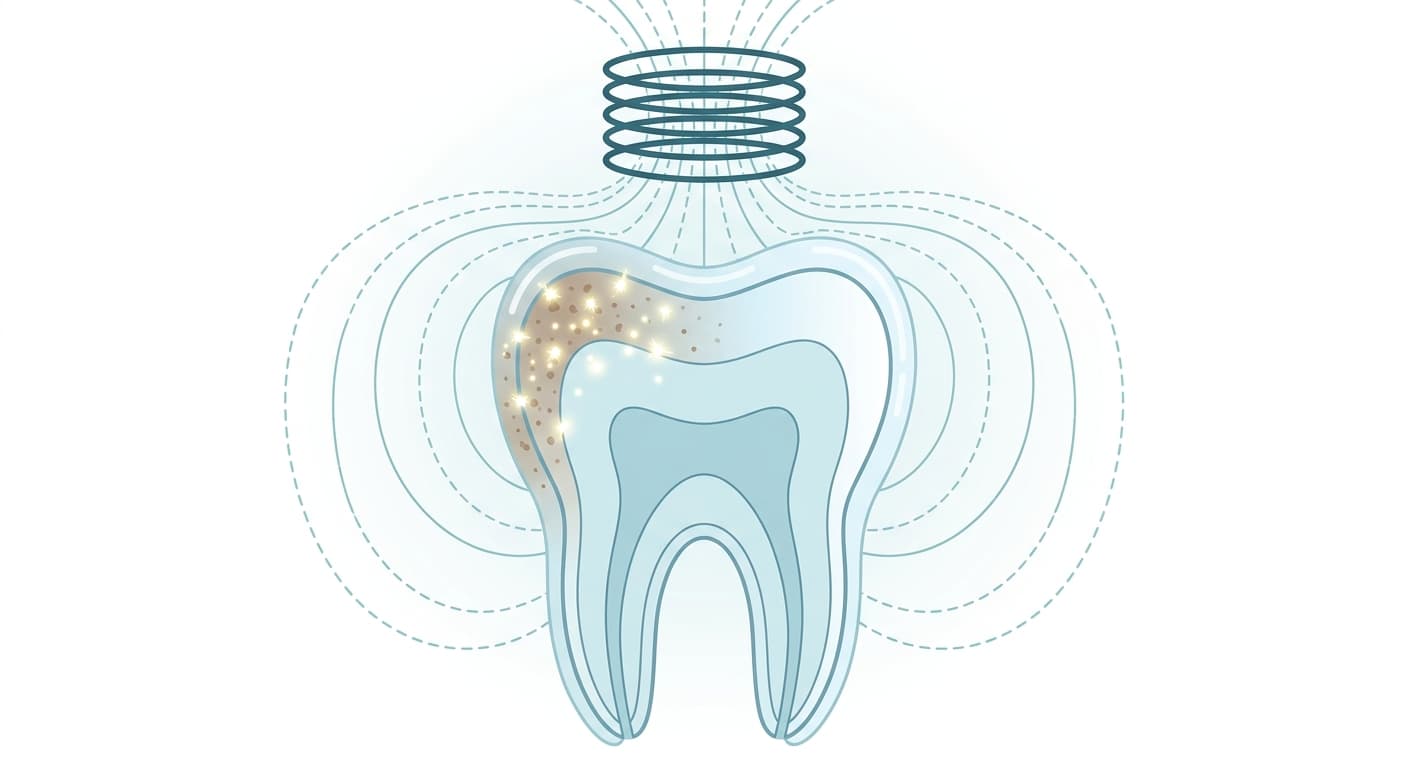
Light has difficulty penetrating deep into the tooth surface, and vibration and temperature change have the limitation that a person must actually brush their teeth or eat food to generate the stimulus. The 2026 study replaced this stimulus source with a magnetic field. The approach mixes a magnetoelectric material, one that generates electricity when exposed to a magnetic field, into the whitening gel, then applies an alternating magnetic field from outside the mouth that continuously changes direction. Without connecting anything to the body, the material responds to the magnetic field by generating electricity, and that electricity triggers the oxidation-reduction reaction that breaks down the pigment inside the gel. The research team reported that this approach markedly sped up the reaction compared with the earlier light-, vibration-, and temperature-based catalysts.
Still at the Tooth-Sample Stage, Results in Humans Remain to Be Seen
Like the earlier piezocatalysis and pyrocatalysis studies, this research is a lab-stage result using stained tooth samples. The paper's abstract only states that the method cut the time needed compared with existing approaches; it does not disclose specific figures showing how much whiter the teeth became within a given number of hours. Piezocatalysts and pyrocatalysts were published in the same journal in 2020 and 2022, respectively, but neither has yet reached clinical use as an actual product. It will likely take more time to confirm whether a catalytic reaction verified in the lab also works safely and effectively inside a person's mouth.
The stimulus that triggers a tooth-whitening reaction has expanded from light to vibration and temperature, and now to magnetic fields. Because the magnetic-field approach can trigger the reaction without connecting any wires, it is easier to handle than the earlier methods, but it is still too early to call it as well validated a replacement for hydrogen peroxide.