
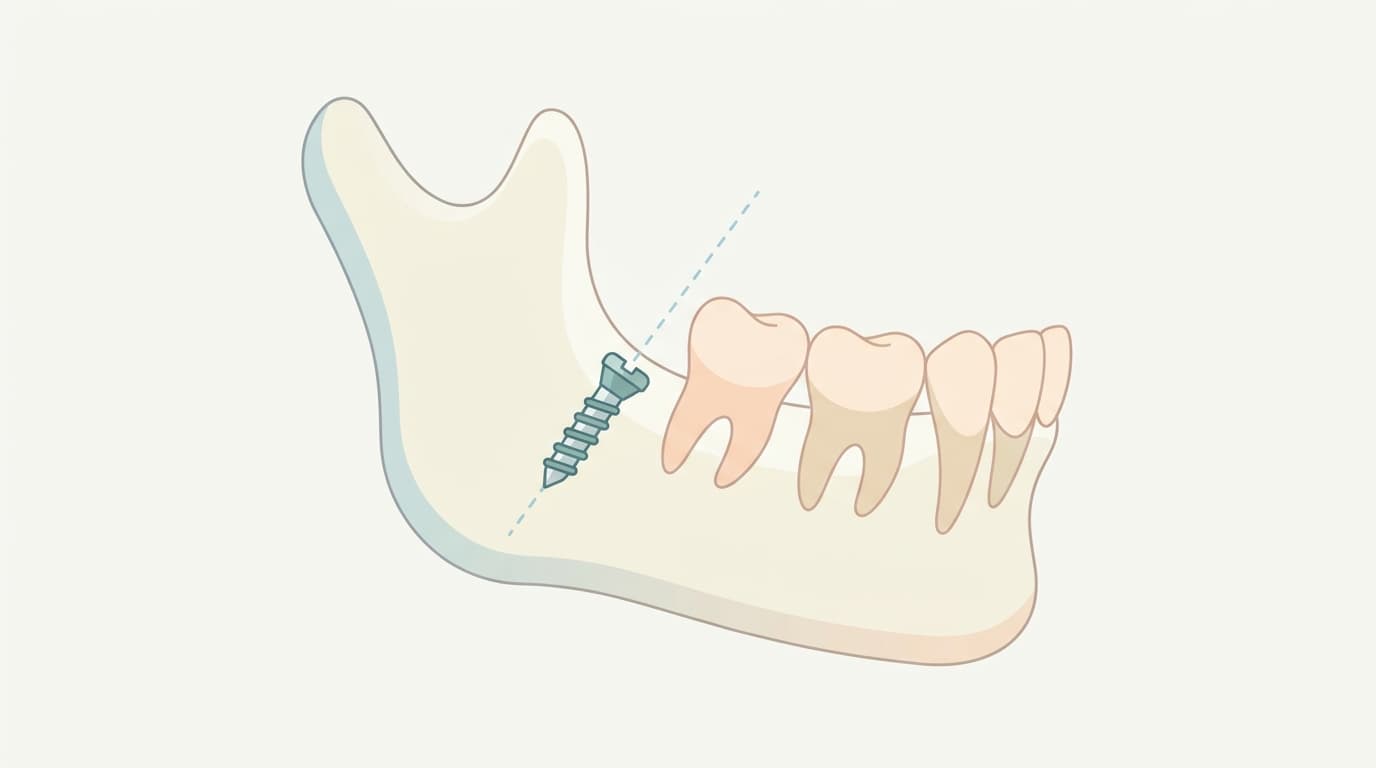
Moving a tooth backward requires an anchorage point on the other side that can resist being pulled along with it. That role has traditionally fallen to other teeth, or to a headgear worn outside the mouth. More recently, miniscrews (skeletal anchorage devices used in orthodontics) have taken over this role: a small screw is placed directly into the jawbone instead of relying on teeth, and the screw itself serves as the anchorage. A study published in 2026 found that simply changing the angle at which this screw is inserted can shift the success rate by nearly 15 percentage points.
Anchored in Bone, Not Teeth
Any force used to move a tooth inevitably acts in the opposite direction as well. When a molar is pushed backward, the anchorage bearing that force gets pulled forward in turn. If other teeth are bundled together to serve as the anchorage, those teeth gradually shift out of place too. A headgear, an external device worn outside the mouth to add force, only works if it's worn for a set number of hours each day.
A miniscrew is a small screw, roughly 1.4 to 2mm in diameter and 6 to 12mm long, placed directly into the jawbone through the gum, with the screw itself serving as the anchorage. Because bone doesn't shift under load the way teeth do, it allows a tooth to be moved in the desired direction without sacrificing any other tooth. One representative use is placing miniscrews in the buccal bone below the cheekbone, behind the upper molars (commonly called IZC, short for infrazygomatic crest, in dentistry), to pull back the entire upper dental arch. This is a standard way to correct a protruding-front-teeth malocclusion (Class II malocclusion) without extracting any teeth.
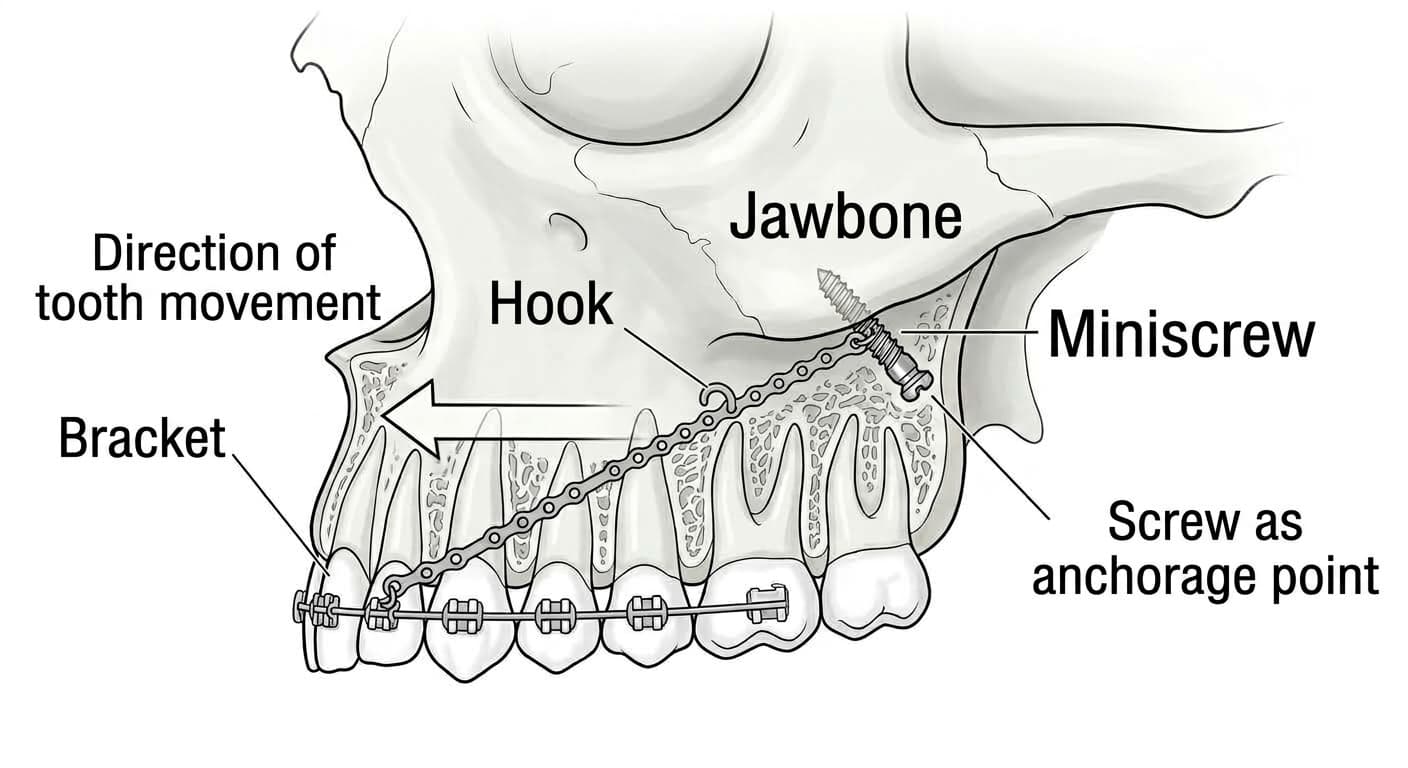
The amount of movement achievable also depends on the type of anchorage. Pooled data from multiple studies show that headgear could push the upper molars back by about 2.5mm, whereas miniscrews achieved 4 to 5.4mm depending on placement site.
| Anchorage type | Posterior movement of upper molars |
|---|---|
| Headgear | ~2.5mm |
| Buccal miniscrew | ~4.2mm |
| Palatal mini-implant | ~5.4mm |
| Infrazygomatic miniscrew (IZC) | ~5mm |
These figures are pooled averages from studies that differed in patient populations and measurement methods, so individual results can vary.
The Insertion Angle Determines Success or Failure
When a miniscrew loosens or falls out, the entire orthodontic plan is thrown off. A 2026 study compared two miniscrews placed in the infrazygomatic region within the same patient's mouth, one at 45 degrees and one at 70 degrees, side by side. Over eight months of follow-up, the success rate at 70 degrees (73.5%) was markedly higher than at 45 degrees (58.8%). The force required to drive in the screw (insertion torque) was also greater at 70 degrees. The thickness of cortical bone (the hard outer layer of bone) that the screw engaged was 2.6mm at 70 degrees, versus 2.05mm at 45 degrees. Inflammation around the gum near the screw was also more frequent at 45 degrees.
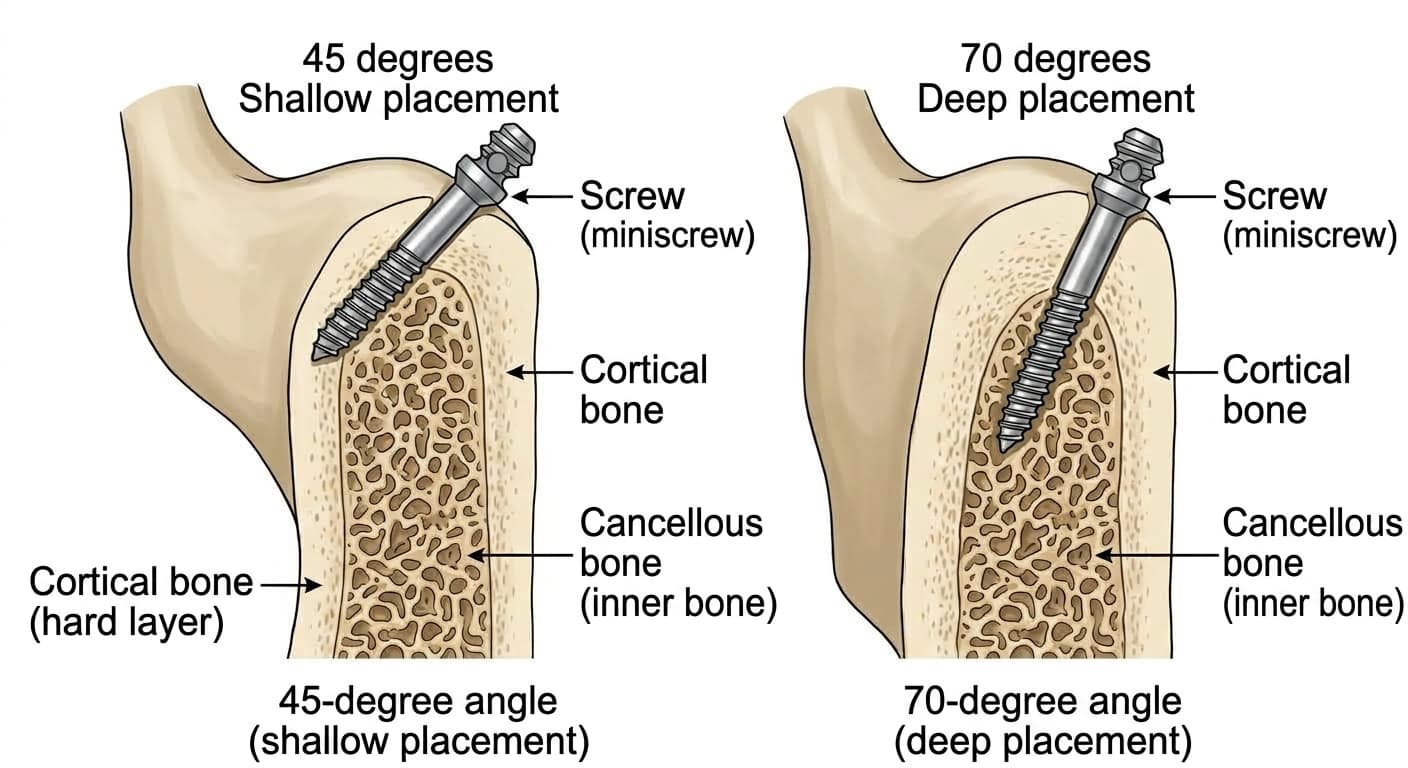
A steeper angle means the screw engages a greater thickness of bone, giving it a firmer grip, the same principle as a wood screw biting more securely into a thick block of lumber than into a thin panel. That said, this comparison came from a single-center study, so it remains to be seen whether the same difference holds up in other clinical settings.
Position and Depth Are Also Becoming Standardized
Placement site and depth matter just as much as angle. Pooled data from multiple studies found that bone was thickest and most stable when the screw was placed on the buccal side of the upper first molar, 10 to 15mm above the occlusal surface, at a 60 to 70 degree angle. A multi-year retrospective study of miniscrews placed at this site found an overall failure rate of just 1.5%, though the failure rate was higher in patients over 45.
A study that tracked actual treatment outcomes with miniscrews placed at this site found that the upper molars moved back by an average of 2.6mm, and overjet (the degree of front-teeth protrusion) decreased by about 2.3mm. When success rates alone were pooled across studies, the average came out to around 92%, though individual studies ranged widely, from 66% to 99%.
Taken together, these three studies show that where a miniscrew is placed, once left to a clinician's experience, is now being pinned down with specific figures for angle, height, and bone thickness. An anchorage that can push teeth in the desired direction without extraction or headgear is moving from a domain of individual clinical intuition into one of defined standards.