
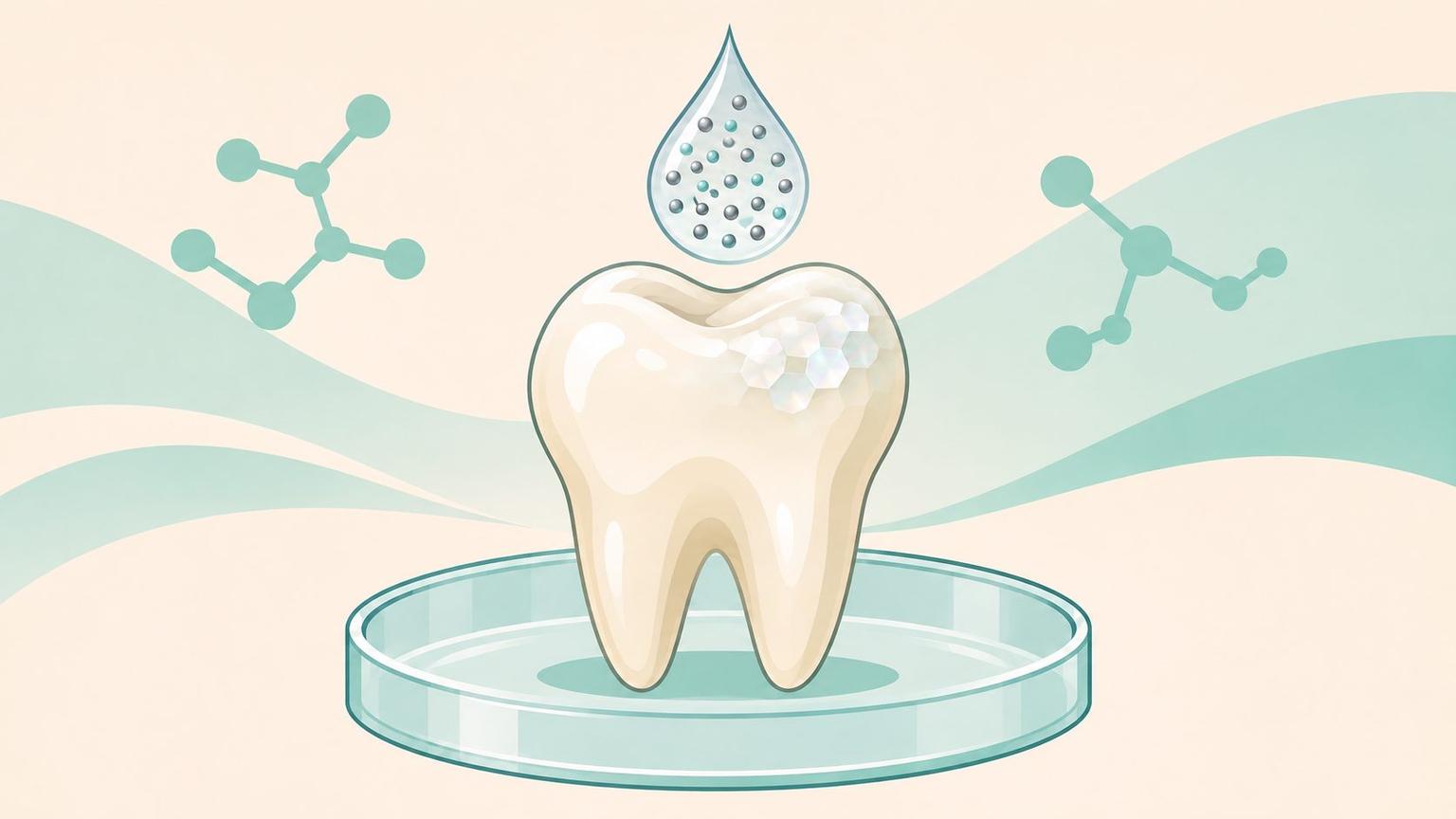
In an experiment published in February 2025 by researchers at Qassim University and Yonsei University, a formulation combining nanosilver and fluoride with the amino acid L-arginine helped restore minerals in areas of early tooth decay in extracted teeth. The black staining seen with silver diamine fluoride (SDF) was not observed with this formulation. These findings reflect the repair of artificially created damage in tooth specimens, rather than treatment of tooth decay in people.
A Form of Silver That Reduces Black Staining
Our previous article on SDF examined the arrest of tooth decay in children. Here, the question is whether changing the form of silver and its formulation can reduce staining while maintaining mineral recovery. The new formulation is called NSF + Arg, meaning nanosilver fluoride (NSF) with added arginine.
SDF combines the antibacterial action of silver with the mineral-restoring action of fluoride. The problem is that reactions involving the silver component turn teeth black. NSF uses silver made into small particles and incorporated into chitosan, together with fluoride. This approach changes the form in which silver is present rather than removing it.
Fluoride helps calcium and phosphate lost from enamel, the outer layer of a tooth, build up again. This process is called remineralization. The early tooth decay targeted by the researchers is the stage before a hole forms in the surface. Its scope of application differs from technologies that recreate tooth structures already lost.
Particles and Fluoride Controlled with Arginine
Arginine binds to silver and helps reduce particle clumping. Electron microscopy showed that adding arginine preserved the generally rounded shape of the silver particles, but reduced their average size and made their size distribution more uniform. In other words, an additive could control the state of the particles within the same nanosilver formulation.
The researchers also focused on arginine's ability to attract fluoride. They explained that it could help damaged areas take up fluoride and promote the formation of a mineral layer more resistant to acid. However, these findings alone cannot establish how much particle stabilization and fluoride uptake each contributed to recovery.
NSF + Arg was synthesized by the research team. Comparisons included NSF without arginine, Elevate Oral Care's FluoriMax fluoride varnish, SDF from Dengen Dental, and tooth specimens receiving no agent. This placed the new formulation in context alongside existing topical fluoride agents and silver-containing solutions.
Assessing Color Change and Mineral Recovery Separately
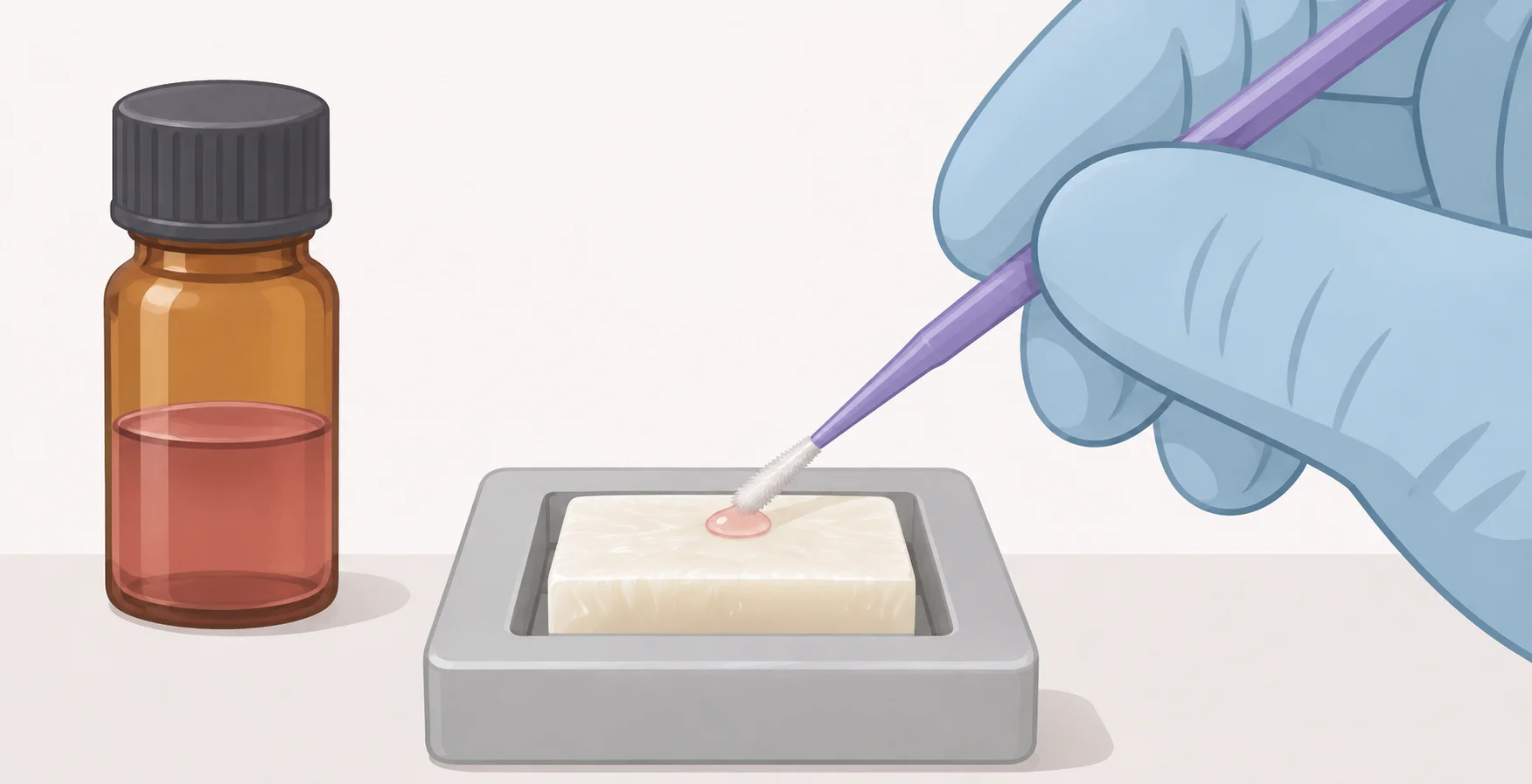
The researchers alternately immersed tooth specimens in an acidic solution and a solution supplying minerals. Micro-CT assessed mineral density inside the teeth, an indentation test assessed surface hardness, and a color-measuring instrument assessed staining. Surface hardening and internal mineral recovery were evaluated separately.
With NSF + Arg, the proportion of lost minerals recovered was 35.07%. This does not mean that 35.07% of the entire tooth was newly created. This measure was higher than with NSF without arginine and fluoride varnish, but showed no clear difference from SDF. Meanwhile, no differences in surface hardness were found among the four formulations applied to the specimens. The new formulation therefore cannot be described as superior on every measure.
For staining, only SDF produced a clearly greater color change than the other formulations. Color change with NSF + Arg was not statistically distinguishable from that with fluoride varnish or no agent. However, varnish was left in contact for 24 hours and the other solutions for 3 minutes, so the comparison did not use equal contact times. An experiment that alternates solutions cannot reproduce the mouth, where saliva and bacterial biofilms act together, and the new formulation's cytotoxicity also needs separate assessment.
This development points to the possibility of controlling black staining and mineral recovery separately while still using silver. Designing the form of the silver particles together with the addition of arginine helped restore minerals in extracted teeth while reducing staining compared with SDF.