
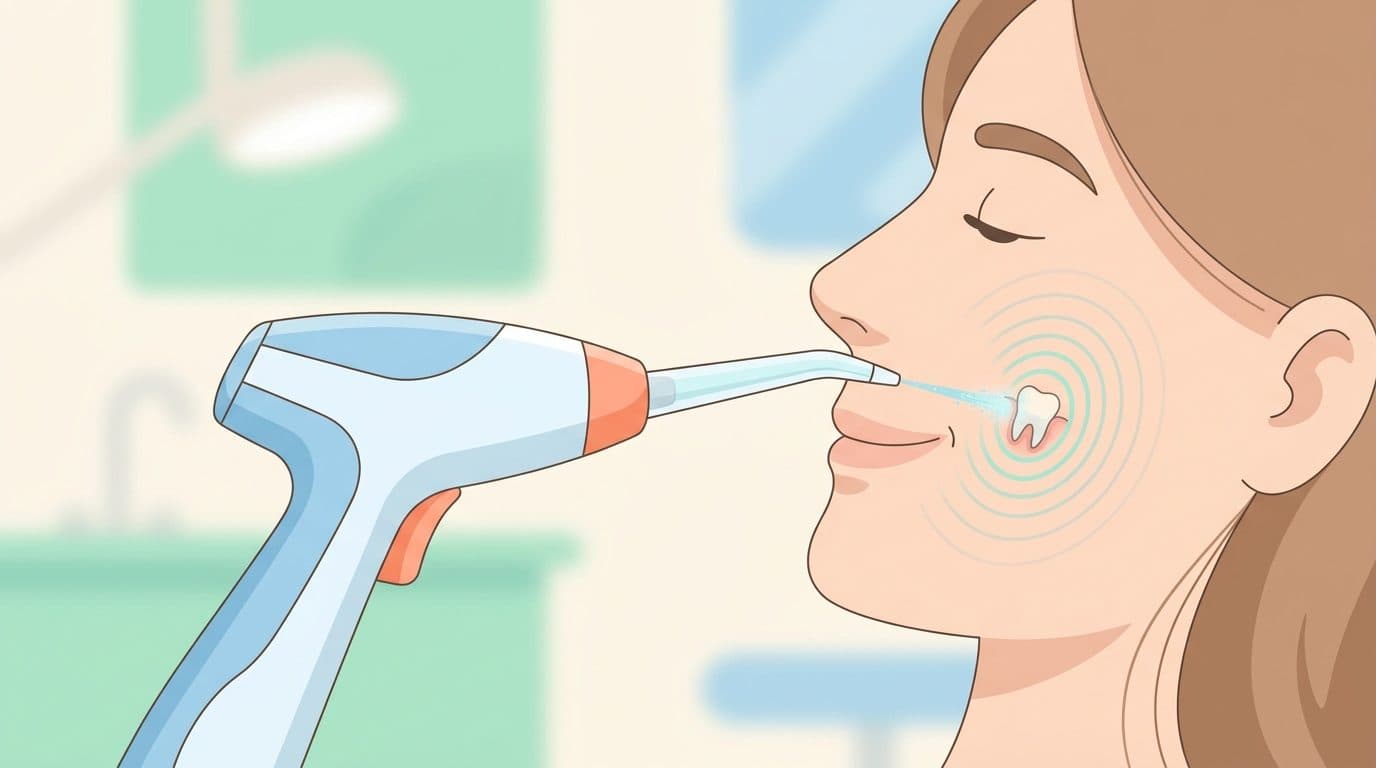
The scariest moment of getting anesthesia at the dentist is the brief instant when the needle enters the gum. Devices that eliminate the needle altogether, firing a very fine jet of numbing agent into the gum under strong pressure, are now being tested in clinical trials in several countries. Known as "needle-free anesthesia" or "jet injection," this method was listed as a non-covered dental item in South Korea starting in August 2025. However, the device cannot replace every injection. For procedures that work on the gum surface, results have already matched those of needle injections, but treatments requiring anesthesia deep enough to reach the nerve inside a tooth still often need a repeat injection.
The Pressure-Based Mechanism and Firing Angle
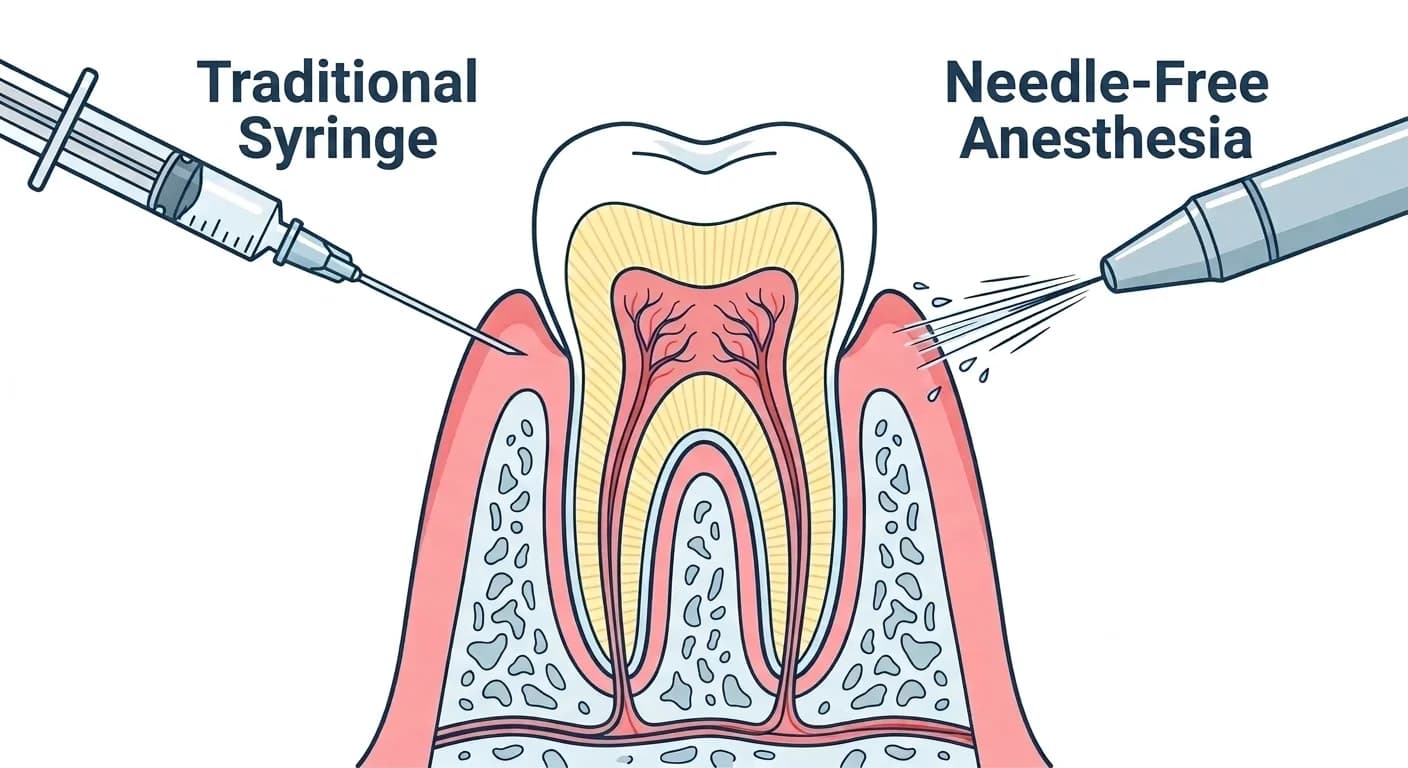
Needle-free anesthesia devices, such as INJEX and MadaJet, use a spring or compressed gas to generate a burst of pressure and fire numbing agent as a very fine jet into the gum mucosa. Instead of a needle piercing the tissue, the pressure of the jet itself breaks through the mucosa, so the pain signal from the moment of puncture never arises in the first place. This is a fundamentally different approach from computer-controlled anesthesia, which keeps the needle but reduces pain by computer-controlling the injection speed.
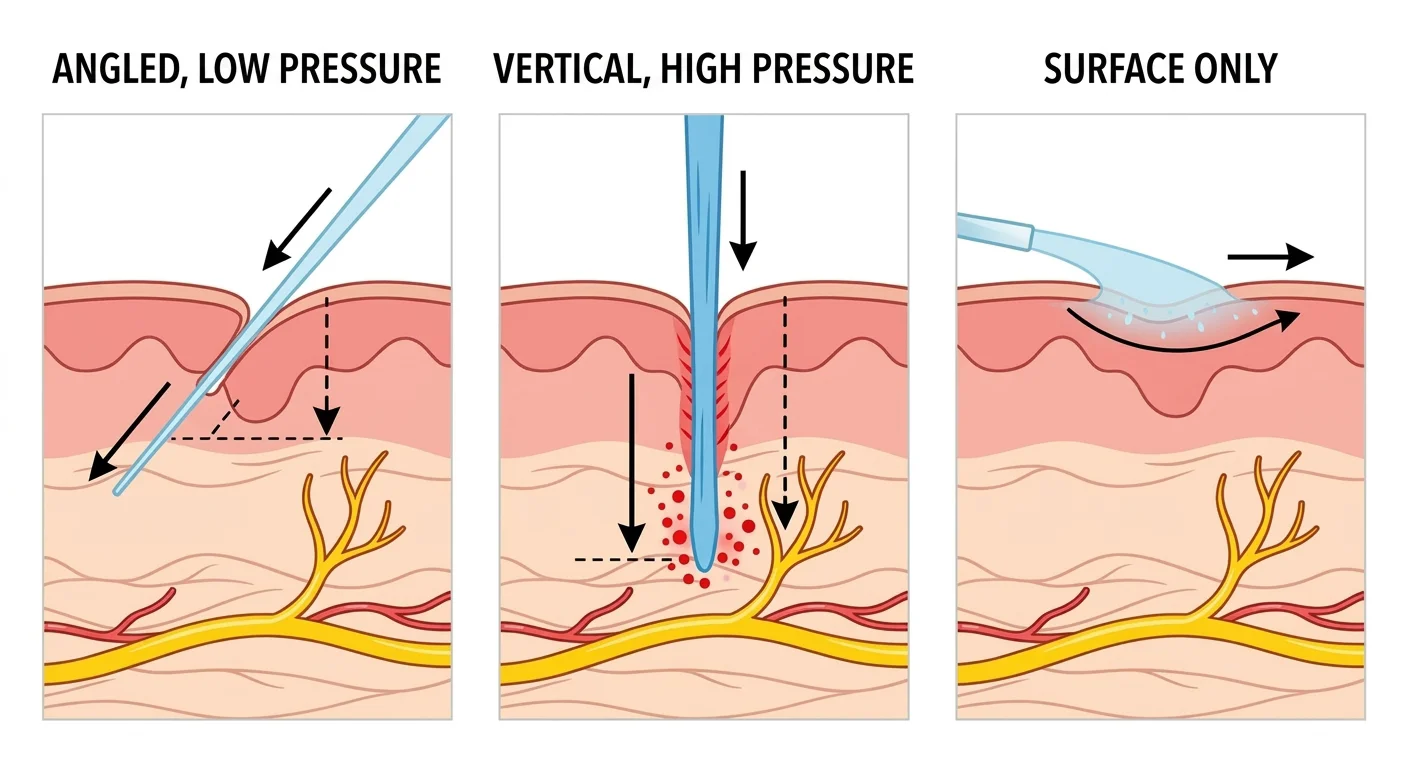
A research team at McGill University in Canada used high-speed cameras to film the jet's behavior in tissue models and cadavers, finding that penetration depth increased in proportion to the pressure and the volume of drug fired at once. The firing angle also mattered. When fired at an angle onto the mucosa, cadaver experiments showed a success rate of 83.3%, identical to needle injection, but when fired vertically, bleeding or tissue tearing occurred in more than 80% of cases. The device's performance depends on how precisely the pressure and angle are matched.
Less Pain and Effective Anesthesia in Gum Procedure Trials
When pressure and angle are well matched, needle-free anesthesia has produced good results in procedures involving the gum surface or just beneath it. In a comparison trial that used a needle-free device on one side of the gum and a traditional syringe on the other in thirty patients needing gum surgery, pain and anxiety scores were markedly lower on the needle-free side. When anesthetizing the palate of children who needed a primary maxillary tooth extracted, a needle-free device (Comfort-in) worked as well as a traditional injection and caused even less pain. In a trial using a newly developed electric needle-free device to extract maxillary teeth, conducted by a joint research team from the University of Otago and the University of Auckland in New Zealand, about six out of eight patients achieved sufficient anesthesia, and most patients found the device more comfortable than a traditional injection.
Re-Injections and Side Effects in Treatments Needing Deep Anesthesia
In contrast, results differed for treatments that require drilling into a tooth or anesthetizing close to the nerve. In a trial using a needle-free device (MadaJet®XL) on children getting a primary maxillary tooth filled, pain scores themselves were lower than with a traditional injection, but about six out of ten patients had insufficient anesthesia and needed a repeat injection. Results for extracting adult teeth also varied by device. In a trial in Turkey using INJEX for extraction anesthesia, pain was actually greater on the needle-free side and anesthesia was insufficient.
Even applying the same principle that higher pressure drives the jet deeper, side effects increased along with it. In a pilot trial anesthetizing the nerve near the lower front teeth, about one in five patients in the higher-pressure group was left with lingering numbness or tingling. In the lower-pressure group, this side effect disappeared, but the rate of complete anesthesia was 60% for the needle-free device, slightly lower than the 70% for the needle. Lowering the pressure makes the procedure safer but also means the jet cannot penetrate as deep, leaving the anesthesia shallower, so the device still cannot fully replace the needle for treatments that need to reliably anesthetize the nerve inside a tooth.
New Health Technology Review and Non-Covered Listing in 2025
In South Korea, the Ministry of Health and Welfare's New Health Technology Assessment Committee reviewed needle-free jet injection in 2023 and found it to be a safe and effective technology, and it was listed as a non-covered dental item starting August 1, 2025. The committee stated that the clinical effect of this method is similar to that of needle injection and is not clearly superior to conventional injection. Accordingly, the device is presented less as a way to improve anesthetic performance itself and more as an option for patients seeking to reduce fear of needles or injection pain. The committee also noted that caution is needed when using it on children under 5 years old, due to the risk of skin damage.
What needle-free anesthesia has changed is the fear of the moment of needle puncture, not the certainty of the anesthesia itself. For procedures involving the gum surface, results already rival the needle, while for treatments that must anesthetize deep inside a tooth, how to match pressure and angle remains a task for future research.