
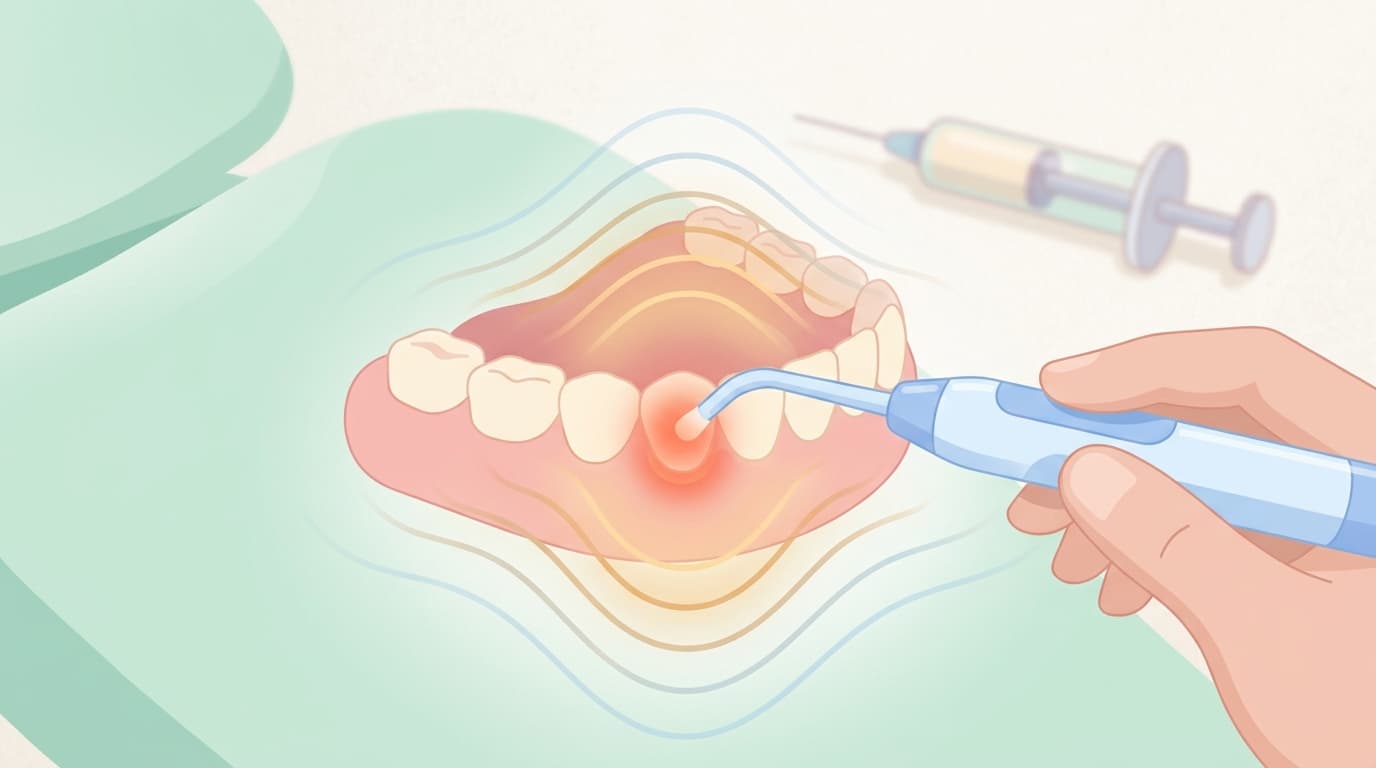
The sting of a dental anesthesia injection is usually concentrated in the instant the needle first touches the gum. One approach to easing this pain has been eliminating the needle altogether. More recently, a different line of research has grown: keeping the needle but briefly shining a low-level laser on the gum just before the injection to dampen the pain signal itself. A 2026 meta-analysis published in an international journal pooled the results of 27 clinical trials involving 1,519 participants and found that pain scores were lower in the group that received laser pre-treatment than in the group that did not.
Light Slows the Pain Signal
The light used in this method is red or near-infrared laser light with an even longer wavelength. It belongs to low-level laser therapy, long used for tissue regeneration and pain relief, and more specifically to photobiomodulation, the use of light to modulate cellular activity. Shining the laser on the gum for a few seconds to several dozen seconds has been shown in multiple experiments to reduce the action potentials of the thin nerve fibers that carry pain signals through the peripheral nerves in that area, and to slow the nerve conduction velocity itself. Mitochondria inside nerve cells absorb the light and shift their energy metabolism, which is also thought to increase local endorphin release and reduce inflammatory substances, contributing to the analgesic effect. Unlike an anesthetic, which blocks the pain signal outright, this light works more by temporarily lowering the speed and intensity at which the nerve transmits pain. When the same technology was applied to orthodontic pain, the pain-reducing effect was confirmed repeatedly, but the effect of speeding up tooth movement was not yet substantial. This article looks at a different application: pain at the moment of an anesthesia injection.
What the Meta-Analysis Found
The meta-analysis reported that the laser pre-treatment group scored lower across all three pain scales used. The patient-rated Visual Analog Scale (VAS) score was, on average, 1.72 points lower, and significantly lower scores were also seen on the facial-expression scale and the behavior-observation scale. However, no clear difference appeared on objective measures that don't rely on the patient's subjective response, such as the electrical response of sweat glands. In other words, patients reported feeling less pain, but this data alone doesn't confirm whether the body's stress response was reduced to the same degree.
Some Trials Found No Difference From Placebo
Among the individual studies, some compared an actual light-emitting laser device against a placebo condition in which the device was placed on the gum but left switched off. In these studies, both conditions produced less pain than an untreated control group, but there was no significant difference between the laser-on and laser-off conditions. This makes it hard to rule out the possibility that the distraction or reassurance from simply having something placed on the gum and waiting for a moment is mixed in with the laser's biological effect. The meta-analysis also noted that the wavelength, irradiation time, and intensity of the laser varied widely across the 27 trials, producing very high variability in the results, and rated the certainty of the evidence at the lowest grade.
Pediatric Dentistry Is Trying It First
Trials using low-level lasers have often focused on child patients in particular. One study reported that, before pulp therapy on primary teeth in children aged 6 to 9, shining an 808-nanometer laser on the gum produced smaller changes in pain and heart rate than applying a benzocaine topical anesthetic gel. Another study found that combining an 810-nanometer laser with topical anesthesia reduced injection pain, but made no difference to how well the anesthesia itself worked or how long it lasted. Unlike methods that eliminate the needle entirely, this approach keeps the conventional injection method in place and simply adds a low-burden way to reduce pain, which appears to be why pediatric dentistry has been among the first to try it. Taken together, these studies make clear that low-level lasers don't eliminate the pain of a local anesthesia injection outright, but they have repeatedly lowered pain scores across multiple clinical trials. Still, cases showing no difference from placebo and the low certainty of the evidence remain, and the meta-analysis concludes that trials standardizing wavelength and irradiation time are still needed.