
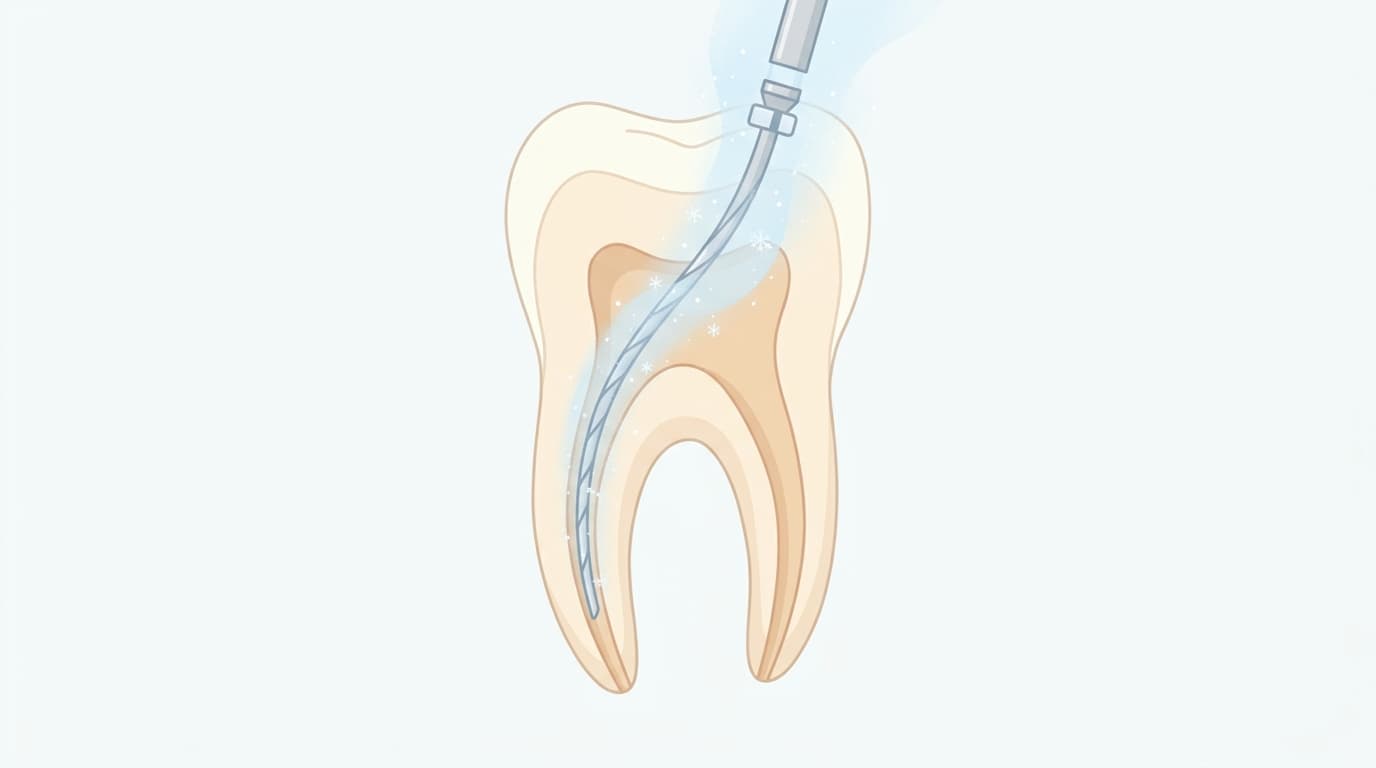
Root canal files fracturing while rotating inside the canal during endodontic treatment is not a rare complication. A joint research team from India, Indonesia, and Malaysia recently proposed a 'cryo-instrumentation' technique that cools both the file surface and the canal interior to 2°C during rotation. In laboratory testing, this method increased the number of rotations files withstood before fracturing by about 53% compared to conventional use, and the files followed the canal's original shape more accurately even in curved canals. Cutting efficiency, the ability to shave away tooth structure, remained unchanged.
What Happens When a File Fractures
File fracture, or instrument separation, is widely regarded as one of the complications most likely to jeopardize the outcome of root canal treatment. When a rotating file repeatedly bends and straightens inside a narrow, curved canal (cyclic fatigue), microscopic cracks accumulate in the metal, and the added torsional stress from rotation can eventually snap off the file's tip, leaving a fragment lodged in the canal. A consensus statement from several Chinese dental schools noted that attempting to remove such a fragment carries the risk of perforating the tooth or fracturing the root, and that failing to remove it altogether can affect the overall success of the treatment.
Efforts to reduce this problem have run alongside the history of dental materials. Hand-operated stainless steel files gave way to rotary files made of nickel-titanium (NiTi) alloy, gaining flexibility and speed, and later, heat treatment that altered the metal's crystal structure produced 'controlled memory (CM)' files that raised flexibility even further. While guided and navigation technology for locating hard-to-find root canals addresses the problem of 'finding' the canal, file fracture is the problem of 'handling it without breaking' that remains even after the canal has been found.
A Metal Whose Character Changes With Temperature
Nickel-titanium alloy shifts between two crystal structures depending on temperature. At lower temperatures, the martensite phase dominates, offering greater flexibility and resistance to cyclic fatigue; as temperature rises, the austenite phase becomes dominant, making the metal stiffer and more vulnerable to cyclic fatigue. Controlled memory files are manufactured with a higher proportion of martensite, but when used at body temperature (37°C), they shift toward austenite and lose much of that advantage.
A research team at Tokyo Medical and Dental University compared five heat-treated files against one non-heat-treated file and found that at room temperature (25°C), the heat-treated files clearly lasted longer, but at body temperature (37°C) that gap narrowed, and some heat-treated files performed no differently from the non-heat-treated one. A 2017 U.S. study that rotated three types of files in water at 3°C, 22°C, 37°C, and 60°C likewise found that, in general, the number of rotations files withstood before fracturing declined as temperature rose.
Shaping the Canal While Keeping It Cold
The research team cooled the surface of a heat-treated file, HyFlex CM (Coltene Whaledent), with the same manufacturer's Endo-Frost cooling spray, and irrigated the canal interior with saline chilled to 2°C. This was compared against files used under a 37°C condition matching body temperature, with both conditions tested in extracted human tooth root canals curved beyond 20 degrees and in transparent resin models cast from them.
The average number of rotations files withstood before fracturing was 1,025 under the body-temperature condition compared to 1,572 under the cooled condition, an increase of about 53%. The amount of tooth structure removed was measured with before-and-after three-dimensional X-ray (CBCT) imaging, and showed no clear difference between the two conditions, indicating that cutting efficiency was preserved. On the measure of how closely files tracked the canal's curved shape, there was no difference near the canal entrance, but the cooled condition showed a clearly better result in the middle and apical sections. The interpretation is that the stiffer files under the body-temperature condition tended to shave down one side of the curve and straighten the canal path, while the more flexible files under the cooled condition followed the original curvature more closely.
What Remains Unconfirmed
This result comes from a single research team's lab test with one type of file, and whether it holds up at other institutions or with other file brands has not yet been confirmed. Keeping the temperature inside a canal in a patient's mouth at 2°C throughout a procedure is also not straightforward in practice. Based on earlier observations that a low temperature persists for about 10 seconds after cold irrigant is introduced, the research team suggested that using the file in short bursts while repeatedly reintroducing cold irrigant could sustain much of the effect, though this remains an untested hypothesis. How much longer the procedure would take in a real clinic is also a question for future research to answer. Even so, this study is a first attempt at translating the fact that temperature changes file durability into a procedure that can actually be tried in practice, adding temperature control as a new variable to the long-standing problem of file fracture in root canal treatment.