
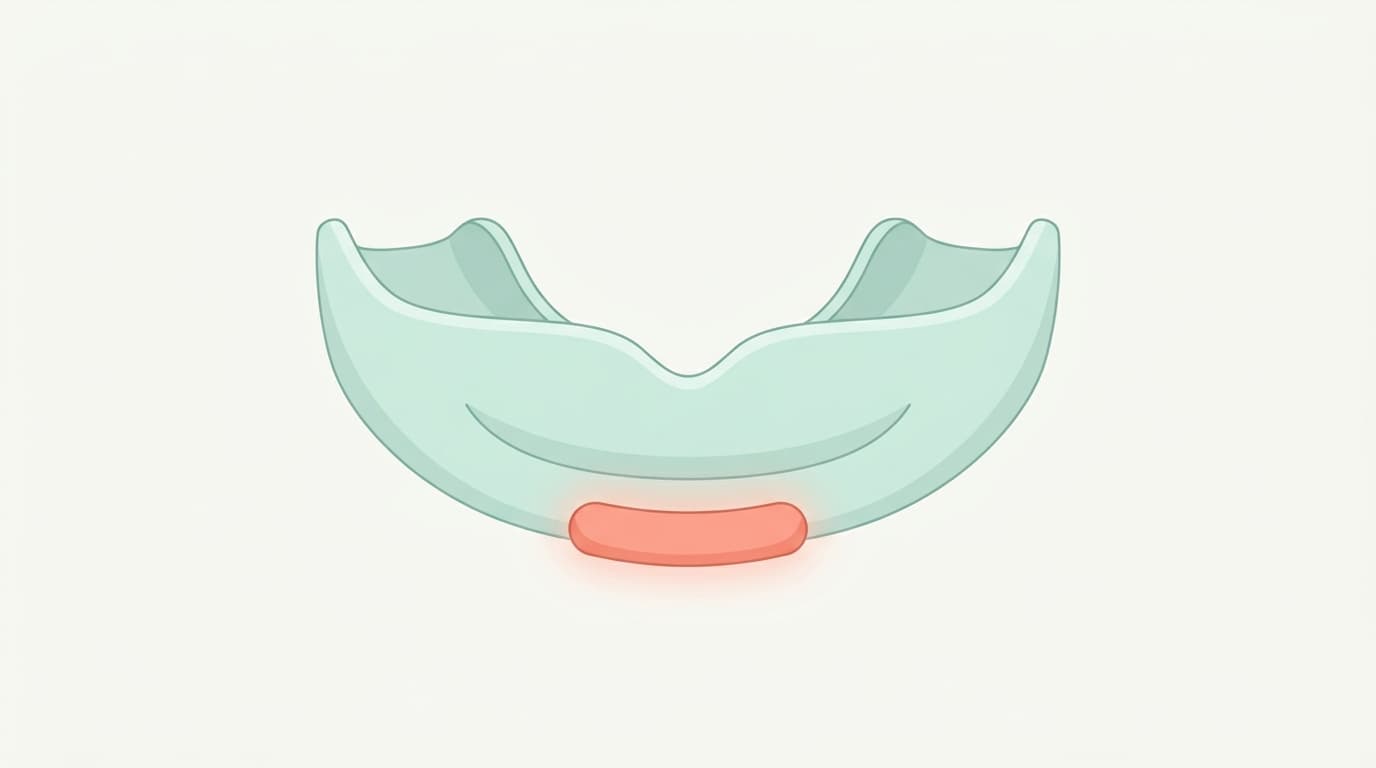
Researchers are studying oral appliance designs that reduce lower front tooth pain in mouthpiece-style devices used to treat snoring and sleep apnea. A pilot trial of 24 patients comparing a new device with a customized lip bumper against a single-block design found a difference in pain. Because both devices were digitally fabricated, the comparison does not test the effect of digital fabrication itself.
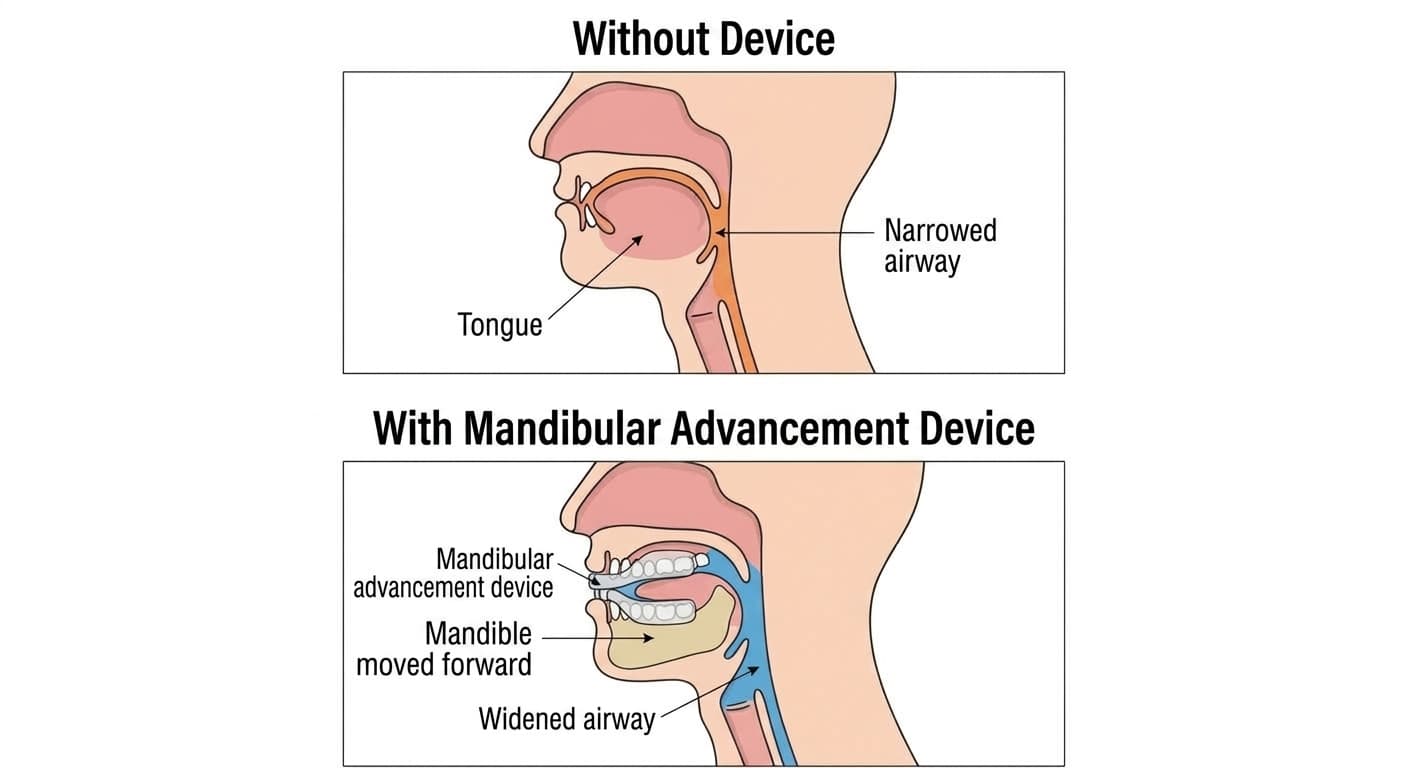
How Pulling the Jaw Forward Widens the Airway
The formal name is mandibular advancement device (MAD). It works by pulling the lower jaw, and the tongue attached to it, forward and holding it there during sleep, widening the space behind the tongue base and soft palate.
In a separate randomized crossover trial, 41 patients with moderate-to-severe sleep apnea were enrolled, and 38 completed all treatment arms. Comparing each treatment for one night at a time, the reduction in the apnea-hypopnea index relative to a sham treatment was 54% for the device alone and 68% for the device combined with supplemental oxygen. The 68% figure is a reduction measured against the same sham comparator, not an additional reduction on top of the device-alone result.
Whether the Device Is Adjustable Affects Side Effects
Devices come in titratable designs, which let the amount of jaw advancement be adjusted, and fixed designs, which stay set at their initial position. A meta-analysis of 26 studies found that titratable devices had less impact on the jaw joint and chewing muscles, but reduced front-tooth overlap even more. Another meta-analysis found that in patients using devices for more than six months, the front teeth tilted, with overbite depth shallowing by an average of nearly 0.9mm.
Adding Support to the Lip Side of the Lower Front Teeth
Lower front tooth pain is one of the discomforts that can arise from using these devices. One research team attached a customized, roughly 3mm-thick lip bumper to the lip-facing surface of the portion of the device covering the lower front teeth. The design accounts for the force relationship between the lower front teeth and the lip muscles. Digital data from tools such as intraoral scanners make it possible to design this kind of structure for each individual patient.
In the pilot trial, 24 patients were split evenly into a group using the new device and a group using a digitally fabricated single-block device, 12 in each. At one month, the new-device group reported less lower front tooth pain. At two months, there was no statistically significant difference between groups in the apnea-hypopnea index or lowest oxygen saturation. The small sample and short follow-up mean the findings cannot establish long-term effects or confirm that the two devices are equivalent.
Usable Even With Missing Teeth
Because these devices are anchored onto remaining teeth, patients with extensive tooth loss have traditionally been excluded. A review of studies on modified devices fitted over the gums or dentures found that even patients with insufficient teeth saw their apnea-hypopnea index drop from an average of 22.4 to 5.6. However, most of these were small case studies, so the findings need confirmation in larger clinical trials. Customized supports and modified devices represent two separate approaches: one aimed at reducing discomfort, the other at changing how the device is anchored. Whether each design's benefits hold up across more patients and longer follow-up remains to be tested.