
After orthodontic treatment, patients wear a retainer to keep their teeth from shifting back into their old positions. "Smart retainers," which embed a temperature sensor to record actual wear time down to the second, have now been tested in orthodontic departments in several countries. A pooled analysis of this sensor data found that while the sensors succeeded in measuring wear time accurately, simply letting patients know they were being tracked did not make them wear their retainers any longer.
Measuring Temperature Instead of Taking Patients at Their Word
Once orthodontic treatment ends, whether teeth were moved with clear aligners or brackets, patients wear a retainer. The problem is that compliance during this period has, until now, been confirmed only by what patients say. There has often been a gap between "I wore it every night" and how long the retainer was actually worn.
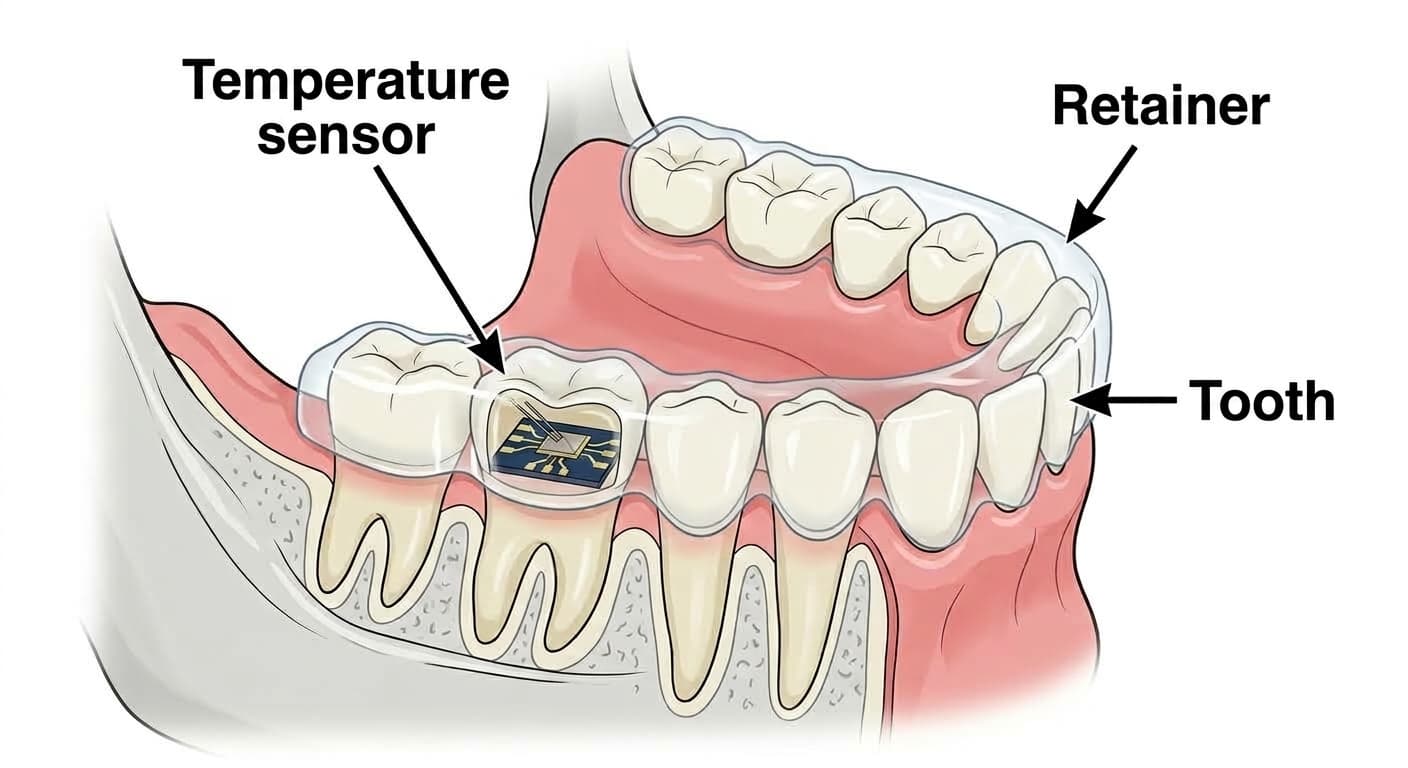
Smart retainers close that gap with technology. A small temperature sensor embedded inside the retainer's acrylic detects the temperature difference between when it's in the mouth and when it's out, calculating daily wear time in increments of 0.1 hours. The sensor takes continuous readings for the first two days to establish the patient's baseline temperature, after which the clinic downloads the recorded data at one- or three-month intervals. A review pooling fifteen clinical studies found that products such as TheraMon, Smart Retainer, DentiTrac, and Air Aid are used this way, with TheraMon leading in both measurement accuracy and ease of use.
Accurate Measurement Didn't Make Patients More Diligent
The trouble starts after that. Pooling data from eight studies covering 439 patients, the difference in average daily wear time between patients who were told their wear was being sensed and given feedback, and those who weren't, came to only about 30 minutes. Even that gap varied so widely across studies that it was hard to call it statistically meaningful. Wear time did rise briefly once patients first learned they were being monitored, but reminders sent by text message or notification helped in some studies and did nothing in others.
Measuring accurately and getting patients to actually wear their retainers more faithfully turned out to be two different problems. Still, one of these eight studies found that longer wear time was associated with less relapse, teeth shifting back out of position, and a larger study looked more closely at that relationship.
How Few Hours a Day Before Teeth Shift Back?
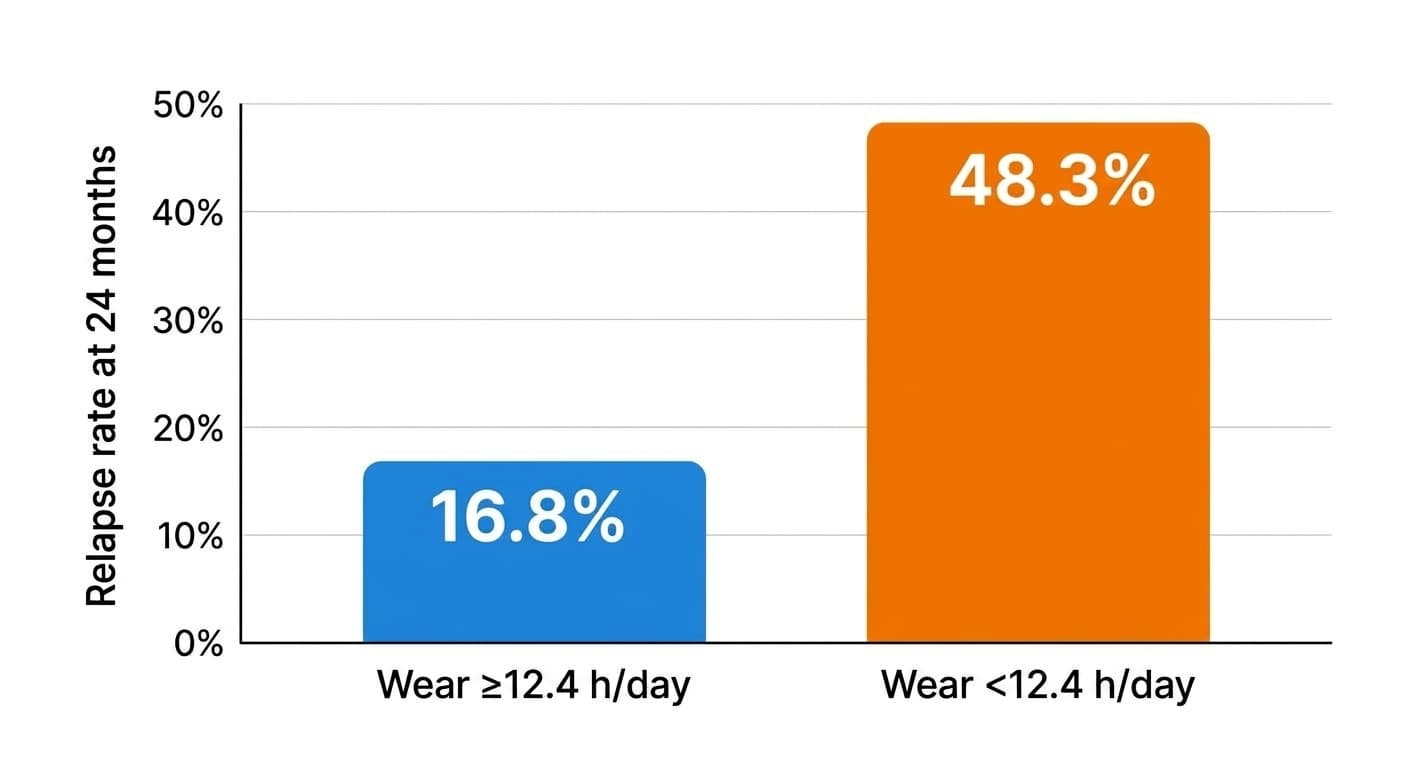
In a study that tracked 156 patients who had finished orthodontic treatment for 24 months, measuring wear time with smart retainers, average daily wear time dropped from 11.6 hours in the first year to 8.9 hours in the second. Using 12 hours a day as a cutoff, patients who wore their retainer that much or more had a relapse rate of 15.4%, while those who fell below it saw their relapse rate climb to 50.0%. When researchers recalculated the threshold that best separated relapse outcomes statistically, it came out to 12.4 hours a day: patients who wore their retainer more than that had a relapse rate of 16.8% at 24 months, versus 48.3% for those who didn't.
Because these figures come from a single study observing 156 patients at one clinic, it isn't yet confirmed whether the same threshold would hold at other clinics or in other populations. Even so, the relationship between wear time and relapse itself came through clearly in this data.
Using This Data to Flag Relapse Risk in Advance
The same research team built an AI model that added age, treatment difficulty, and the initial severity of the malocclusion to these wear-time records. Among several algorithms tested, a method called random forest was the most accurate, correctly flagging nearly 90 out of every 100 patients who actually went on to relapse, while correctly avoiding misclassifying about 94 out of every 100 patients who wouldn't relapse as high risk. The factor the model weighted most heavily, above all others, was daily wear time. Testing it again on 34 patients from a different clinic produced similar results, though the model has so far been validated at only two institutions.
Embedding a sensor in the retainer has eliminated the back-and-forth between patients and clinics over whether the retainer was actually worn. But what this research shows is that measuring accurately and patients becoming more diligent as a result don't necessarily go together. Instead, the accumulated data is now being used to flag, early in treatment, which patients carry a high risk of relapse.