

Congenital tooth agenesis is a condition in which some permanent teeth never form from the start. A 2008 study of 1,622 subjects in Korea observed it in 11.2% of participants, though this cannot be taken as the current prevalence across the entire Korean population. Treatment is planned according to the patient's age and the location of the missing tooth: closing the gap with orthodontics, retaining the primary tooth, or supplementing it with a bridge or an implant. Now, however, a research team originating from Osaka's Kitano Hospital and Kyoto University is developing a treatment that uses a single antibody injection to regrow a dormant tooth bud (the cluster of cells that would become a tooth). New teeth grew in mice and ferrets. Toregem Biopharma, which took over development, has since announced that it completed a Phase 1 trial in humans, and in August 2026 announced that the regulatory review of its Phase 2a trial plan had been completed. Tooth regeneration in animals and progress in early human trials are separate achievements.
USAG-1: The Brake That Was Holding Back Tooth Growth
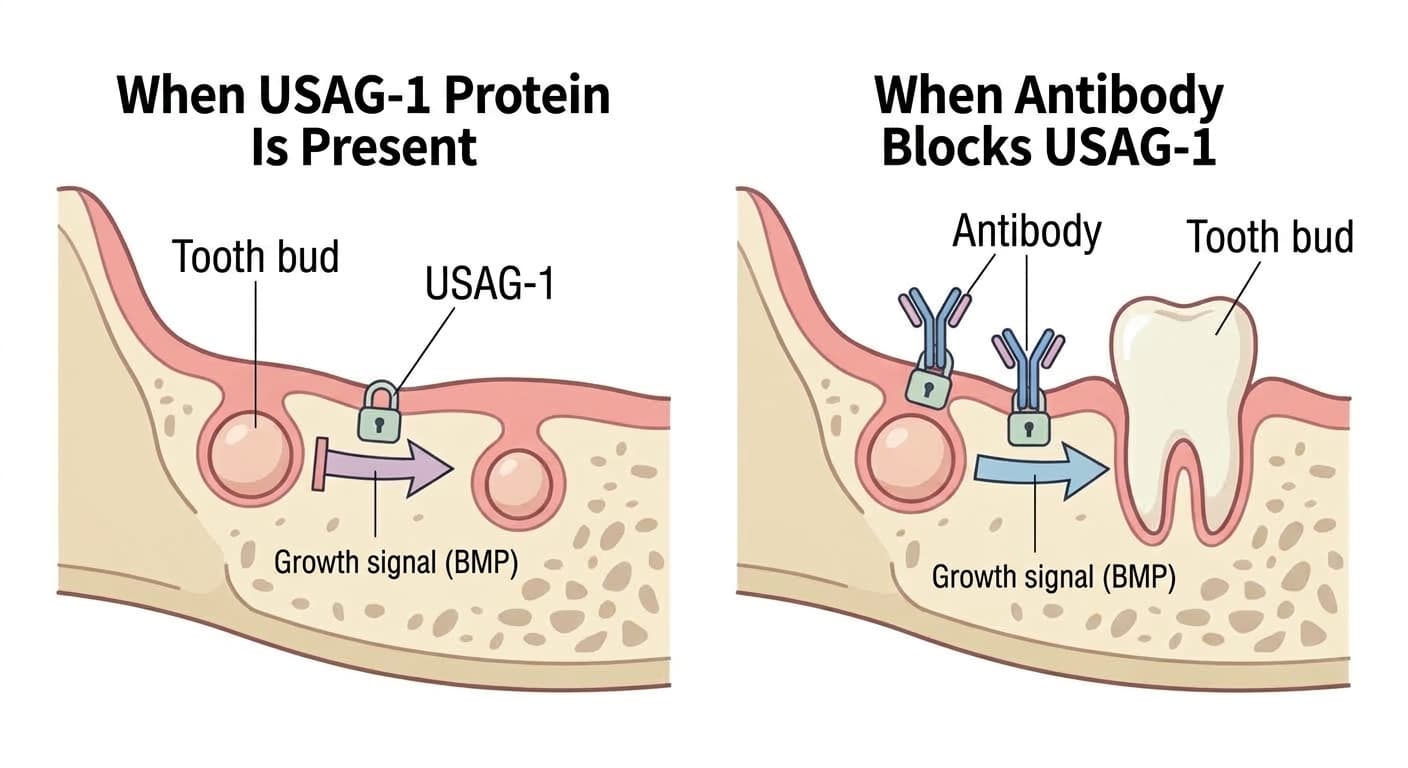
This research began with the study of mutant mice that grew more teeth than normal. The team found that mice lacking a protein called USAG-1 grew extra teeth. USAG-1 is a protein that regulates the BMP and Wnt signals involved in tooth development. In a 2021 animal study, an antibody that specifically released the inhibition of BMP signaling promoted tooth formation. This does not mean that every gap in a human's teeth still has a regrowable tooth bud left behind. The research team reasoned that artificially releasing this suppression could allow dormant tooth buds to grow again, and developed an antibody that binds to and neutralizes USAG-1.
Extra Teeth Confirmed in Mice and Ferrets
The team first crossbred mice carrying gene mutations that cause congenital tooth agenesis (Msx1-deficient and Eda1-deficient mice) with mice lacking USAG-1. Normal-sized molars grew in mice that should not have grown teeth at all. The same result occurred when USAG-1 antibody was injected instead of eliminating the gene entirely. Injecting the antibody into Eda1-deficient mice grew molars that had never erupted, and injecting it into normal mice caused an extra tooth to grow next to an existing one. Depending on where they grew, however, some of these extra teeth fused together.
Mice grow only one set of teeth, so their tooth development differs from that of humans. The team therefore also administered the same antibody to ferrets, which, like humans, grow baby teeth followed by permanent teeth in sequence. After three rounds of antibody injections, a new tooth grew next to the upper incisors. The new tooth had a shape similar to the existing permanent incisor, and even a short root was confirmed to grow within the gum. The research team explained that this could be regarded as a third generation of teeth, following the baby and permanent teeth.
Toregem's Phase 1 Completion Announcement and Phase 2a Preparation
The humanized antibody developed for administration to humans is named TRG035. Developer Toregem announced on November 27, 2025 that it had completed a Phase 1 clinical trial in Japan and confirmed its safety. This is the company's own announcement of early trial results, and it does not mean that the efficacy of regrowing new teeth in patients with congenital tooth agenesis, or its long-term safety, has been established.
On August 17, 2026, the company announced that Japan's Pharmaceuticals and Medical Devices Agency (PMDA) had completed its required review of the Phase 2a exploratory clinical trial plan targeting congenital tooth agenesis. Completion of the trial plan procedure should not be confused with confirmation of efficacy in patients or approval to market the product.
How Will Researchers Confirm Whether New Teeth Are Growing?
Follow-up research also addresses how to locate tooth buds and measure changes in their growth. A 2026 imaging study, using observations of ferret development and human MRI data, proposed a method for evaluating pre-calcification tooth buds, which are hard to confirm with X-rays alone, using a combination of MRI, CT, and X-ray. This work is intended for tracking tooth development in clinical trials, and the imaging study itself does not demonstrate the antibody's therapeutic effect.
Even in animal experiments, results varied depending on which gene mutation was involved. The effect cannot be generalized to every case of congenital tooth agenesis, or to teeth lost to cavities or periodontitis. The key question now is whether follow-up clinical trials confirm that real teeth grow, develop proper function, and what adverse reactions occur.