
A research team at Pusan National University has built a mouthguard-type wearable sensor that continuously measures, while worn in the mouth, the concentration of an enzyme that signals how severe gum inflammation has become. Earlier periodontitis self-test kits worked by dropping oral rinse onto a test strip and reading a single value within five minutes, but this new device lets saliva seep in on its own while the mouthguard is worn, continuously outputting readings. It went through laboratory validation and saliva testing on 60 adults, and a deep learning model to interpret the signal was developed alongside it.
An Artificial Cavity Molded to the Enzyme's Shape Captures the Target
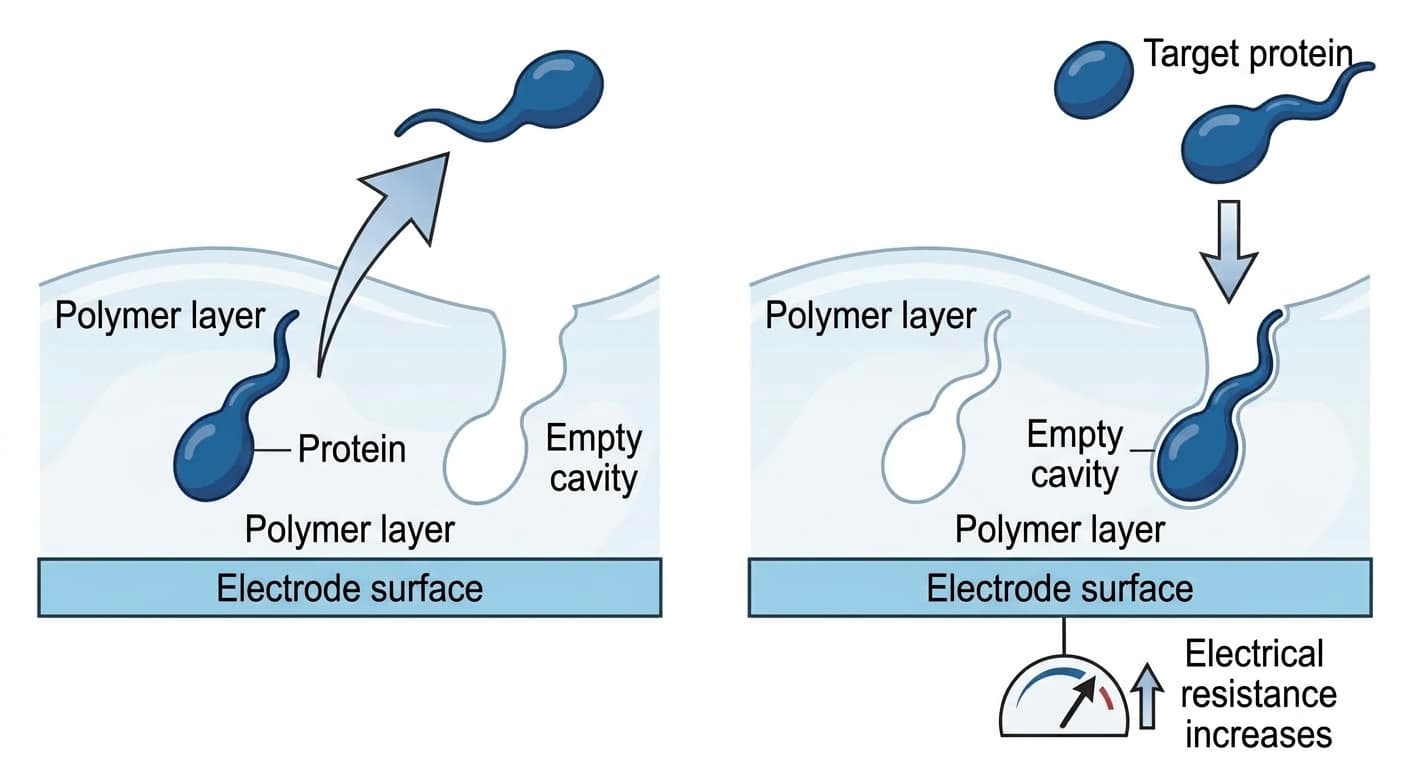
The substance this sensor measures is aMMP-8 (active matrix metalloproteinase-8), an enzyme released alongside gum collagen breakdown when white blood cells degrade it. Instead of antibodies, the research team polymerized o-phenylenediamine (o-PD) together with the target protein on the electrode, then removed the protein to leave a cavity molded to its shape. This approach is called a molecularly imprinted polymer (MIP), and it is more resistant to heat and chemicals than antibodies and can be stored for longer. The team used molecular dynamics and quantum chemistry simulations to calculate in advance which amino acid sites bind most strongly to o-PD, designing the cavity's specificity accordingly, and the electrode they built responded distinctly to aMMP-8 alone even when mixed with other inflammatory substances of similar size and charge (TNF-α, MMP-1, MMP-9, IL-1β).
Concentration Is Read from the Degree of Resistance Change
The electrode surface was thinly coated with a carbon material called graphene oxide, and a molecularly imprinted polymer layer was built on top of it. Graphene oxide serves as an intermediate layer that boosts the sensitivity of impedance measurement, which gauges how much a solution undergoing oxidation-reduction reactions is impeded as it moves across the electrode surface. When aMMP-8 lodges into the cavity, electrical resistance increases, and the concentration is calculated from the magnitude of that change. The limit of detection was 82 ng/mL and the limit of quantification was 250 ng/mL, and repeated measurements across 100 electrodes showed a reproducibility of over 90%. In standard-sample experiments, more than 95% of measured values fell within a clinically reliable margin of error, and saliva samples from three groups (healthy individuals, periodontitis patients, and patients who had recovered after treatment) showed a strong correlation with the existing standard test (ELISA), with a correlation coefficient of 0.92.
A Filter and Wireless Chip Are Embedded in the Mouthguard
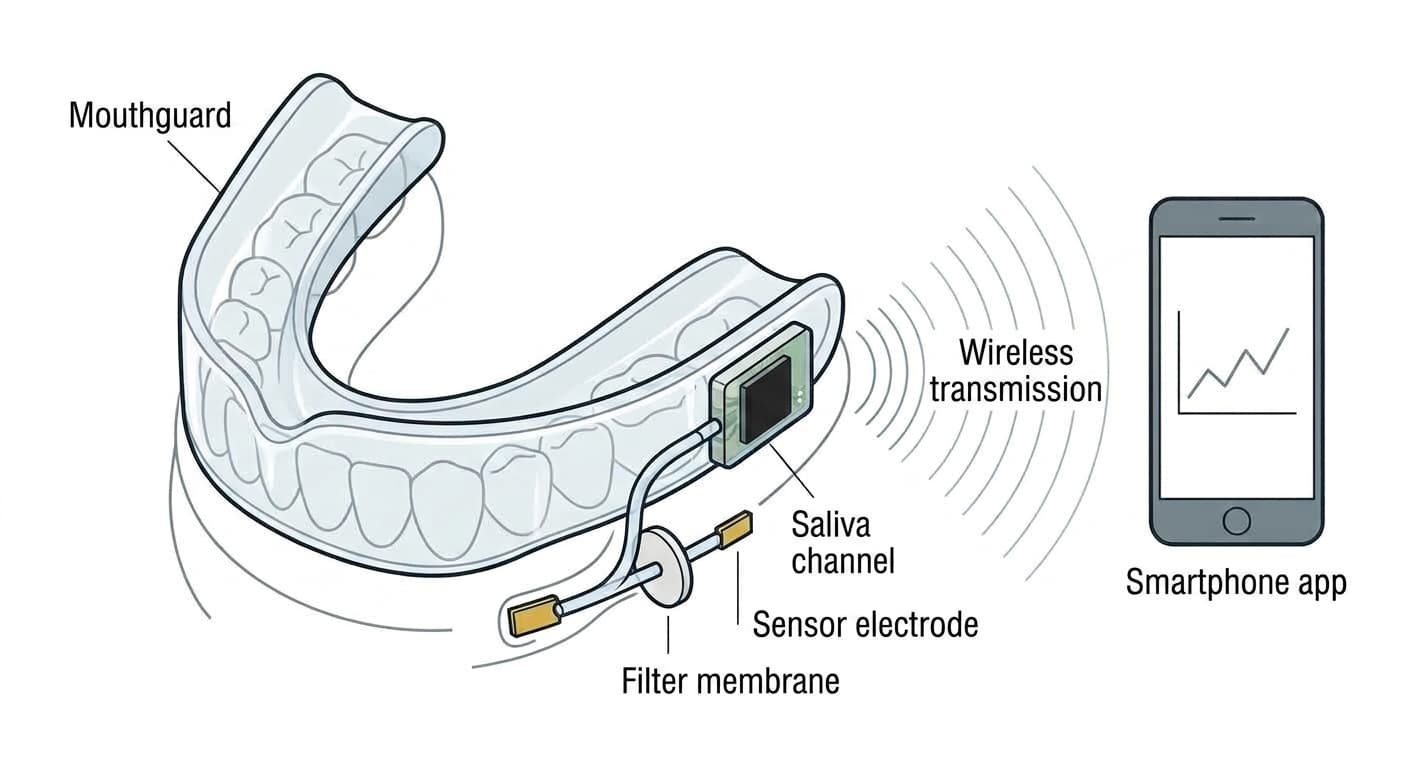
The sensor electrode was placed inside a silicone mouthpiece, with a channel cut for saliva to pass through a polyvinyl alcohol (PVA, a highly water-absorbent polymer) hydrogel membrane. This pretreatment membrane reduces impurities such as cell debris while allowing aMMP-8 to diffuse toward the sensor. Protein recovery after passage through the membrane was about 80%. A wireless chip and circuit are built in as well, transmitting measured values directly to a smartphone application. Unlike self-test kits where a sample is applied to a test strip, values accumulate simply from wearing the device, without separately collecting a sample or swapping out a test strip.
Deep Learning Sorts the Signal into Grades
To a human eye, the impedance values coming off the electrode are just a graph, but the research team converted them into 128×128 images and trained a convolutional neural network (CNN) on them. A conventional machine-learning approach that looks only at a few pre-selected values achieved 89.6% accuracy only in a range with a clear concentration difference (0 vs. 200 ng/mL), and dropped to as low as 68.9% in a range with a small difference (100 vs. 200 ng/mL). By contrast, the deep learning model trained on the converted images showed over 99.5% accuracy across both ranges. The team used transfer learning, pre-training the model on laboratory standard samples and then retraining it with a small amount of patient data. This approach does not eliminate the limitation of having few patients.
These results were confirmed with just 60 adult volunteers recruited at a single site, Pusan National University Hospital, so the deep learning model's accuracy also reflects how well it distinguished concentration ranges within this dataset rather than across diverse patient groups at multiple hospitals. Whether the same accuracy holds up across different clinics in practice, and whether the prototype-stage mouthguard produces stable readings over long-term wear, still need to be confirmed going forward. This research has moved the chemical signal that indicates gum inflammation from a one-time test-strip reading to continuous measurement while worn, and it is built on a structure that captures its target with a molecularly imprinted polymer instead of antibodies and interprets that signal with deep learning.