

A research team at the University of Turku in Finland reviewed clinical trial data from 2026 and found that xylitol gum and candy reduced plaque, gingivitis, and cavities even in older adults and people with disabilities who struggle to brush their own teeth. The team was the first to bring together evidence on whether this effect, previously confirmed in healthy children and adults, also appears similarly in these two groups who have difficulty brushing by hand.
People Who Struggle to Brush Their Teeth
As people age, hand movements become less precise and cognitive function declines, making brushing itself difficult. Older adults taking multiple medications together often experience dry mouth as a side effect. People with intellectual or developmental disabilities are also known to have a higher risk of cavities and periodontal disease than healthy people, since they may struggle with fine hand movements or learning the sequence of brushing.
This outlet has previously covered chewing-training devices for older adults whose bite strength has weakened (Biofeedback Masticatory Training Devices Are Replacing Chewing Gum Exercises). That article covered a device that turns the act of chewing gum into muscle training. This result, however, looks not at the chewing motion itself but at how the ingredient xylitol in gum and candy changes oral conditions.
A Sweetener That Starves Sugar-Loving Bacteria
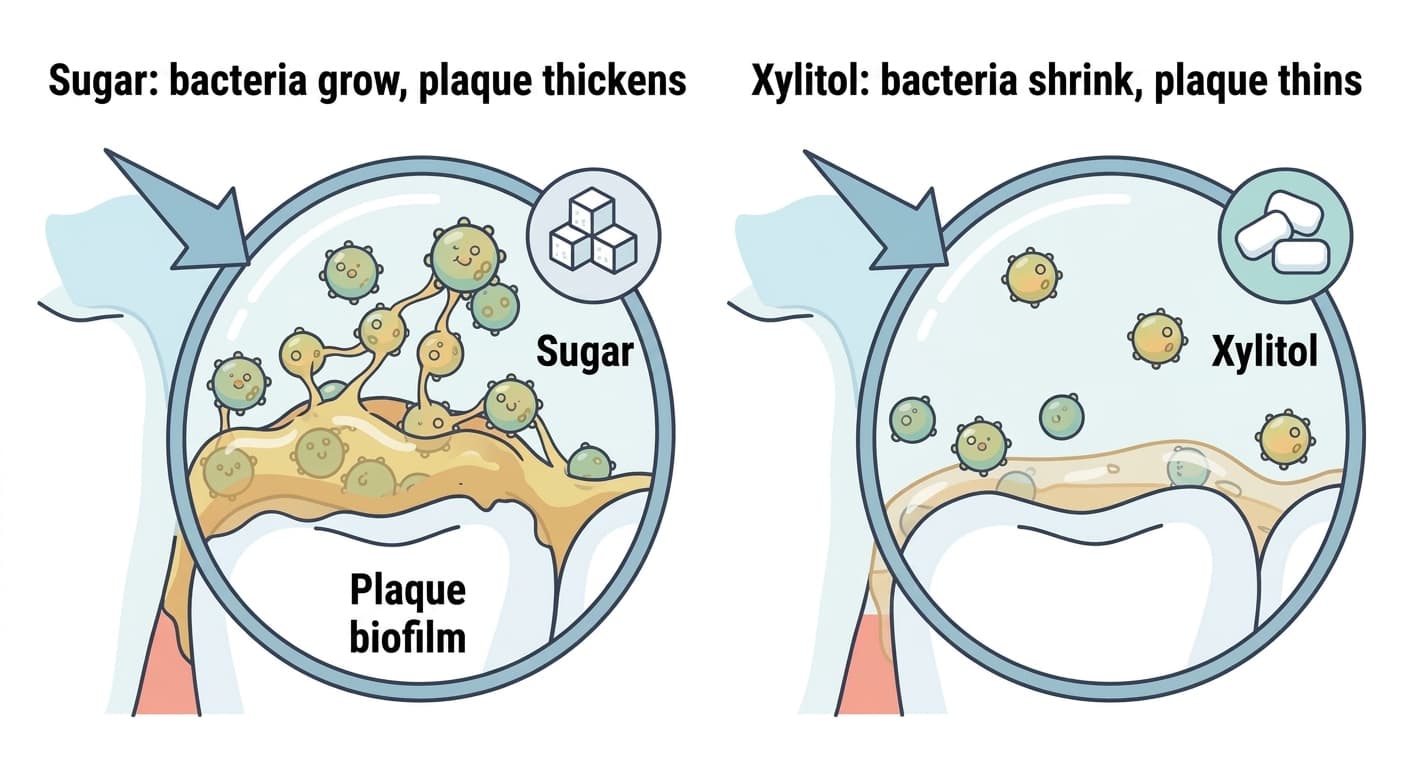
Xylitol is a five-carbon sweetener used in place of sugar. Unlike other sweeteners such as the six-carbon sorbitol, bacteria in the mouth cannot use it as food. Streptococcus mutans, the bacterium most responsible for cavities, cannot break xylitol down, so its growth slows and it produces less of the sticky substance that attaches plaque to teeth. Xylitol is also noted for reducing plaque's ability to produce acid. For people at risk of swallowing gum or who have difficulty learning how to spit it out, slower-dissolving candies or tablets were used more safely than gum.
Plaque, Gums, and Even Cavities Were Reduced
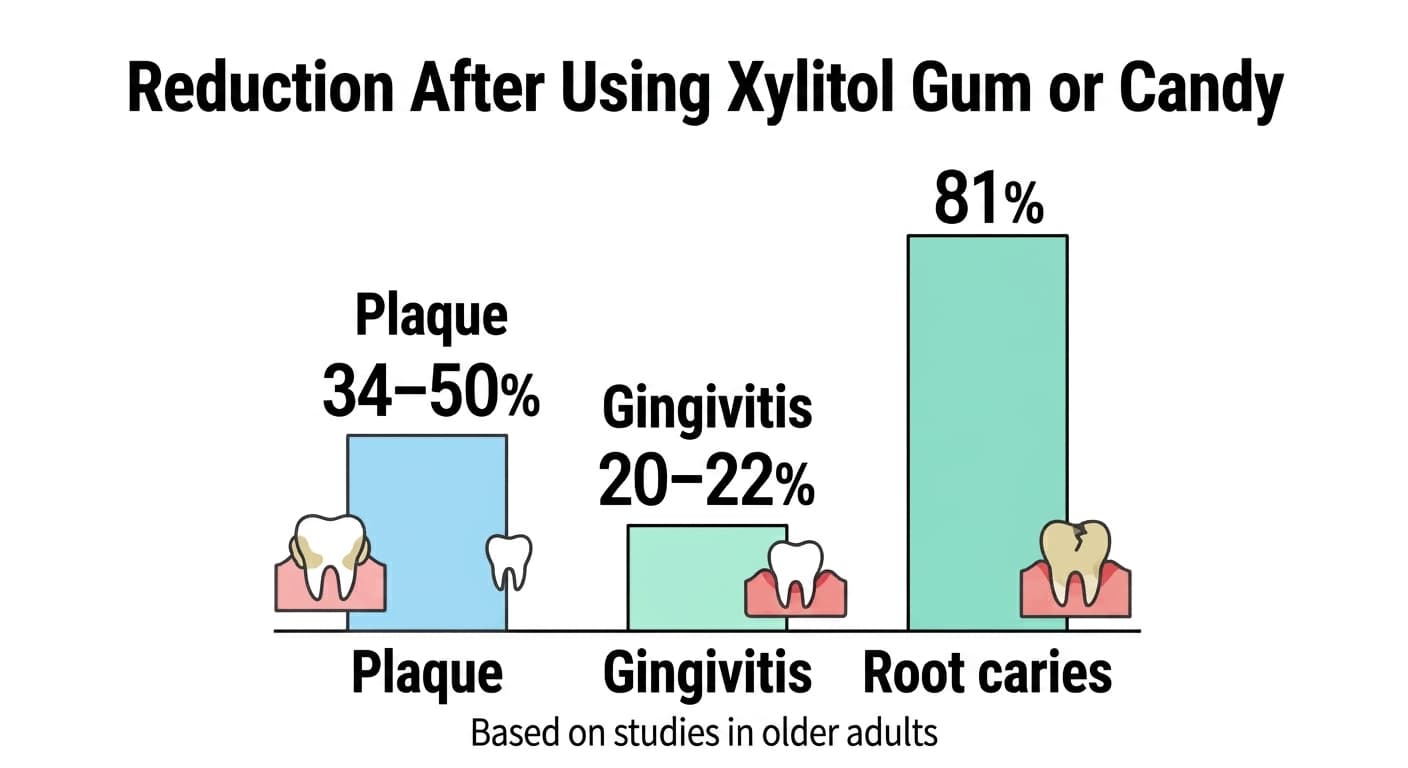
In studies of gum chewing among older adults, the plaque index fell by 34-50%, and the index measuring plaque remaining on dentures fell by 60%. In a study that gave xylitol candy to students with disabilities, plaque fell by 34%, a larger drop than the 18% decrease seen in the group that did not receive candy.
The index for gingivitis severity also fell by 20-22% in the study of older adults and by 33% in the study of students with disabilities, larger than the 14% decrease in the control group. Compared with control groups, cavity prevention rates reached 81% for root caries in older adults and 134% among disabled students in Kuwait. However, a study of disabled students in Thailand found a 33% prevention effect only in primary teeth, with no effect seen in permanent teeth, likely because the observation period was a short one year.
The Effect on Streptococcus Mutans Depended on the Dose
In a study of older adults who chewed a low dose (1.2-2.8g) of gum once or twice a day, Streptococcus mutans counts did not decrease. By contrast, in a study that gave people with intellectual disabilities high-concentration candy containing 5.2-5.4g of xylitol five times a day, mutans bacteria in plaque and saliva fell by more than tenfold. The research team concluded that reducing mutans bacteria required at least 5-6g per day split across three or more doses. A recent study linking blood xylitol levels to cardiovascular risk caused controversy, but the issue in that study was drinking 30g of xylitol dissolved in water all at once. The research team judged that this result is hard to apply directly here, since the method and amount of intake differ from chewing gum or candy split across a day.
It Also Helped With Dry Mouth
Changes in saliva flow were clear among older adults with dry mouth. In a 12-month study of nursing home residents with an average age of 85 who chewed xylitol gum for 15 minutes twice a day, stimulated saliva flow rose from 0.8 mL/min to 1.6 mL/min, entering the normal range. Over the same period, rates of angular cheilitis, in which the corners of the mouth crack, and denture stomatitis, in which the area under a denture becomes swollen and red, also decreased. Over the same period, the control group's saliva flow actually decreased.
These findings are the first to bring together evidence that xylitol's effects, previously confirmed in healthy people, appear similarly in older adults and people with disabilities who have difficulty brushing by hand. The evidence for reducing plaque, gingivitis, and cavities was relatively clear, and the effect of increasing saliva flow was also repeated across several studies. However, the effect of reducing mutans bacteria appeared only when the dose was sufficient, and because few studies have addressed this topic, the certainty of evidence is lower than for studies in healthy people.