Question
While my tooth was being prepared for a crown or filling, the nerve (pulp) was exposed and I was treated on the spot. I was told that instead of removing the nerve entirely, only part of it was left in place. Since this is a permanent tooth, I'm worried whether finishing the treatment this way is really okay, and whether problems might come back later.
Short Answer
There is indeed a treatment that removes only the pulp in the crown portion of the tooth while preserving the vitality of the pulp in the root portion. It is called pulpotomy, and it is described as a treatment that can also be applied to mature permanent teeth whose root development is already complete. However, whether this approach can be chosen depends on whether bleeding stopped within a short time at the moment of exposure and whether there were no signs beforehand that inflammation had progressed deep into the pulp, and it is followed by periodic checks after treatment to confirm that the pulp is actually still alive.
Why Is That?
How Much of the Pulp Does Pulpotomy Leave in Place?
The pulp, the nerve tissue inside a tooth, is divided into the coronal pulp, which fills the wide space in the crown of the tooth, and the radicular pulp, which continues along the thin canals inside the root. Pulpotomy is a treatment that removes only the coronal pulp and applies a biocompatible material such as MTA at the entrance where the root canal begins, preserving the vitality of the radicular pulp beneath it.
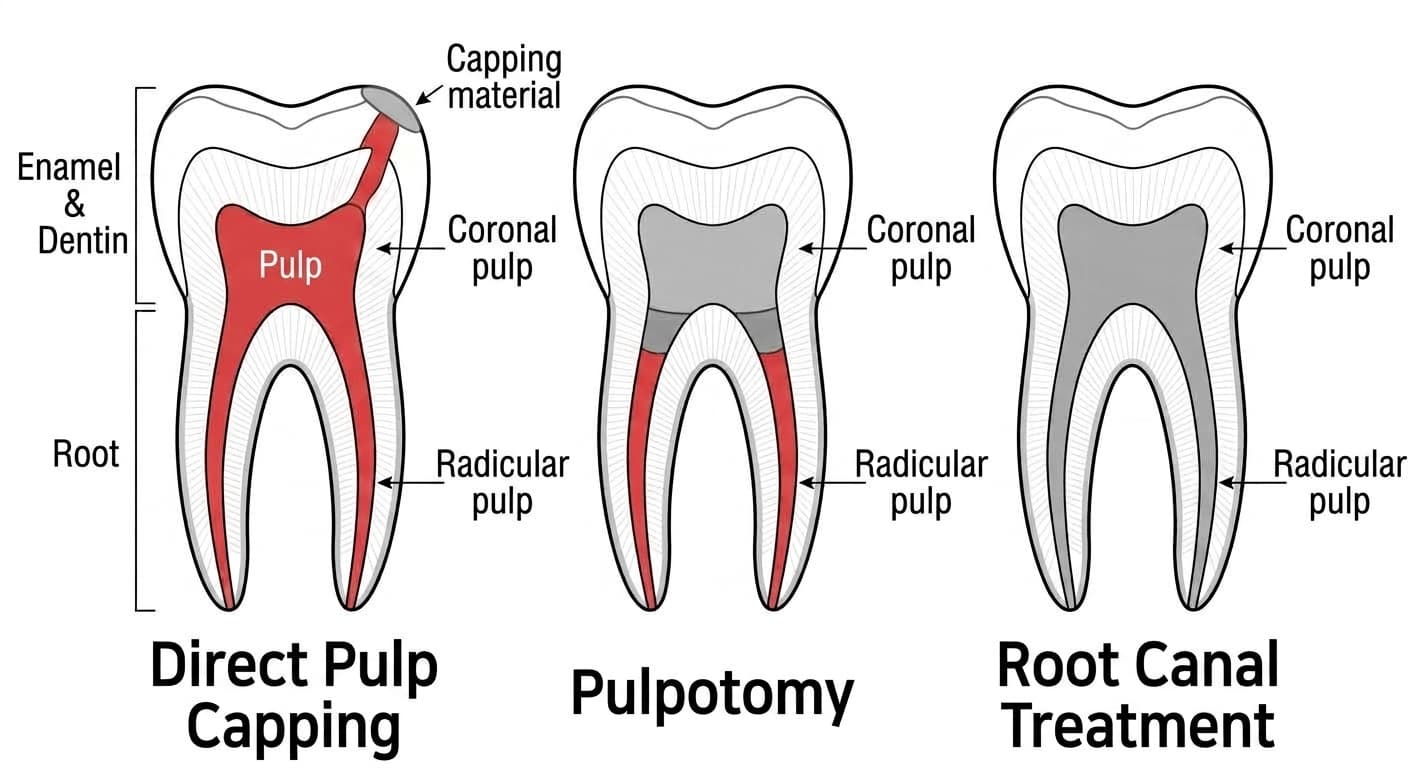
Direct pulp capping leaves the entire pulp intact and covers only the exposed area; pulpotomy removes only the coronal pulp, leaving the radicular pulp; and root canal treatment removes both the coronal and radicular pulp.
When the exposure is very small, there is no spontaneous pain, normal vitality is shown, and bleeding stops within 10 minutes of rinsing, direct pulp capping (covering only the exposed area while keeping the entire pulp intact) can be chosen. Pulpotomy is used when the damage is judged to be deeper or more extensive than that: the entire coronal pulp is removed down to the entrance of the root canal, and only the tissue below is preserved.
What Conditions Determine the Extent of Treatment?
The goal of treatment differs depending on whether the inflammation in the exposed pulp is at a stage that subsides once the irritant is removed, or has progressed to a stage where it can no longer recover on its own. A state that can recover once the irritant is removed is called reversible pulpitis, and at this stage priority is given to preserving as much of the pulp as possible. However, if pulpitis has progressed to a degree that is difficult to recover from, pulpotomy (removing the entire coronal pulp) can be used either as an emergency measure or as definitive treatment.
If the pulp is exposed during treatment, the area is kept moist with an irrigating solution and the speed of hemostasis is checked. If bleeding stops within a short time, the damage is considered to be limited to the surface, and a more conservative approach such as partial pulpotomy (removing only 1–2 mm of the surface at the exposed site) can be considered. Conversely, if hemostasis takes a long time, the inflammation is considered to have progressed deep into the pulp, and the approach shifts to removing the entire coronal pulp. The cause of exposure also matters. Sudden exposure from trauma is known to have a better prognosis than exposure that occurs gradually as long-standing decay invades the pulp.
The stage of root development also determines the treatment approach. For an immature permanent tooth whose root tip (apex) has not yet fully formed, the traditional method removes the coronal pulp down to the cervical level where the root canal begins. The main purpose is to let the remaining radicular pulp continue producing dentin so that root development can continue. In contrast, for a mature permanent tooth whose root development is already complete, pulpotomy can be applied as an emergency measure to relieve pain or as a treatment for pulpitis that has progressed beyond recovery.
What Should Be Checked After Treatment?
Receiving a treatment that preserves part of the pulp does not mean the matter is completely finished. Whether the remaining radicular pulp continues to stay alive must be checked over time. Follow-up includes checking the pulp's response with tests such as thermal testing and examining radiographs for any new changes around the root. The formation of a dentin bridge, where the pulp tissue itself produces dentin that seals off the area beneath the capping material, is considered a good sign.
On the other hand, if the remaining pulp eventually progresses to pulp necrosis, treatment then moves on to root canal treatment. Another point to keep in mind is that calcification can gradually narrow the root canal beneath the area covered by the pulp-preserving material. Because of this, if root canal treatment becomes necessary later, locating the narrowed canal can become more difficult. This is especially important if you are planning a long-term restoration such as a crown or bridge. Clinical cases have been reported in which pulp-preserving treatment was performed before a restoration, and when root canal treatment later became necessary, the canal had already calcified severely, making treatment difficult, so it is helpful to first confirm that the pulp is stable before moving on to the next step.