Question
A cavity showed up during a dental checkup, and the dentist said, "This cavity looks like it has stopped progressing," and suggested watching it instead of treating it right away. I'm wondering whether a cavity can really stop progressing, and whether it's okay to leave it untreated.
Short Answer
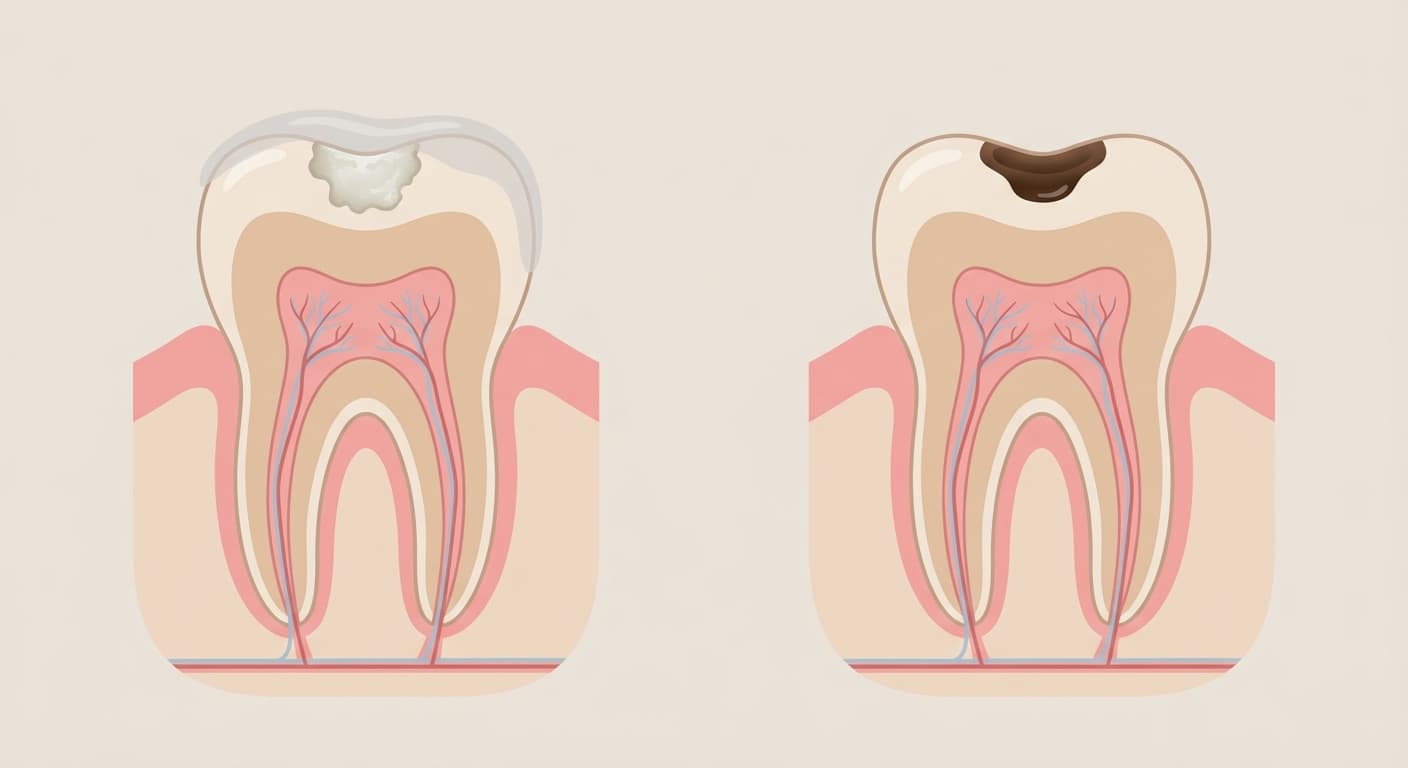
A cavity can genuinely remain in a state where it has stopped progressing, if the conditions are right. This is called arrested caries, and it often appears hard and discolored brown or black. If this lesion is in a spot reachable by brushing, is judged not to be active right now, and doesn't cause an aesthetic problem, the dentist may decide to monitor it over time instead of performing restorative treatment that removes and fills the tooth structure. However, this judgment isn't "it stops on its own over time" - it's the result of an exam confirming whether the lesion is currently active or arrested.
Why Is That?
Tooth surfaces are constantly losing and regaining minerals
Tooth surfaces undergo demineralization every time bacteria break down fermentable carbohydrates from food into acid, causing minerals to leach out. Conversely, when the oral pH returns to normal and the calcium and phosphate concentrations in saliva become sufficient, remineralization occurs, in which the lost minerals are redeposited into the tooth's crystal structure. This remineralization is promoted even by low concentrations of fluoride in saliva. The crystals redeposited this way are more resistant to acid than the original crystals. A cavity is the repetition of these two processes: it progresses when it tips toward mineral loss for a long time, and it slows or stops when it turns toward mineral recovery.
What signs indicate it has "stopped"
Dentists determine whether a lesion is currently active or arrested by combining clinical features such as the lesion's location, how much dental plaque is attached, the texture and opacity of the tooth surface, its color, how it feels to the touch, and the condition of the surrounding gingiva. Among these, arrested lesions often appear hard and discolored a deep brown or black. Because this visual assessment relies to some degree on the dentist's clinical judgment, it isn't settled with a single observation - it's checked again at the next visit.
In a study that tracked 72 early white spot lesions for 7 years in an area with fluoridated tap water, only 13% progressed to the point of cavitation, while 51% remineralized back to the level of normal enamel. The rest remained as visible lesions that didn't progress further. The reason the same type of early lesion can turn out so differently isn't how long the lesion has been there, but rather which direction the oral environment and care habits tip the mineral balance. That's why arrest isn't judged by elapsed time alone, such as assuming "it's been stable for a few months," but is reassessed at every checkup.
This process of distinguishing active from arrested lesions is also used together to determine what stage dental caries is at, and the same approach applies when deciding whether to watch or treat a painless cavity. The process of also weighing an individual's caries risk is covered in more detail in If a cavity shows no pain, is it okay to delay treatment?.
Why watch instead of filling it right away
In an arrested lesion, the mineral content on the surface is redeposited in the form of fluorapatite (a crystal more resistant to acid than the tooth's original mineral), making the surface even more acid-resistant than the surrounding healthy tooth structure. If this surface is in a spot reachable by a toothbrush or floss to clear away plaque, and it isn't a particular aesthetic concern, the dentist may choose to leave this already-hardened tissue in place and monitor it rather than performing restorative treatment that removes tooth structure to fill it. In a visible spot like a front tooth, where discoloration is noticeable, treatment may be chosen for aesthetic reasons even if the lesion is arrested.