
Question
My child had a deep cavity and received root canal treatment on a baby tooth, and the dentist is recommending a crown. There's no discomfort right now, so I'm wondering whether the crown is really necessary, or whether we could just leave the filling material in place.
Short Answer
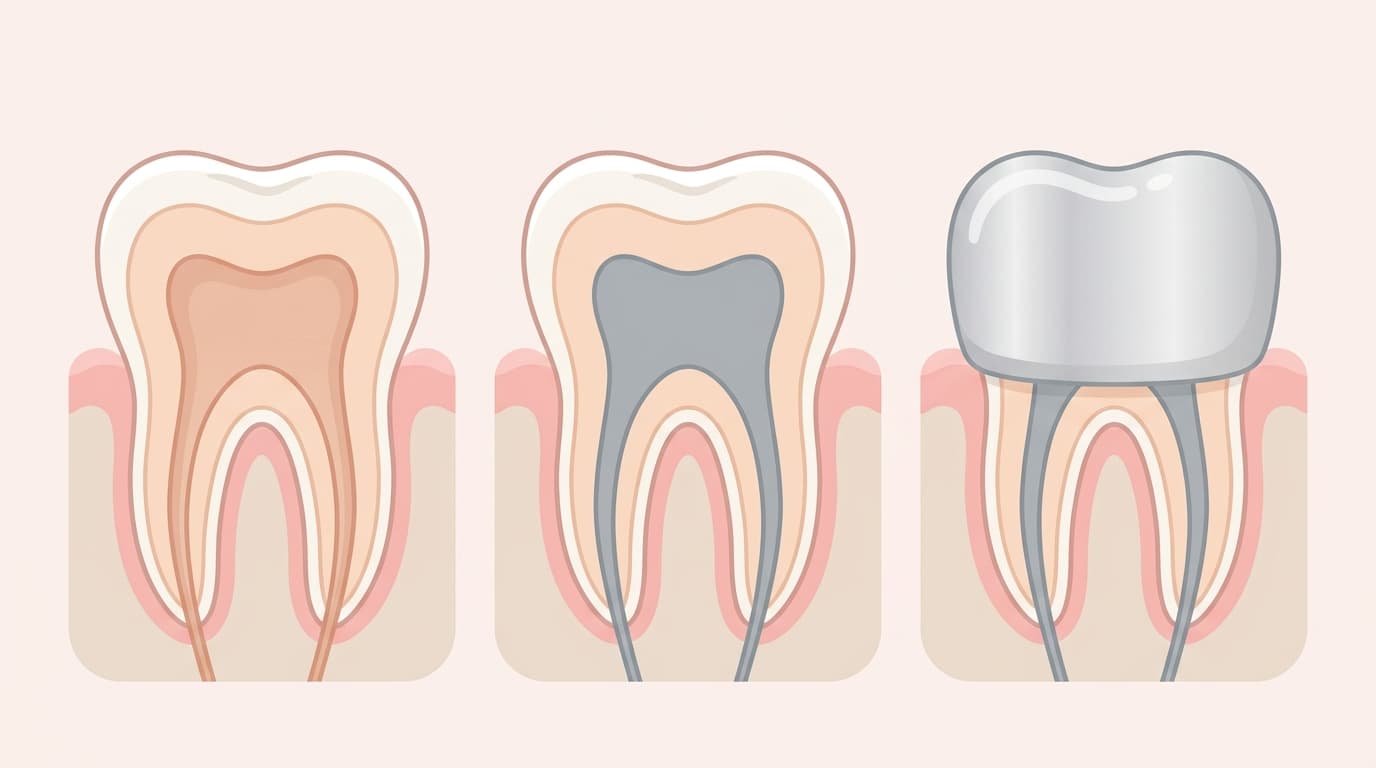
A baby tooth that has had root canal treatment (pulp therapy) loses a large amount of internal tissue during the procedure, which weakens the remaining tooth structure. For this reason, textbooks describe covering such a tooth entirely with a stainless steel crown (a prefabricated crown made of stainless steel) as the standard restoration method. That said, a crown is not applied uniformly to every baby tooth that needs cavity treatment. For small cavities with minor tooth structure loss, materials such as composite resin or glass ionomer can sometimes be sufficient, and even when a crown is needed, a tooth-colored zirconia crown can be chosen instead of a stainless steel crown for esthetic reasons.
Why Is That?
Why Does Root Canal Treatment Weaken a Baby Tooth
There are two types of root canal treatment for baby teeth. Pulpotomy removes only the inflamed nerve tissue in the crown (the upper part of the tooth) while preserving the nerve in the root. Pulpectomy removes the nerve tissue in both the crown and the root when the infection has spread to the point that the entire nerve has lost vitality.
Both procedures involve using a dental rotary instrument to open the pulp chamber inside the tooth and remove the nerve tissue, but pulpectomy requires going further, into the root canals themselves. Because the root canals of baby teeth (the passages the nerve runs through) have thin, sharply curved roots with many small lateral branches, they are difficult to shape precisely with instruments, so pulpectomy relies heavily on chemical cleaning with irrigating solutions. On top of this, a cavity advanced enough to require root canal treatment has usually already caused significant tooth structure loss, so the remaining tooth walls alone may not be able to withstand chewing forces after treatment is complete.
Why the Stainless Steel Crown Is Considered the Standard Restoration
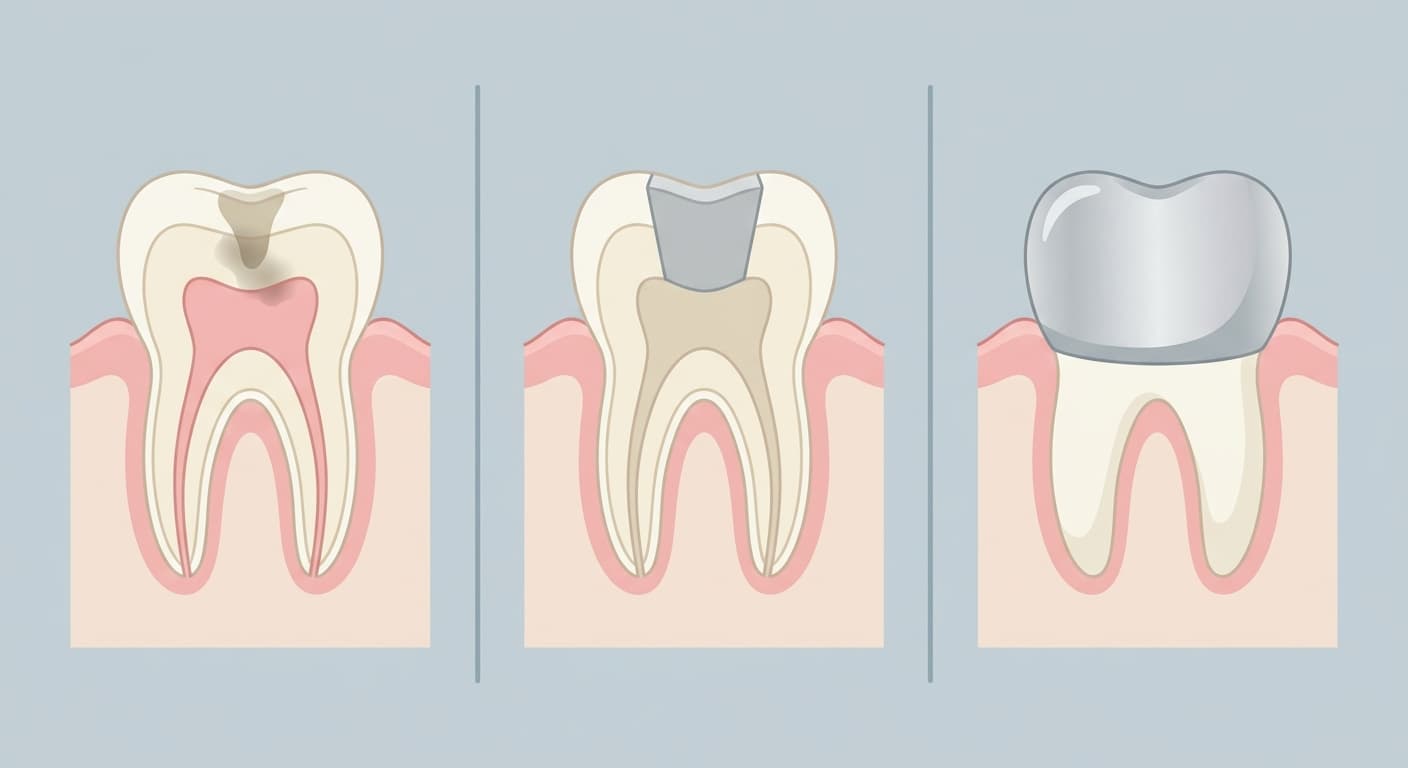
A diagram in the textbook summarizing the root canal treatment process for baby teeth shows that, after either pulpotomy or pulpectomy, the standard sequence is to fill the treated area with a core (material that fills the inside of the tooth) and then, as the final step, place a stainless steel crown. The stainless steel crown is made of thin, elastic metal about 0.15 to 0.2mm thick that fits onto the natural contours of the primary molar surface, gaining strong retention. Its margins are described as fitting very closely against the tooth, which is effective at preventing new decay. The textbook specifically identifies the stainless steel crown as the material for restoring the entire crown portion of a primary molar weakened by extensive decay, developmental defects, or pulp therapy, showing that a tooth that has had root canal treatment falls within this indication.
Not Every Baby Tooth Needs a Crown
Pediatric dentistry textbooks cover amalgam, composite resin, glass ionomer, stainless steel crowns, and zirconia crowns together as restoration materials for primary molars. The fact that the indication for a stainless steel crown is clearly defined as a tooth weakened by extensive decay or pulp therapy also means that, conversely, a small cavity with minor tooth structure loss leaves room to choose a different material. Just as permanent teeth have cavity treatment materials chosen by the extent of damage, dividing options into resin, inlay, or crown (How Are Resin, Inlay, and Crown Chosen for Cavity Treatment?), for baby teeth as well, whether root canal treatment was performed and how much tooth structure remains are the criteria that determine the restoration material. Permanent molars also have their need for a crown after root canal treatment judged based on the remaining tooth structure (Does a Molar Always Need to Be Covered with a Crown After Root Canal Treatment?), but because baby teeth differ from permanent teeth in both tooth structure and the root canal treatment approach itself, the specific criteria for applying this also need to be considered differently.
If Esthetics Are a Concern
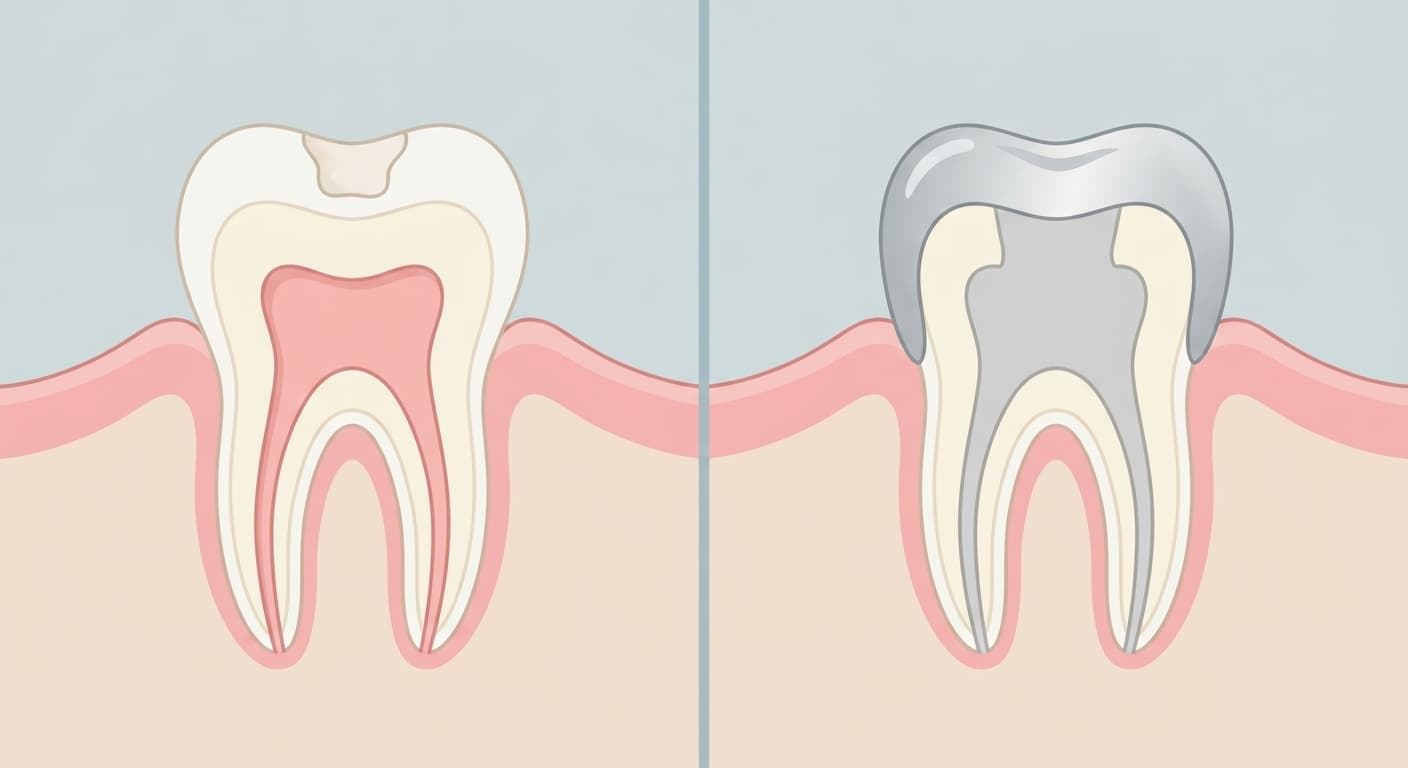
A drawback of the stainless steel crown is that its metallic color is visible and stands out. The textbook includes a case of esthetic restoration with a zirconia crown after pulp therapy on a primary molar, showing that even when a crown is needed, a tooth-colored material can be chosen instead of metal. That said, the zirconia crown is described as having greater strength and esthetics than the stainless steel crown, but its thicker crown wall requires removing more tooth structure, and adjusting the margins to fit the tooth is also described as more demanding. Which material to choose is decided by weighing the remaining tooth structure together with esthetic requirements.