Question
I had root canal treatment on a molar, and my dentist told me to get a crown. Given the cost and the fact that I'm not having any trouble chewing right now, I'm wondering whether I can leave just the filling material in place and put off the crown, or even skip it altogether.
Short Answer
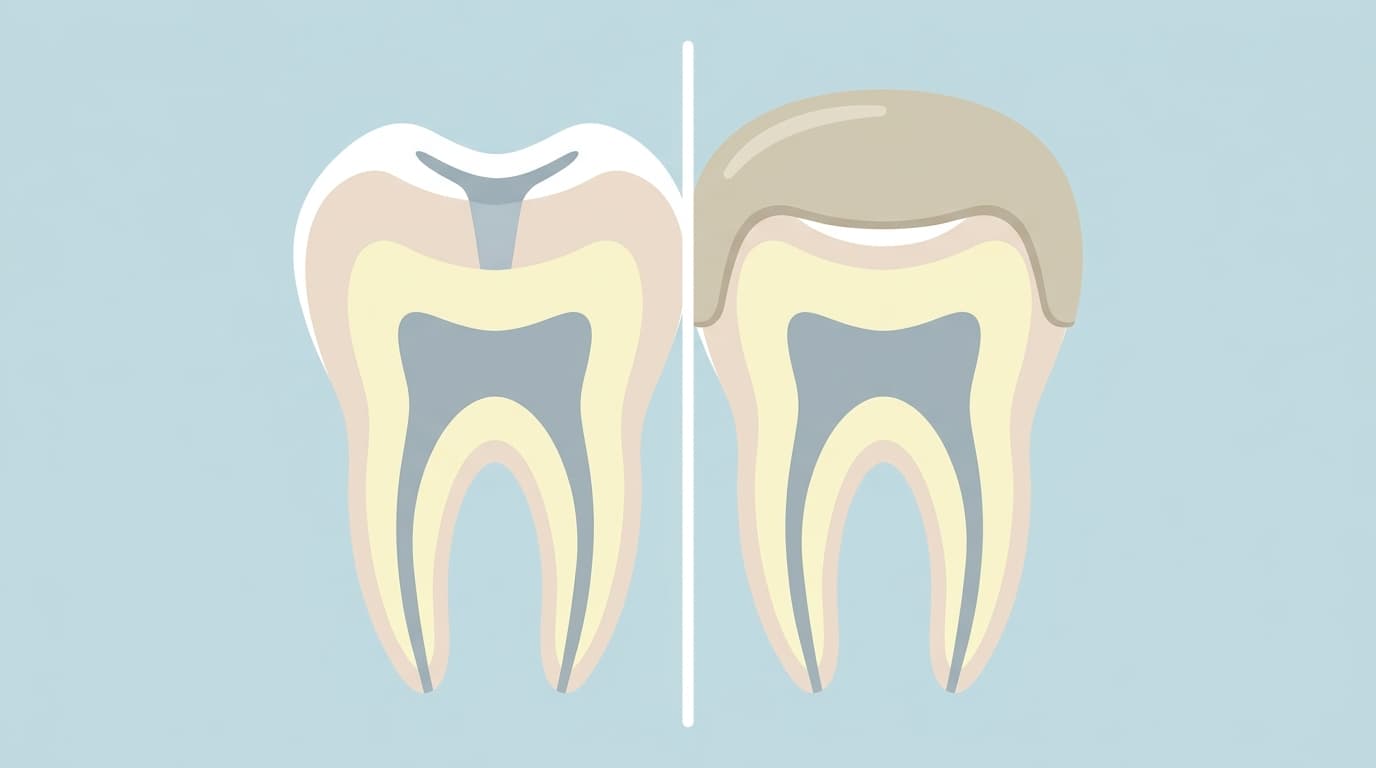
A crown isn't always mandatory for a molar after root canal treatment. The answer depends on the size of the opening made in the chewing surface during treatment and how much tooth structure remains to support the cusps (the pointed projections on the chewing surface).
If the width of the chewing-surface opening exceeds two-thirds of the distance between cusps, the walls supporting the cusps are considered weakened, and using a restoration that covers and protects the cusps greatly lowers the risk of the tooth fracturing. On the other hand, if the opening is small and the cusp walls remain intact, a resin filling or inlay can be enough to finish the job. Within cusp-covering restorations there are also different options that vary in extent and method, such as onlays, crowns, and endocrowns, so which one is right can only be determined by looking directly at the remaining tooth structure.
Why Is That?
Why Root Canal Treatment Weakens a Molar
Root canal treatment requires cutting an opening in the center of the chewing surface to reach the canals, and once decay or fractured portions are also trimmed away, a substantial amount of the tooth's interior ends up hollowed out. When the dentin that once connected the tooth horizontally is severed, each cusp is left standing like a separate, isolated pillar that has to withstand the opposing forces of chewing on its own. A large cavity that crosses all three of the tooth's central surfaces is reported to lower the tooth's fracture resistance by roughly 60%. The weaker the cusps' ability to withstand force, the greater the chance that even a small impact will crack or break the tooth.
The Criteria for When Cusps Need Protection
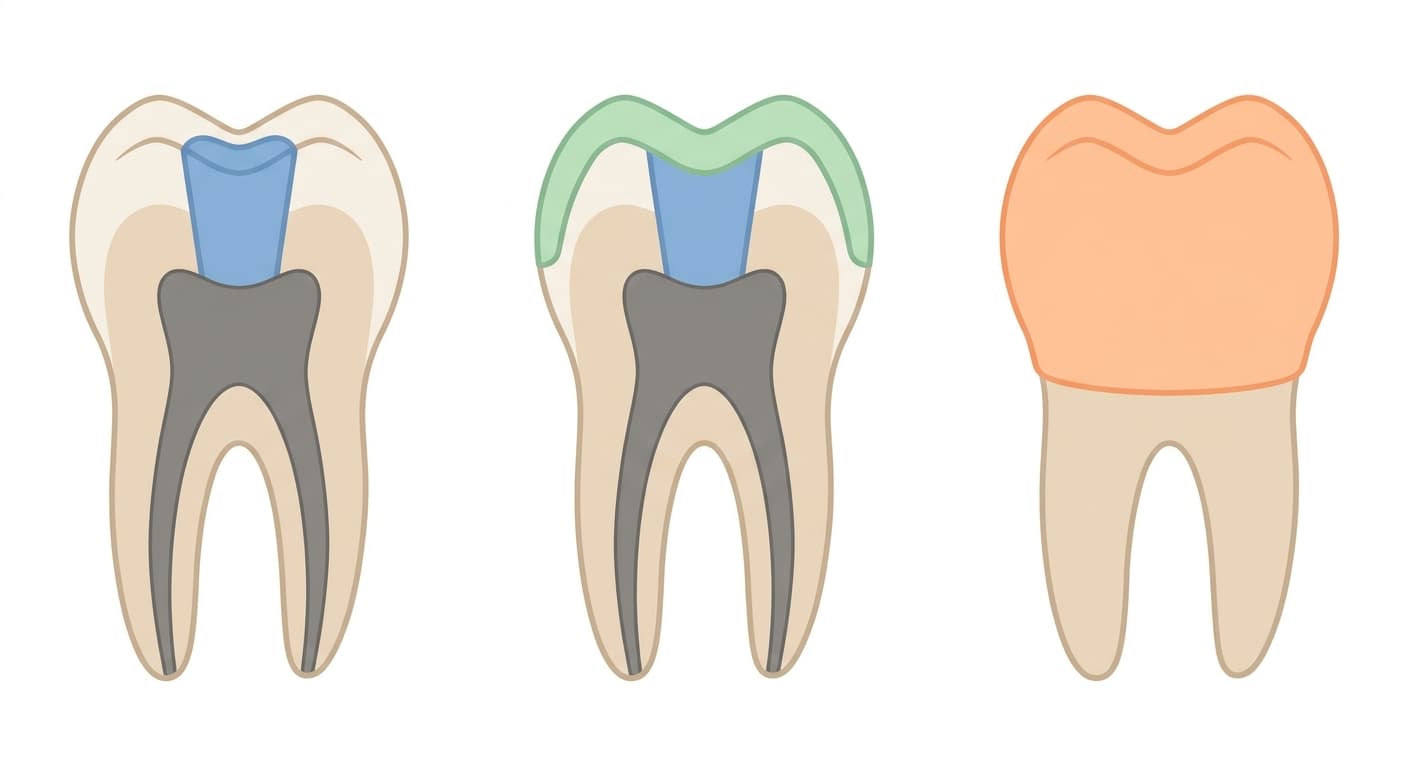
If the width of the chewing-surface cavity is less than half the distance between cusps, a stable restoration is possible without trimming the cusps at all. Between half and two-thirds, it's a borderline range where cusp protection may be worth considering, and beyond two-thirds, the remaining cusps need to be trimmed down and covered with a restoration, known as cusp coverage. In a study that followed 400 teeth for nine years, root-canal-treated teeth that received cusp-protecting coverage had a sixfold higher survival rate than teeth that were simply filled. This finding is the basis for recommending cusp-covering restorations, such as onlays or crowns, for root-canal-treated molars.
What's the Difference Between an Onlay and a Full Crown?
An onlay is a restoration that covers one or more weakened cusps. Because it's bonded in place without cutting down the entire crown (the visible portion of the tooth above the gumline), it preserves more tooth structure and allows the margin to be placed above the gumline, which also makes it easier to maintain. That said, it's only an option when there's enough bonding surface, such as at least 1.5mm of enamel remaining to bond to.
A full crown covers the entire remaining crown circumferentially. When the damage is extensive enough that there isn't enough wall left for an onlay to engage, or when multiple cusps are weakened together, a crown that wraps around the whole tooth is more stable in terms of resistance and retention. Whichever option is used, a core (the material that rebuilds the shape of the crown that was cut down after root canal treatment) is built up first as a foundation, and the restoration is placed on top of it.
When 1.5 to 2mm or more of healthy tooth structure remains circumferentially above the crown margin, this is called the ferrule effect, and it makes the restoration last longer. One report found that when this circumferential wall was secured at 2mm or more, the restoration failure rate was only 7%, but when it fell short of 2mm, the failure rate rose to as high as 26%. If the damage extends deep below the gumline and makes it difficult to secure this circumferential wall, a crown-lengthening procedure to expose the tooth may be needed first.
A Post Isn't Always Required
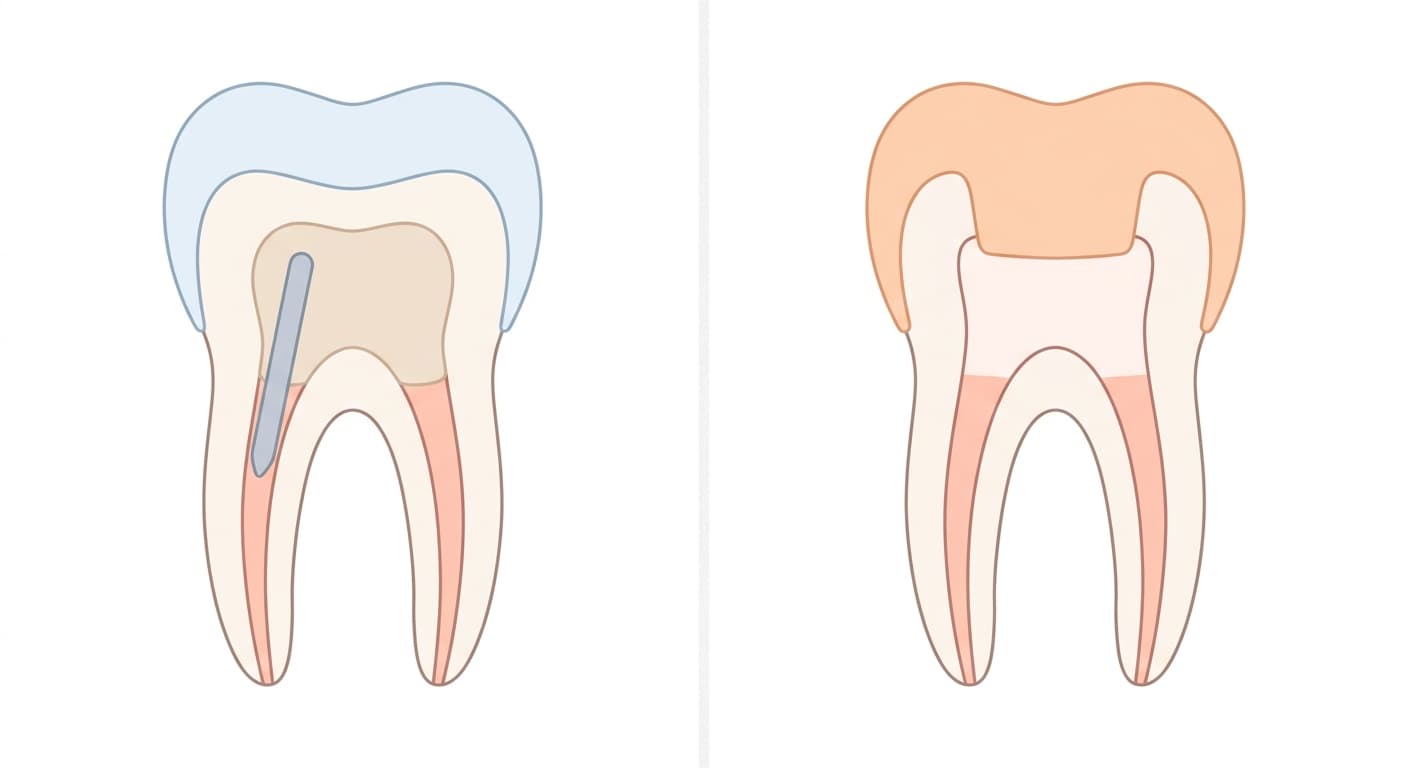
A post (a post-shaped structure placed inside the canal) doesn't reinforce the tooth itself; its only role is to hold the core in place so it doesn't come loose from the canal. This principle is explained in more detail in Does Placing a Post After a Root Canal Make a Tooth Stronger?. Because the pulp chamber (the space that once held the nerve) opened up for root canal treatment in a molar is wide and deep to begin with, if enough crown wall remains, the core alone can provide sufficient retention without a post. A post is added only when the damage is extensive enough that the core can't stand on its own, and even then, at least 3 to 5mm of canal-filling material needs to remain at the root tip.
When Occlusal Space Is Limited, an Endocrown Can Be an Alternative
When the chewing space is too tight to stack a post, core, and crown, an endocrown is an available alternative. An endocrown is a restoration that bonds directly to the inner walls and floor of the pulp chamber without a post, combining the core and crown into a single unit. It can only be done when the depth of the pulp chamber created by root canal treatment is about 4 to 6mm, and it's mainly used on molars with extensive crown damage. Because the most commonly reported cause of endocrown failure is debonding rather than the tooth fracturing, it's especially important to watch for whether the restoration has come loose.
Whichever Option You Choose, Don't Delay the Final Restoration
Whether you choose a direct filling, an onlay, a crown, or an endocrown, it's important not to leave a root-canal-treated tooth's crown portion open for long. While the final restoration is delayed, bacteria can re-enter through gaps in the temporary filling material, and there are reports of bacteria and their byproducts being found at the root tip of teeth that went three months without a coronal restoration. How to manage a temporary crown until the final restoration is decided is covered in What Chewing Precautions Should I Take With a Temporary Crown After a Root Canal?.
Front teeth are governed by different conditions that matter more than cusp support, so the criteria differ. Front teeth are covered separately in Do Front Teeth Also Need a Crown After a Root Canal?.