
Question
I finished root canal treatment but haven't received the final crown yet, so I'm wearing a temporary crown. Every time I chew with that tooth it hurts, and I'm worried about whether it's okay to keep chewing like this, what else I should be careful about, or whether I need to go back to the dental clinic to have it checked.
Short Answer
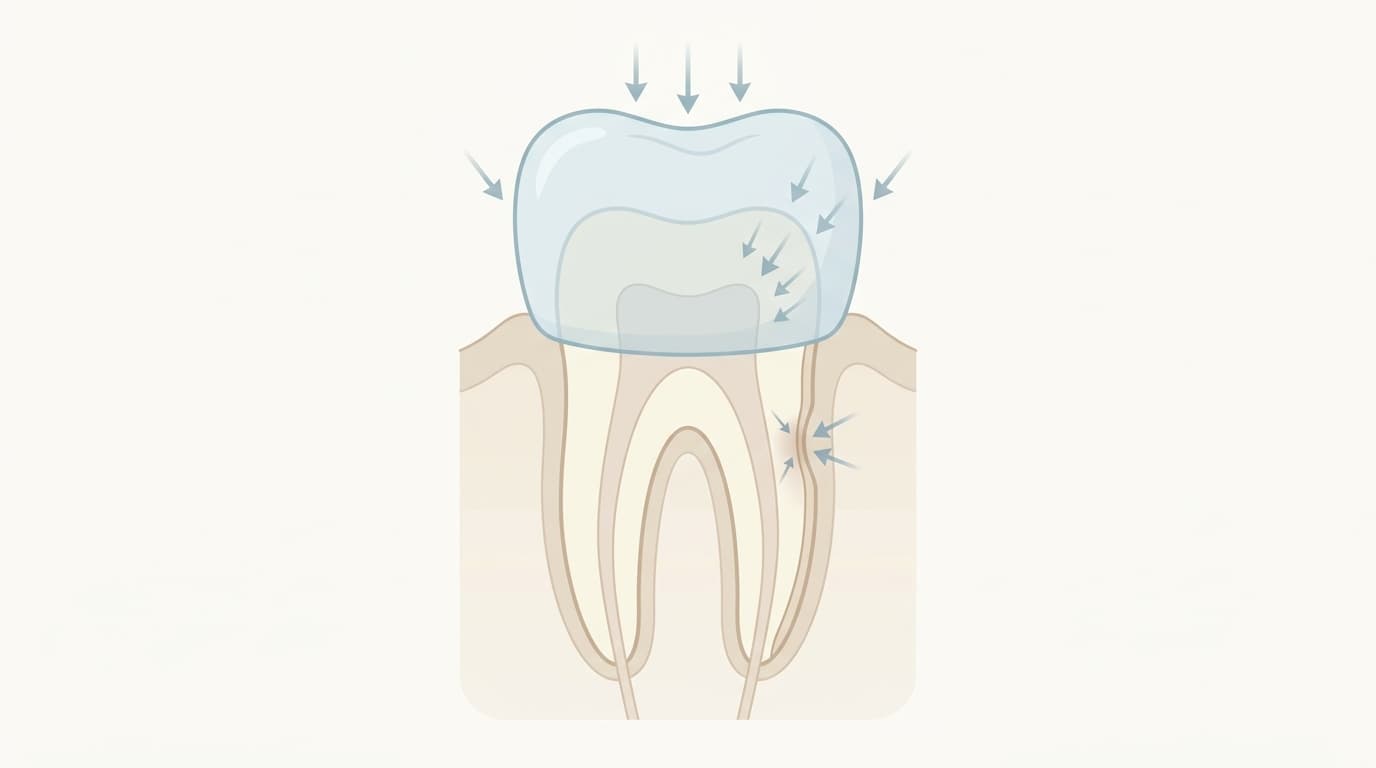
A tooth that has finished root canal treatment has thin, weakened remaining walls because a large amount of the tooth's interior was removed during treatment, and until the final crown is placed, the temporary crown is standing in to protect that weakened part. The temporary crown blocks irritation and bacteria from the inside of the tooth and holds the tooth's position, but it does not seal as tightly or distribute chewing force as evenly as the final crown. So it's best to reduce chewing hard or biting down on hard things with that tooth, and if the pain while chewing continues or the temporary crown starts to feel loose, it's safer not to put it off and have it checked again at the dental clinic.
Why Is That?
Why a Tooth That Has Finished Root Canal Treatment Is Weak Against Chewing Force
Looking at root canal treatment itself, meaning just the process of shaping and filling the canals inside the tooth, tooth strength drops by only about 5%. What actually weakens the tooth isn't the root canal process itself, but the opening made in the top of the tooth to perform it (access cavity preparation) and the tooth walls that were already lost to decay or an old filling beforehand. When walls on multiple surfaces are lost together, tooth strength can drop by as much as 60%.
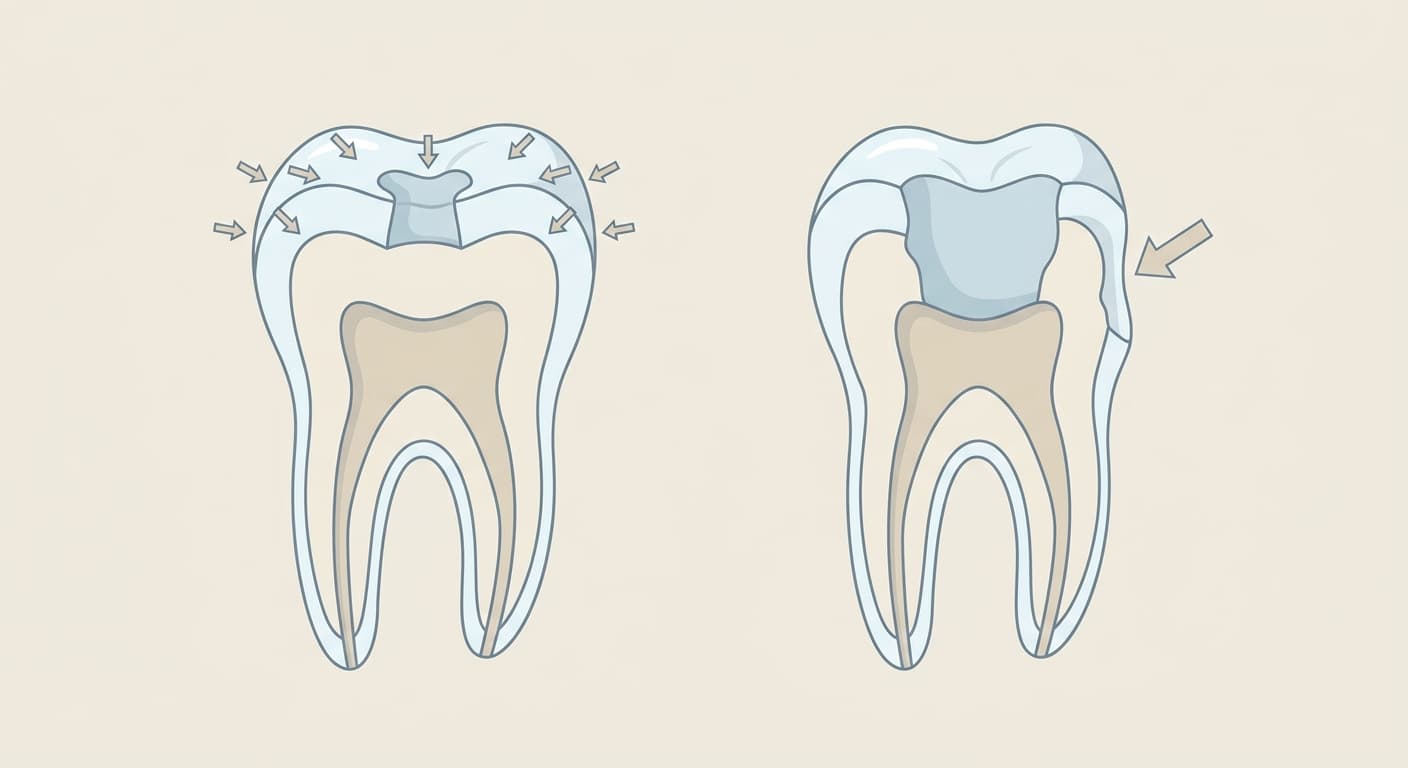
When a tooth's remaining walls have thinned like this, if chewing force concentrates at one spot, the risk of a crack or fracture at that point increases. That's why a tooth that has lost walls on multiple surfaces together, or whose cusps (the pointed parts of the chewing surface) have weakened, needs a restoration that covers the entire cusp and distributes chewing force evenly. The temporary crown you have now is made to hold the space while the final restoration is being made, so it doesn't fully perform this role of covering the whole cusp and distributing force the way the final restoration does. So at this stage, it helps to reduce biting down hard on things with that tooth, to avoid concentrating force on the one remaining tooth wall.
What the Temporary Crown Protects Right Now, and What It Doesn't
A temporary crown (temporary restoration) is a provisional restoration made to protect the prepared tooth surface from irritation and bacterial invasion while the final restoration is being made, and to maintain the tooth's position and the state of the gums. It's made directly in the mouth from a resin that sets at room temperature, or made on a model taken from an impression and then attached with temporary cement. It isn't designed to last a long time from the start; it's made only to hold the space during the fabrication period. So, as explained in Why Is a Temporary Filling Placed While Waiting for an Inlay or Crown?, the bonding method itself is different from that of the final restoration.
For a tooth that has finished root canal treatment, there's one more thing at stake here: preventing coronal leakage, the phenomenon where the material filling the canal is re-exposed to saliva and bacteria. After the canal filling is completed, the coronal area needs to be sealed right away; if it's left incompletely sealed for a long time, bacteria can re-enter the canal and cause reinfection.
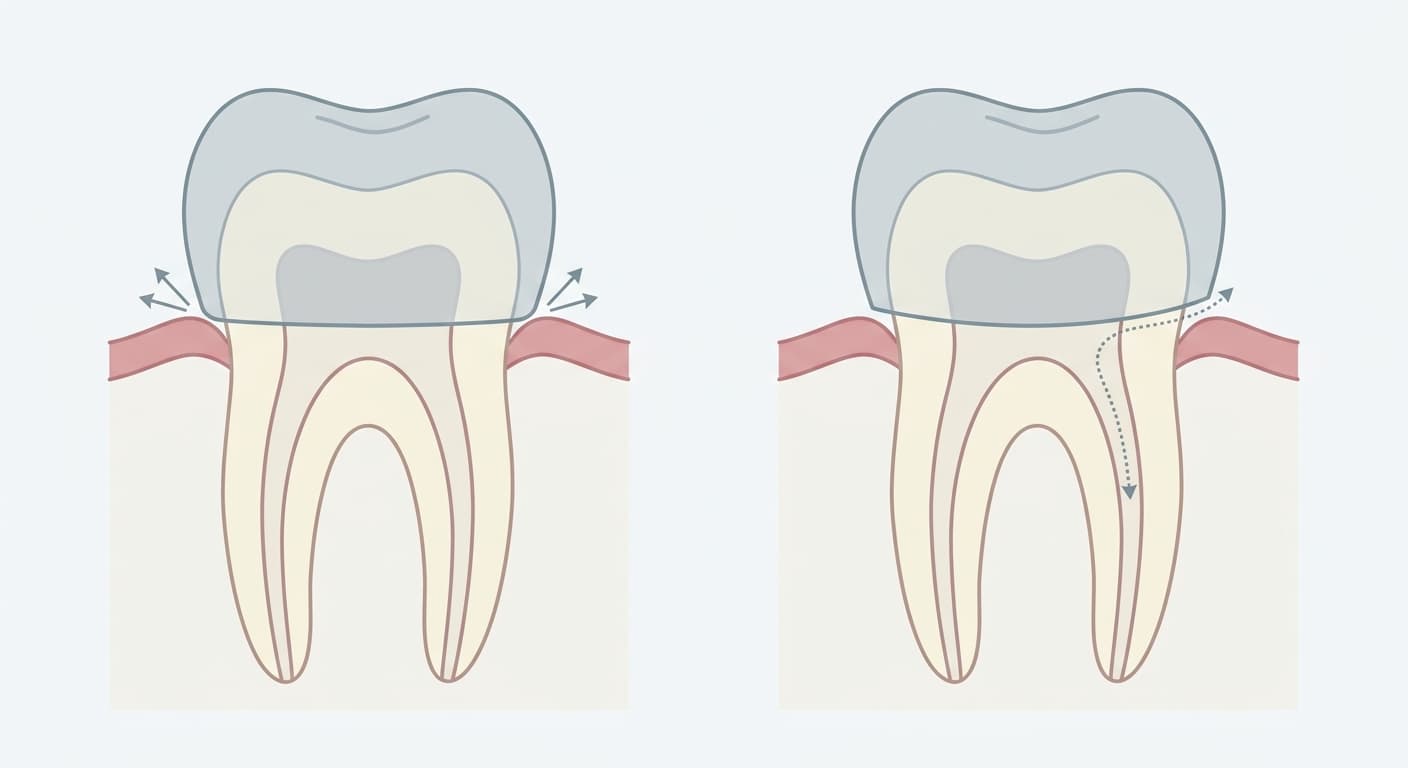
If the temporary crown is repeatedly pressed under chewing force and its margin lifts or loosens, this seal can break, so if you feel the temporary crown move while chewing or notice new sensitivity, that can be a sign the seal has weakened. If the temporary crown comes off entirely, as explained in Is It Okay to Wait If the Temporary Filling or Crown Placed During Root Canal Treatment Falls Out?, it's best not to wait until the next appointment and to notify the dental clinic right away.
If the coronal damage is extensive, as with a front tooth, and a temporary full crown that includes a post (a pillar structure built up inside the canal) has been placed, there's one more thing to watch for. Making and using the space for the post ahead of time reduces the space left in the canal for medication, and because this kind of temporary post-and-crown relies on cement alone to seal the margin, the risk of bacterial leakage is greater than with other temporary crowns. So in this case, bonding the final post and crown as soon as possible is recommended. As explained in Does Placing a Post After Root Canal Treatment Make the Tooth Stronger?, the post itself isn't so much a device for reinforcing the tooth as a device that holds the core in place when the remaining tooth structure makes it hard to secure a restoration.
What to Check If Pain Continues While Chewing
If pain while chewing like this doesn't settle within a few days, or if you feel a sharp, momentary jolt only when chewing in a particular direction, then besides a problem with the temporary crown itself, the possibility of an actual fine crack in the tooth should also be looked into. Even a tooth that has finished root canal treatment can develop this kind of crack if the remaining walls are thin, and in that case checking with a method such as a bite test is needed. This kind of momentary, sharp pain in only one direction is a pattern commonly seen in cracked teeth, so if that's the case, it can be checked in more detail.
Whatever the cause of the pain, it's also important not to extend the period of wearing the temporary crown any longer than necessary. Chewing force spreads evenly across the whole tooth and the coronal seal stabilizes only once you move to the final crown, so if pain while chewing continues or the temporary crown keeps becoming loose, it's better to notify the dental clinic and have the condition checked first rather than waiting for the next scheduled visit.